All species › Nightjars › Nightjars and nighthawks › Pauraque
Position in the tree Birds Aves › Birds with a flexible palate Neognathae › All other modern birds Neoaves › Birds of the elements Elementaves › Nightjars and swifts Strisores
Pauraque | Nyctidromus albicollis
Pauraque | Chotacabras pauraque
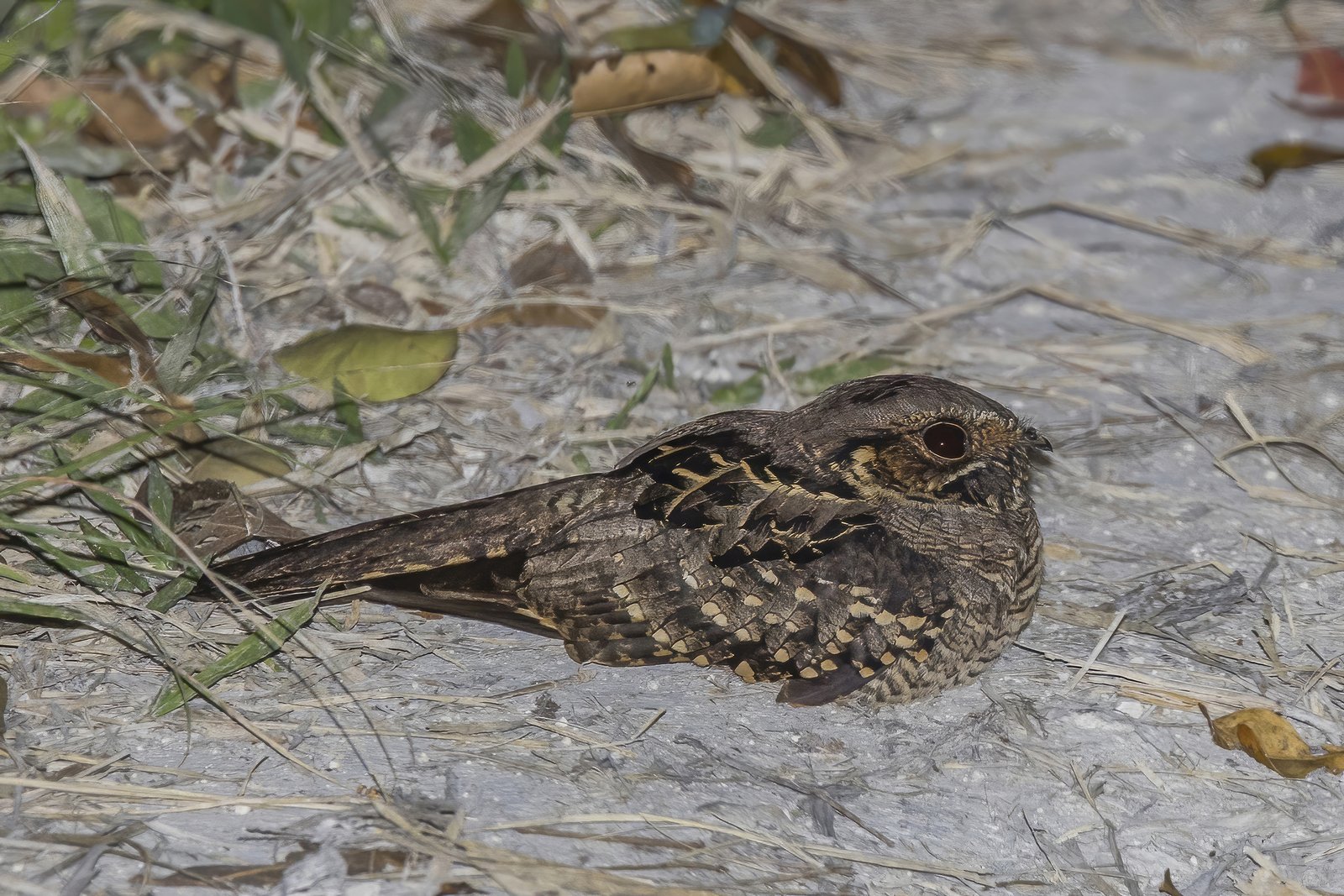
The Pauraque is the most frequently seen and heard nightjar in the guide area. In the evening it sits on dirt roads and tracks, where its eyes glow orange-red in headlights, and its whistled call is part of almost every tropical lowland night. For a nightjar it is strikingly ground-bound; it sometimes walks and runs rather than taking off. The name derives from the call.
Voice
The song is a whistled pur-wheeeer, often preceded by a few short puk notes; it is repeated endlessly at dusk and at night, especially in the dry season and the early breeding season. Also soft week calls in flight.
Recording: Jonas Nilsson — CC BY-NC-SA 4.0 · converted to mono · xeno-canto
Identification
22–28 cm, with a long, rounded tail and fairly short, round wings. The plumage is mottled grey-brown or rufous-brown, with a row of black, buff-edged spots on the scapulars and a rufous ear patch. The throat has a white band. The male has a broad white band across the primaries and largely white outer tail feathers. In the female the wing band is narrower and buffier and there is much less white in the tail. There are grey and rufous birds. In flight the white band near the wing tip is conspicuous.
Confusion species
Rufous Nightjar Antrostomus rufus and Chuck-will's-widow Antrostomus carolinensis are more uniformly rufous-brown, lack a white wing band and have a shorter tail. White-tailed Nightjar Hydropsalis cayennensis in Costa Rica and Panama is smaller, with a shorter body. Common Nighthawk Chordeiles minor and Lesser Nighthawk Chordeiles acutipennis have pointed wings with a white band midway along the wing and hunt in the air. Poorwills are smaller, with a shorter tail and no white wing band.
Habitat
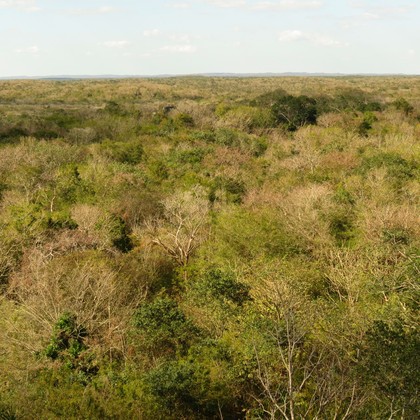
Semi-open country in the lowlands and lower hills: forest edges, open dry forest, scrub, gallery forest, savanna with groves, pastures with bushes and the edges of fields and plantations, where dense vegetation gives cover by day and open ground serves as hunting ground at night. It hunts with short jumps or sallies from the ground for moths, beetles and other insects. The eggs are laid without a nest on bare soil or in leaf litter.
Where the bird is most at home, classified by the vegetation units of Mexico and Central America.






Range and movements
Throughout the guide area in the lowlands and lower hills. In Mexico on the Pacific side from southern Sonora and Sinaloa south to Chiapas, and on the Gulf side from Nuevo León and Tamaulipas through Veracruz and Tabasco to the Yucatán Peninsula; further in all countries from Guatemala and Belize to Panama. Outside the guide area from southern Texas to northern Argentina.
- Resident
- dark = core range, pale = thinly spread
How and when to look
Driving slowly along country lanes and forest tracks after dark often produces birds sitting on the road, for example around the lodges at Tikal, on the roads of Guanacaste or in the lowlands of Belize. The eyeshine in a torch beam gives them away; by day they are rarely found.
Conservation status
Not threatened. Common in the guide area. The species adapts to farmland and secondary growth. Birds on roads are regularly killed by traffic.
Scientific name
Nyctidromus albicollis | (Gmelin, 1789)
Gmelin described the species in 1789 as Caprimulgus albicollis; because it was later moved to another genus, the author and year stand in brackets. The genus Nyctidromus was introduced in 1838 by Gould. Nyctidromus is Greek, from nux, nuktos 'night' and dromos 'runner': 'night-runner', after its habit of running about on tracks and open ground at night. albicollis is Latin, from albus 'white' and collum 'neck', after the white throat band. The specimen the first description was based on came from Cayenne, French Guiana.