All species › Nightjars › Nightjars and nighthawks › Short-tailed Nighthawk
Position in the tree Birds Aves › Birds with a flexible palate Neognathae › All other modern birds Neoaves › Birds of the elements Elementaves › Nightjars and swifts Strisores
Short-tailed Nighthawk | Lurocalis semitorquatus
Kortstaartnachtzwaluw | Chotacabras cola corta
The Short-tailed Nighthawk is a dark, forest-dwelling nightjar with long, broad wings and a strikingly short tail. At dusk it flies low over the canopy, along forest edges and above rivers, with fast, erratic turns more reminiscent of a bat than a bird. In the guide area it is resident in humid forest, from southern Mexico to Panama. Unlike other nightjars, it lays its egg not on the ground but on a thick horizontal branch.
Voice
Heard mainly in flight: a sharp, somewhat liquid g'week or gweek, often repeated, and a series of regularly repeated calls. The vocalizations differ between subspecies and are still incompletely described from the guide area.
Recording: JAYRSON ARAUJO DE OLIVEIRA — CC BY-NC-SA 4.0 · converted to mono · xeno-canto
Identification
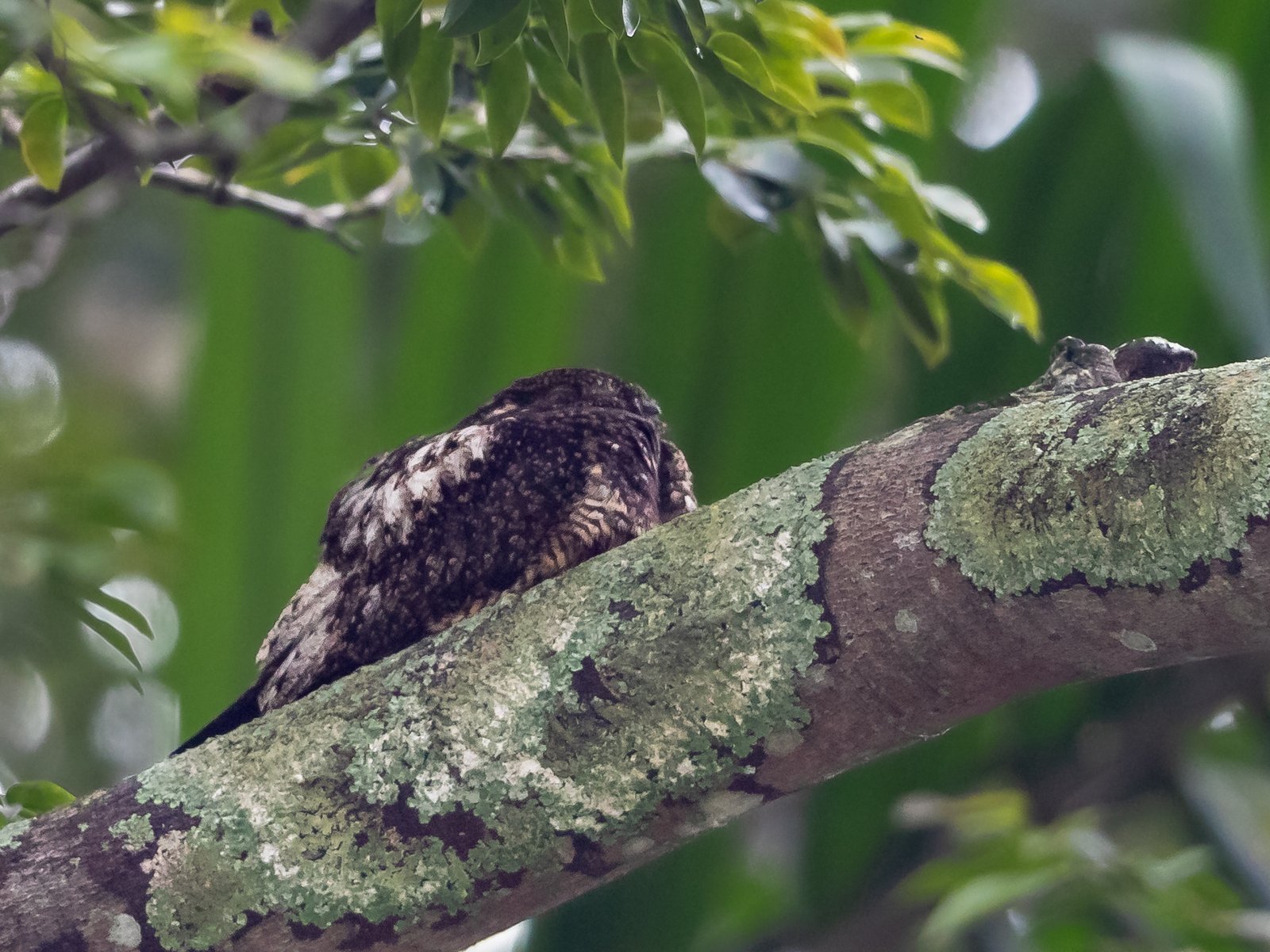
19–21 cm. The upperparts are dark brown to blackish, finely spotted with rufous and buff; the wings are long and broad and at rest extend beyond the tail tip. There is no white in wing or tail. The throat is white, the breast dark, and the belly and undertail coverts are brown and buff with dark barring. The tail is short and square-ended. The sexes are almost alike. In flight the silhouette stands out: broad wings, a short tail and a stocky body.
Confusion species
Common Nighthawk Chordeiles minor and Lesser Nighthawk Chordeiles acutipennis have narrower, pointed wings with a white wing bar and a longer, slightly forked tail, and more often hunt over open ground. Pauraque Nyctidromus albicollis has a long tail and a white band across the primaries and hunts mainly from the ground. Swifts and bats over the forest are smaller or fly differently, but in the last light confusion is possible.
Habitat
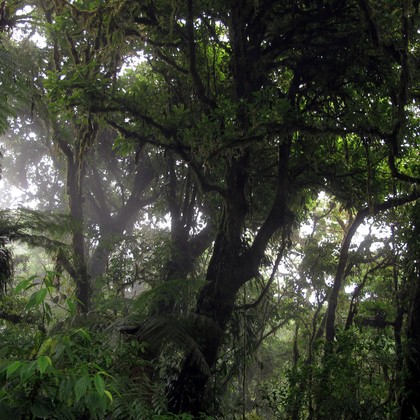
Evergreen lowland forest and forest on the lower mountain slopes, with clearings, forest edges, river valleys and gaps in the canopy; also older secondary forest. At dusk it hunts above and just below the canopy for beetles, bugs and other flying insects. By day the bird rests lengthwise on a thick branch, where its colouring makes it almost invisible.
Where the bird is most at home, classified by the vegetation units of Mexico and Central America.




Range and movements
In Mexico only in the south, mainly in Chiapas. Further in Guatemala, Belize, Honduras and Nicaragua, with most records on the Caribbean side, and in Costa Rica and Panama, where it occurs on both sides of the mountains. Records are scattered and the species is probably often overlooked. Outside the guide area through much of tropical South America, to northern Argentina.
- Resident
- Summer visitor (c. Apr–Sep)
- Winter visitor (c. Oct–Mar)
- Passage (Mar–Apr, Oct–Nov)
- dark = core range, pale = thinly spread
How and when to look
Best at nightfall from a clearing or viewpoint above forest, such as around La Selva and in the foothills of the Caribbean slope in Costa Rica or along the Pipeline Road in Panama, where the birds regularly hunt low over the treetops. Watch for the short silhouette and listen for the call; after dark the species is hard to find.
Conservation status
Not threatened. The species has a large range but depends on forest, and loss of lowland forest reduces its habitat.
Scientific name
Lurocalis semitorquatus | (Gmelin, 1789)
Gmelin described the species in 1789 as Caprimulgus semitorquatus; because it was later moved to another genus, the author and year stand in brackets. The genus Lurocalis was introduced in 1851 by Cassin. Lurocalis is Greek, from oura 'tail' and kolos 'docked, stunted', after the strikingly short tail. semitorquatus is Latin for 'half-collared', from semi- 'half' and torquatus 'collared', after the white throat patch. The specimen the first description was based on came from Cayenne, French Guiana.