All species › Passerines › Tits › African Blue Tit
African Blue Tit | Cyanistes teneriffae
Afrikaanse pimpelmees | Herrerillo africano
The blue tit of North Africa: darker and more boldly marked than Eurasian Blue Tit, from which it is now split as a separate species. In the region it is a common resident of the woods, orchards and gardens of the Maghreb, with an isolated form in the mountain forests of Cyrenaica in Libya.

Voice
The song is a clear tsee-tsee-tsurrr with a dry, rattling ending, faster and harder than that of Eurasian Blue Tit. Calls include a sharp, scolding chair-r-r-r and thin tsi-tsi contact notes; in woodland it is usually heard first.
Recording: João Ferreira Tomás — CC BY-NC-SA 4.0 · converted to mono · xeno-canto
Identification
11–12 cm. A small, compact tit with a short, pointed bill. The crown is dark blue-black, not pale blue; a black eye-stripe runs back to a black collar, so the white cheek is sharply framed. A narrow black bib continues as a dark stripe down the bright yellow belly. Mantle blue-grey without a green tinge; wings and tail cobalt blue with a clear white wing-bar. Sexes alike; juveniles are duller, with yellowish cheeks and a greyish-brown crown. The Libyan form cyrenaicae almost lacks the white wing-bar and has an even darker head.
Confusion species
Eurasian Blue Tit (Cyanistes caeruleus) does not occur in North Africa; it has a pale blue crown, a greenish mantle and no dark belly stripe. Great Tit (Parus major) is larger, with a glossy black head lacking blue and a broad black belly stripe on a greenish-yellow body. Coal Tit (Periparus ater) is grey and pale buff, with no blue or yellow, and has a white nape patch.
Habitat
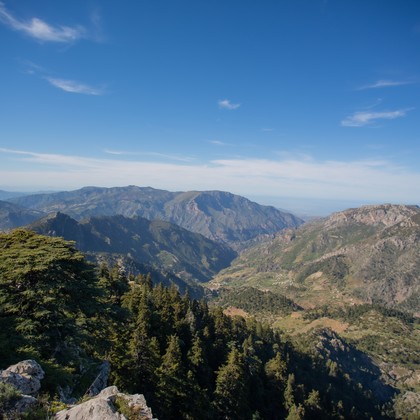
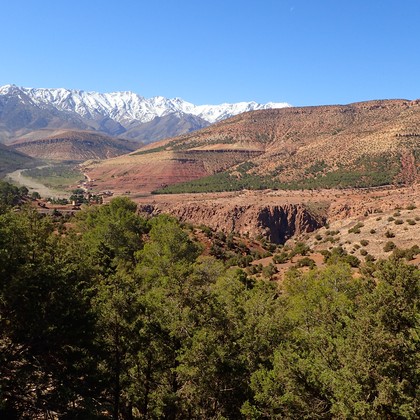
Almost anywhere with trees: cedar, cork oak and holm oak forest in the Rif, the Atlas and Kabylia, mixed conifer forest, riverine woodland, olive groves, orchards, parks and gardens right into towns. On the desert edge also in oases with date palms and tamarisks. Nests in tree holes, wall cavities and nest boxes.
Where the bird is most at home, classified by the habitats of North Africa and the Middle East.

Range and movements
In Morocco common in the north and the Atlas, from the Atlantic plain and the Rif to the High Atlas and Anti-Atlas, locally into the oases of the desert edge. In northern Algeria and Tunisia widespread in the Tell, Kabylia, the Aurès and Kroumirie, south to the first oases. In Libya only the distinct form cyrenaicae in the Jebel Akhdar of Cyrenaica. Beyond the region on the Canary Islands, where almost every island has its own subspecies, and on Pantelleria.
- Resident
- Winter visitor (c. Oct–Mar)
- Passage (Mar–Apr, Oct–Nov)
- dark = core range, pale = thinly spread
How and when to look
The cedar forest near Azrou and Ifrane in the Middle Atlas and the cork oak woods around Aïn Draham in Tunisia: in the early morning they sing everywhere, and at picnic sites they come close. Anyone after the Libyan form must visit the juniper and cypress woods of the Jebel Akhdar.
Conservation status
Not globally threatened and common in the Maghreb. Locally the loss of old woodland with cavities through logging, fire and overgrazing is a problem; the small, isolated population in Cyrenaica is more vulnerable to tree felling and deforestation in the Jebel Akhdar.
Scientific name
Cyanistes teneriffae | (Lesson, 1831)
Lesson described the species in 1831 as Parus Teneriffae; because it was later moved to another genus, the author and year stand in brackets. The genus Cyanistes was introduced in 1829 by Kaup. Cyanistes comes from Ancient Greek kuanos, 'dark blue'. teneriffae is Latin for 'of Tenerife', the Canary island the described specimen came from. The specimen the first description was based on came from Tenerife, Canary Islands.