All species › Passerines › Tits › Eurasian Blue Tit
Eurasian Blue Tit | Cyanistes caeruleus
Pimpelmees | Herrerillo común
The familiar blue-and-yellow garden tit of Europe is a bird of the margins in this region: it lives only in the oak and cedar forests of Lebanon, Syria, northern Jordan and Iraqi Kurdistan. In North Africa it is replaced by African Blue Tit, and in Israel it is virtually absent.
Voice
The song is a clear tsee-tsee-tsuhuhuhu, two or three high notes followed by a liquid trill. Calls include a sharp, scolding tserretetet and thin tsi-tsi-tsi contact notes.
Recording: Beatrix Saadi-Varchmin — CC BY-NC-SA 4.0 · converted to mono · xeno-canto
Identification
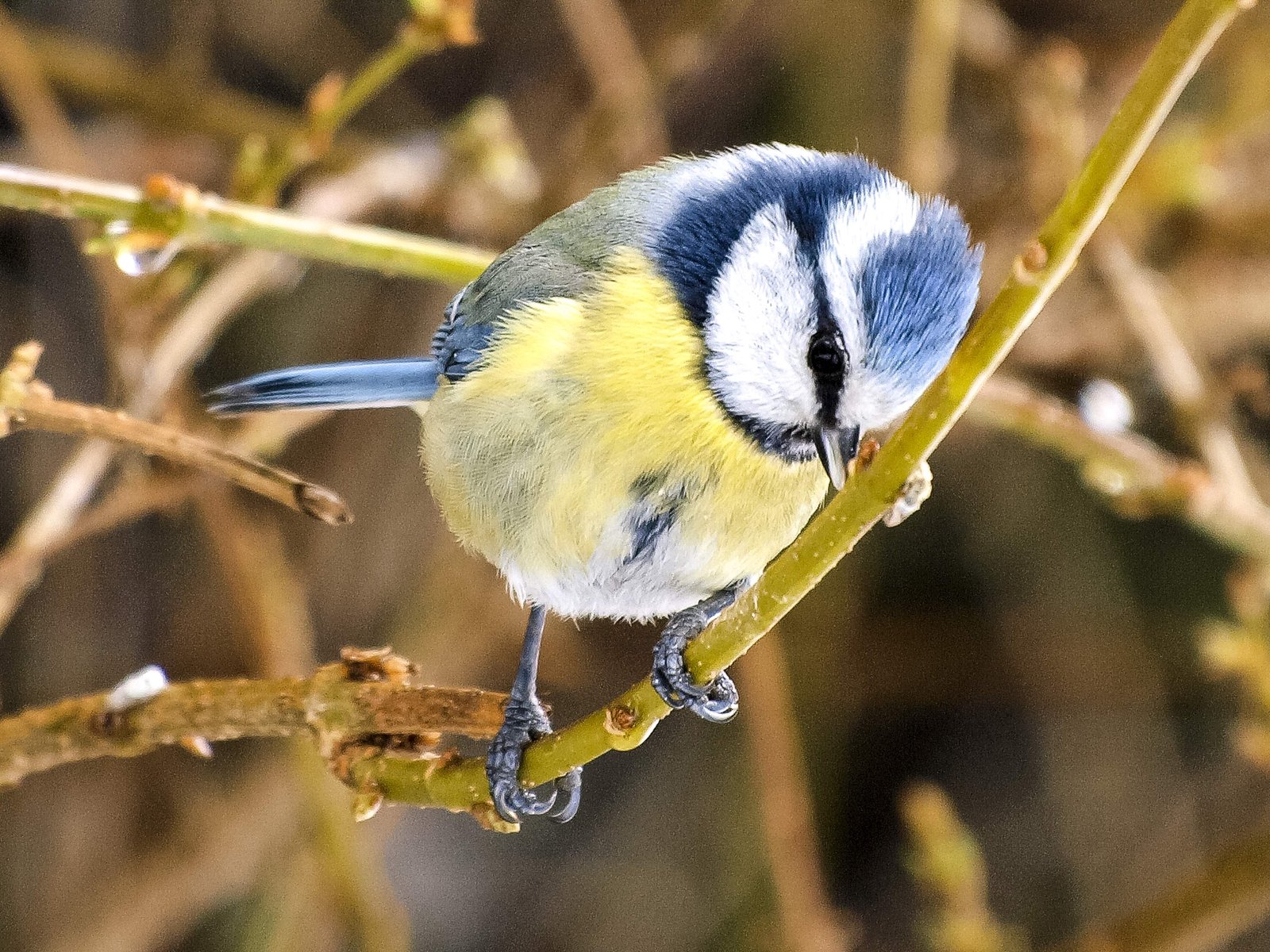
10.5–12 cm. Small and round, with a short, fine bill. Crown pale blue, edged by a white band; a dark blue eye-stripe and a dark collar frame the white cheek. Chin and a narrow throat stripe dark blue-black, underparts yellow with at most a faint dark central line. Mantle greenish, wings and tail blue with a narrow white wing-bar. Eastern birds in Iraq and the Levant are somewhat paler yellow and greyer on the back. Juveniles have yellow cheeks and a greenish-brown crown.
Confusion species
African Blue Tit (Cyanistes teneriffae) of the Maghreb has a dark blue-black crown, a blue-grey mantle and an obvious dark belly stripe; the ranges do not meet. Great Tit (Parus major) is larger, with a black head and a broad black belly stripe. Coal Tit (Periparus ater) has a black head with a white nape patch and no yellow or blue.
Habitat
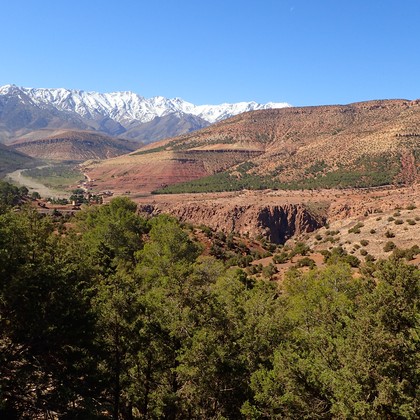
Oak forest and mixed broadleaf woodland in the mountains, cedar and pine forest with broadleaved trees, wooded valleys with plane trees and poplars; also orchards, parks and village gardens at the forest edge. In Jordan in the mixed pine and oak forests of the northern highlands. Nests in tree holes and nest boxes.
Where the bird is most at home, classified by the habitats of North Africa and the Middle East.


Range and movements
In Lebanon in the mountain forests of Mount Lebanon and the Anti-Lebanon, locally down to the coast, and in Syria in the coastal mountains and the north-west. In Jordan only in the northern highlands around Ajloun, Dibbin and Jerash. In Iraq in the oak forests of Kurdistan, from Mosul and Zakho to Sulaymaniyah. In Israel very rare; there are no certain records from the Maghreb or Libya, where the birds belong to African Blue Tit. Beyond the region from Europe and Turkey to the Caucasus, northern Iran and the Zagros.
- Resident
- Summer visitor (c. Oct–Mar)
- Winter visitor (c. Apr–Sep)
- Passage (Mar–Apr, Oct–Nov)
- dark = core range, pale = thinly spread
How and when to look
The Dibbin and Ajloun forest reserves in Jordan are the southernmost reliable sites; in Lebanon the Tannourine cedar reserve and the woods around Mar Chaaya. In Iraqi Kurdistan it sings in spring in the oak forests of Barzan and Peramagroon.
Conservation status
Not globally threatened and very common in Europe. In the region it is confined to a narrow belt of mountain forest under pressure from logging, fires, war and building; in Jordan the population is small and depends on a few protected forests.
Scientific name
Cyanistes caeruleus | (Linnaeus, 1758)
Linnaeus described the species in 1758 as Parus caeruleus; because it was later moved to another genus, the author and year stand in brackets. The genus Cyanistes was introduced in 1829 by Kaup. Cyanistes comes from Ancient Greek kuanos, 'dark blue'. caeruleus is Latin for 'dark blue, cerulean'. The specimen the first description was based on came from Sweden.