All species › Pigeons and doves › Pigeons and doves › African Collared Dove
African Collared Dove | Streptopelia roseogrisea
Izabeltortel | Tórtola rosigrís
The pale collared dove of the Sahel, which in the region occurs only on the southern fringe: in the Tihama and foothills of south-west Arabia and in the far south of Egypt. Its domesticated form is the Barbary Dove, widely kept as a cage bird and sometimes seen feral.
Voice
A rolling, purring coo, coo-krrrrrroo, the second note trilling and falling away; very different from the clear three notes of Eurasian Collared-Dove. When excited a short, hoarse krrr.
Recording: Zsombor Károlyi — CC BY-NC-SA 4.0 · converted to mono · xeno-canto
Identification
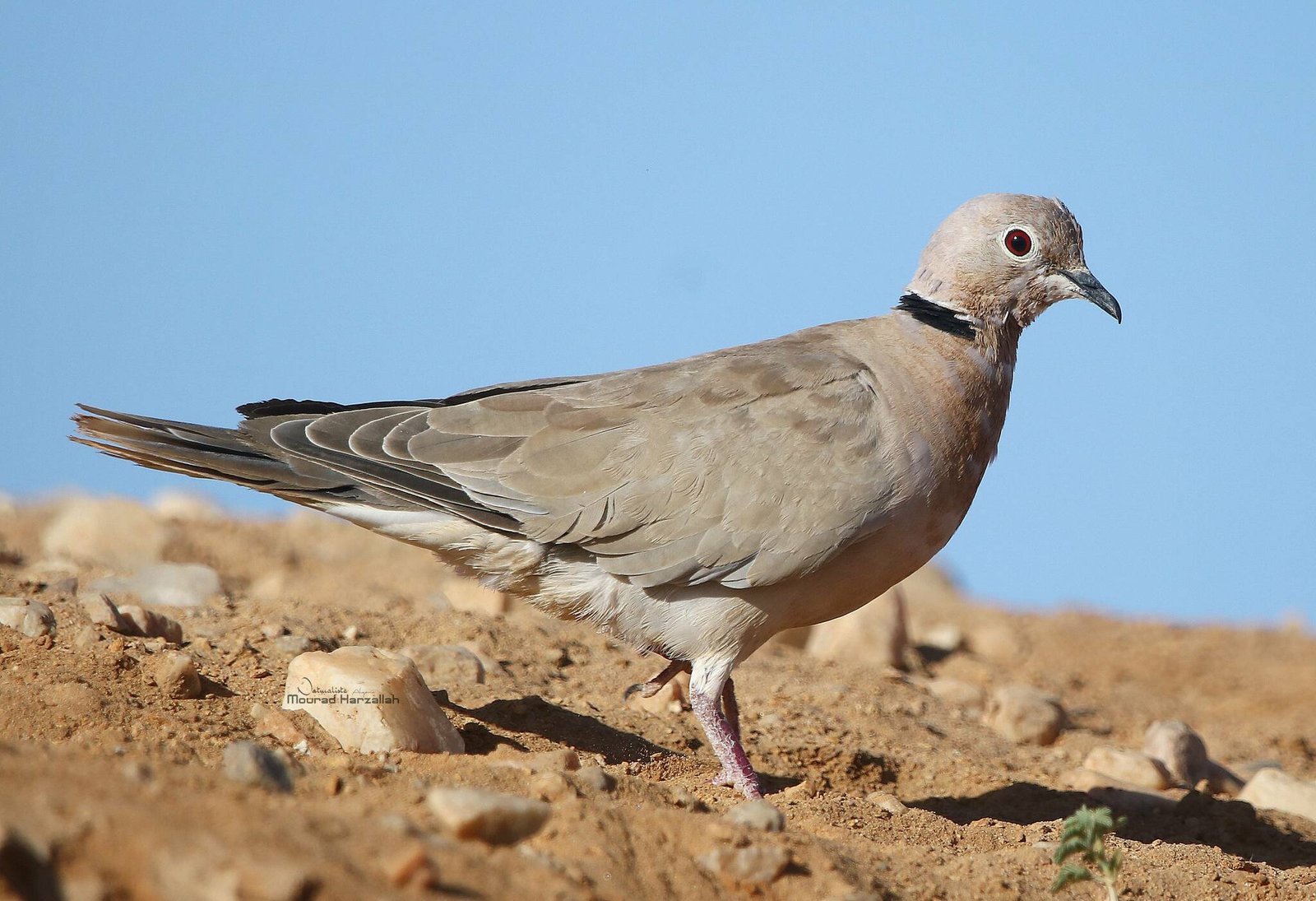
Small, pale dove with a soft pinkish-sandy head and breast becoming almost white on the belly, and a narrow black, white-edged neck band. The pale wing coverts contrast strongly with the blackish primaries. The tail is black at the base below with a broad white outer half; the undertail coverts are white. The Arabian form arabica is slightly darker and greyer than the African one.
Confusion species
Eurasian Collared-Dove (Streptopelia decaocto) is larger, greyer and less contrasting, with grey undertail coverts and a three-note coo. Barbary Doves are creamy, lack the wing contrast and are almost always near buildings. Laughing Dove (Spilopelia senegalensis) is warmer brown and has no neck band but a spotted breast shield.
Habitat
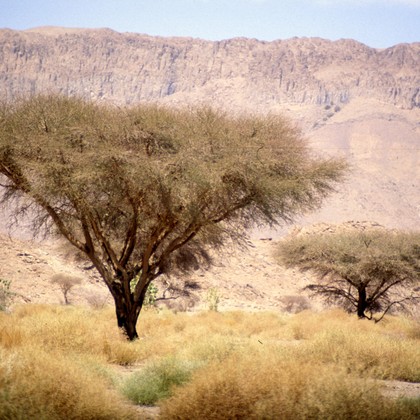
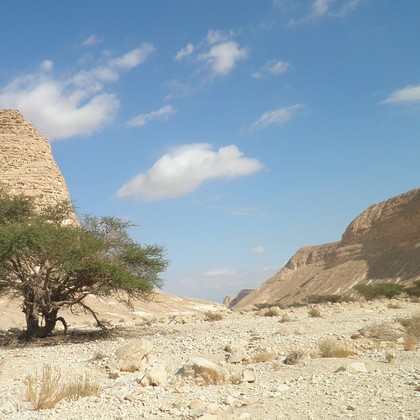
Dry acacia savanna, thorn scrub and wooded wadis in the lowlands and low hills, often near watering places, fields and villages. Feeds on the ground in small groups, often with Laughing Doves.
Where the bird is most at home, classified by the habitats of North Africa and the Middle East.

Range and movements
In the region resident in south-west Arabia: the Tihama and western hills of Yemen and south-west Saudi Arabia, north to about Jeddah. In Egypt scarce in the far south-east, around Gebel Elba. Vagrant to Oman. Beyond the region in the Sahel belt from Mauritania and Senegal to Sudan, Eritrea and Somalia.
- Resident
- Summer visitor (c. Apr–Sep)
- Winter visitor (c. Oct–Mar)
- Passage (Mar–Apr, Oct–Nov)
- dark = core range, pale = thinly spread
How and when to look
Where Eurasian and African Collared Doves occur together, as in new Saudi settlements on the edge of the Tihama, the call is the quickest clue. Check a bird flying off for the white undertail and dark primaries.
Conservation status
Not globally threatened and numerous in the Tihama. The spreading Eurasian Collared-Dove may eventually compete and possibly hybridise; Barbary Doves, the domesticated form, also cross with wild birds.
Scientific name
Streptopelia roseogrisea | (Sundevall, 1857)
Sundevall described the species in 1857 as Columbam roseogriseam; because it was later moved to another genus, the author and year stand in brackets. The genus Streptopelia was introduced in 1855 by Bonaparte. Streptopelia is Greek, from streptos 'collar, twisted chain' and peleia 'dove', after the dark neck collar of these doves. roseogrisea is Latin, from roseus 'rose-red' and griseus 'grey', after the pinkish-grey plumage. The specimen the first description was based on came from Nubia.