All species › Pigeons and doves › Pigeons and doves › Oriental Turtle-Dove
Oriental Turtle-Dove | Streptopelia orientalis
Oosterse tortel | Tórtola oriental
A large, dark dove from Central and East Asia that in the region is seen regularly only as a scarce winter visitor in Oman and remains a rare surprise elsewhere. Anyone who finds one needs to separate it carefully from the much commoner European Turtle Dove.
Voice
Almost silent in winter. The song, a hoarse, hollow coor-coor-cookoo of four or five notes, is rarely heard in the region.
Recording: Ray Tsu 诸仁 — CC BY-NC-SA 4.0 · converted to mono · xeno-canto
Identification
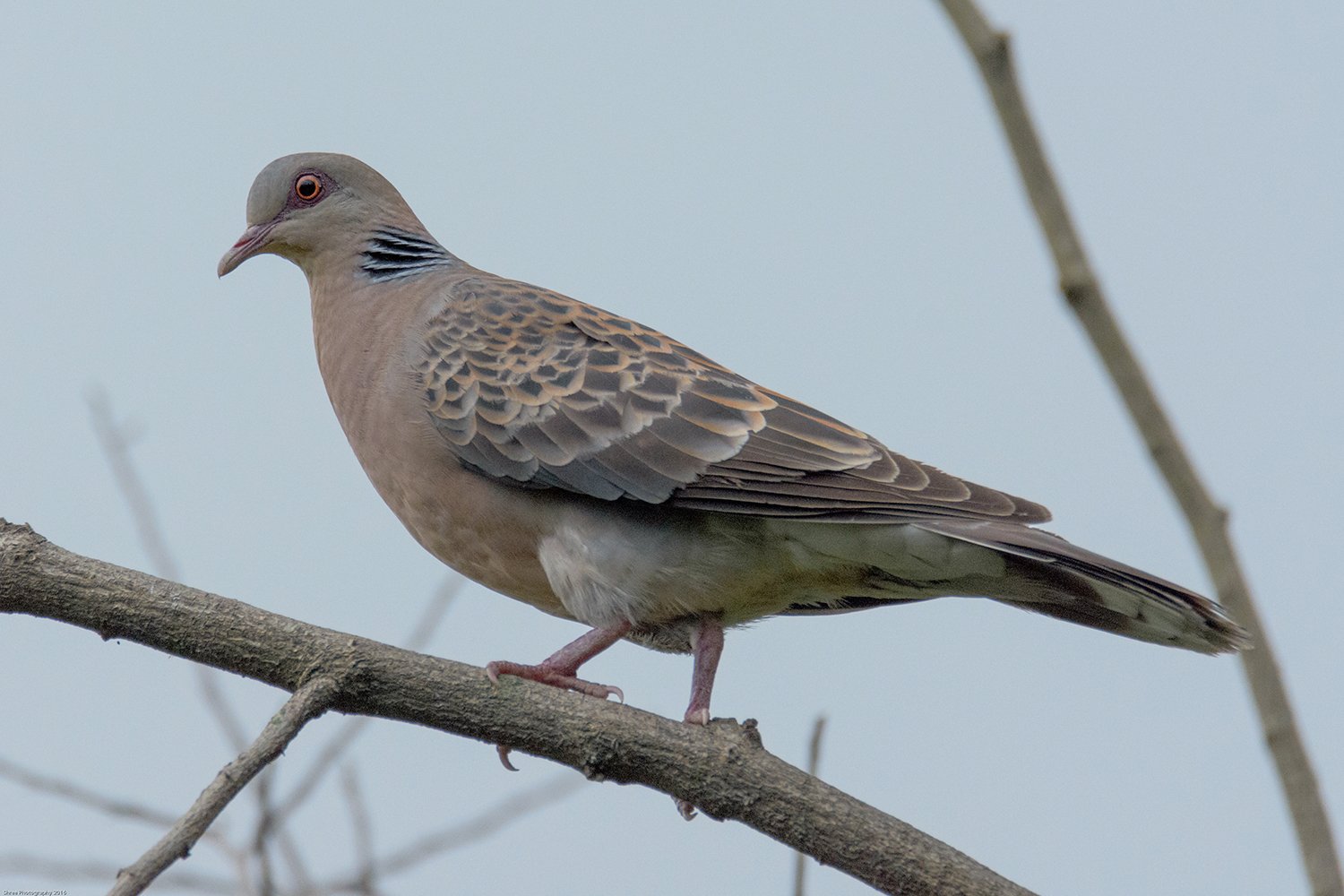
Stocky, heavily built dove, larger and darker than European Turtle Dove. The upperwing coverts have broad black centres with narrow rufous fringes, giving a coarse, dark scaled pattern. Neck patch of black and blue-grey stripes. Grey rump. Breast and belly dark vinous-brown. The tail has a grey tip in the nominate form orientalis, but a dirty-white one in the Central Asian form meena, the one most often seen in Arabia.
Confusion species
European Turtle Dove (Streptopelia turtur) is smaller and slimmer, with narrower, paler orange-fringed wing coverts, white neck stripes, a browner rump and a paler belly; juvenile European Turtle Doves in particular cause confusion. Dusky Turtle Dove (Streptopelia lugens) of south-west Arabia has a plain black neck patch but does not occur in the same area.
Habitat
In Oman in date-palm groves, orchards, wooded gardens and parks, often near water and irrigated farmland. Vagrants usually appear in gardens, on golf courses and at oases, often with other doves.
Where the bird is most at home, classified by the habitats of North Africa and the Middle East.


Range and movements
In the region a scarce but regular winter visitor to Oman, mainly in the north (the Batinah and around Muscat) and on the interior plateaus. Elsewhere a rare vagrant, including to the Emirates and Israel, with scattered records on the Arabian Peninsula. Beyond the region it breeds from the Urals and Central Asia to Japan, with the form meena in western and Central Asia; it winters mainly in South and South-east Asia.
- Winter visitor (c. Apr–Sep)
- Passage (Mar–Apr, Oct–Nov)
- dark = core range, pale = thinly spread
How and when to look
In Oman in winter, walk date-palm groves and parks with many doves and check every large, dark 'turtle dove'. Look for the grey rump, the dark centres of the wing coverts and the blue-grey neck stripes; when in doubt a photo of the tail and neck is indispensable.
Conservation status
Not globally threatened and common in its breeding range. As a vagrant in the region it raises no conservation issue of its own.
Scientific name
Streptopelia orientalis | (Latham, 1790)
Latham described the species in 1790 as Columba orientalis; because it was later moved to another genus, the author and year stand in brackets. The genus Streptopelia was introduced in 1855 by Bonaparte. Streptopelia is Greek, from streptos 'collar, twisted chain' and peleia 'dove', after the dark neck collar of these doves. orientalis is Latin for 'eastern', after the type locality in China. The specimen the first description was based on came from China.