All species › Cranes, rails and allies › Rails and crakes › African Crake
African Crake | Crecopsis egregia
Afrikaanse kwartelkoning | Guión africano
A small, dark grassland crake from the savannas south of the Sahara that moves within Africa with the rains. In the region it is an extreme rarity: since 2009 a handful of birds have been found in the western Sahara, in Algeria and at Eilat, often exhausted after a failed migration.
Voice
In Africa a rapid series of harsh, grating notes, krr-krr-krr-krr, mainly at dusk and at night during the rains. Vagrants in the region are almost always silent.
Recording: Barry Edmonston — CC BY-NC-SA 4.0 · converted to mono · xeno-canto
Identification
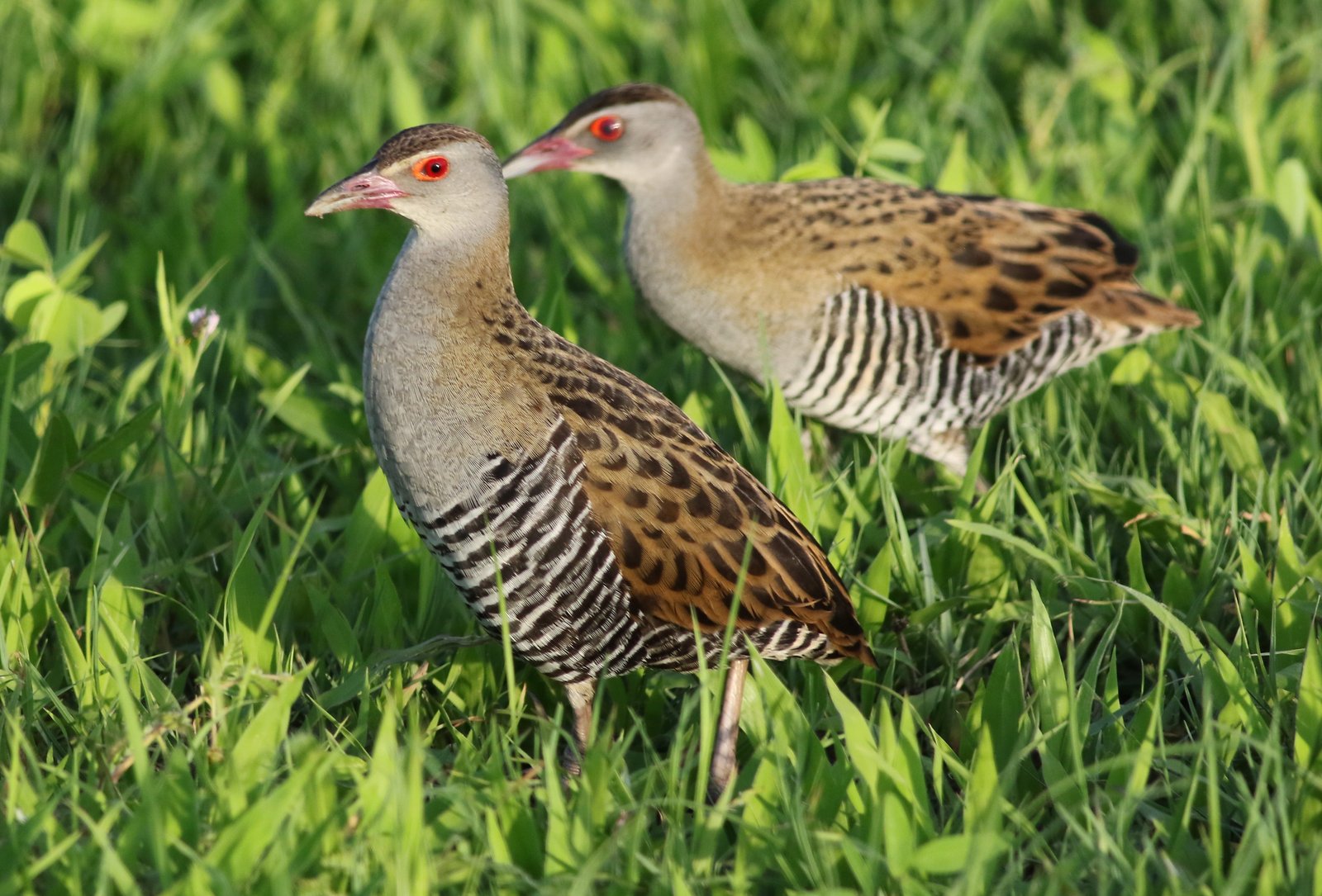
Compact, with a short, conical reddish bill and a red eye. Upperparts olive-brown with bold black blotches; face, throat and breast blue-grey with a white stripe above the lores; flanks and belly sharply barred black and white. Legs greyish-brown. Flight short and fluttering, without the rufous wing of Corn Crake.
Confusion species
Corn Crake (Crex crex) is larger and more yellowish-brown, with a rufous wing and brown, less sharply barred flanks. Spotted Crake (Porzana porzana) has white spots on neck and breast, a yellow bill with a red base and a pale undertail. Little Crake (Zapornia parva) and Baillon's Crake (Zapornia pusilla) are smaller, with unmarked brown upperparts (Little) or fine white streaks (Baillon's).
Habitat
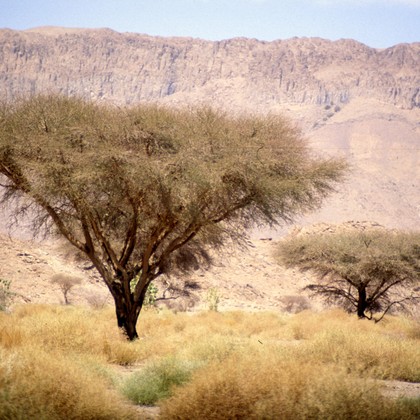
In the breeding range moist grasslands, tall-grass savanna, marsh edges and cultivation. Vagrants in the region have been found in oases, gardens and irrigated fields in the desert, at the edge of sewage ponds and in short grass near buildings.
Where the bird is most at home, classified by the habitats of North Africa and the Middle East.


Range and movements
Vagrant. Morocco: in Western Sahara near Dakhla in December 2009, a dead bird in February 2019 and a bird around the turn of 2023 to 2024. Algeria: an exhausted bird at Kerzaz (Béni Abbès) in late November 2020, the first for the country, and one in the town of Illizi in December 2022. Israel: sightings at Eilat in January 2020 and from late November to early December 2022. Beyond the region more than ten records from the Canary Islands. Breeds in sub-Saharan Africa from Senegal and Gambia to Ethiopia and south to eastern South Africa; moves within Africa with the rainy season.
How and when to look
Finding one is a matter of luck, but the pattern is clear: records fall between late November and February and involve birds that have overshot northwards across the Sahara. In those months, check every crake that flushes from short grass or a garden at Dakhla, Eilat and the Algerian oases.
Conservation status
Not globally threatened and widespread across much of Africa. In the region a vagrant that does not originate from the region itself, with fewer than ten confirmed records since 2009, most of them in the western Sahara.
Scientific name
Crecopsis egregia | (Peters, 1854) (GBIF: Crex egregia)
Peters described the species in 1854 as Ortygometra (Crex) egregia; because it was later moved to another genus, the author and year stand in brackets. The genus Crecopsis was introduced in 1893 by Sharpe. Crecopsis combines Crex, the genus of the Corn Crake, with the Greek opsis, 'appearance' — thus 'resembling a Corn Crake'. egregia is Latin for 'excellent, outstanding'. The specimen the first description was based on came from Tete, Mozambique.