All species › Cranes, rails and allies › Rails and crakes › Baillon's Crake
Baillon's Crake | Zapornia pusilla
Kleinst waterhoen | Polluela chica
The smallest and most secretive crake in the region, barely larger than a sparrow and rarely in view for more than a few seconds. It breeds here and there in the large marshes of the Maghreb, the Nile Delta and southern Iraq, but is heard far more often than seen.
Voice
The male sings a dry, frog-like rattle, trrrr-trrrr, lasting two to three seconds, always at the same speed and pitch, like running a fingernail along a comb. Mainly at dusk and at night from March to June. Unlike Little Crake, the song does not accelerate or drop in pitch.
Recording: Sébastien Reeber — CC BY-NC-SA 4.0 · converted to mono · xeno-canto
Identification
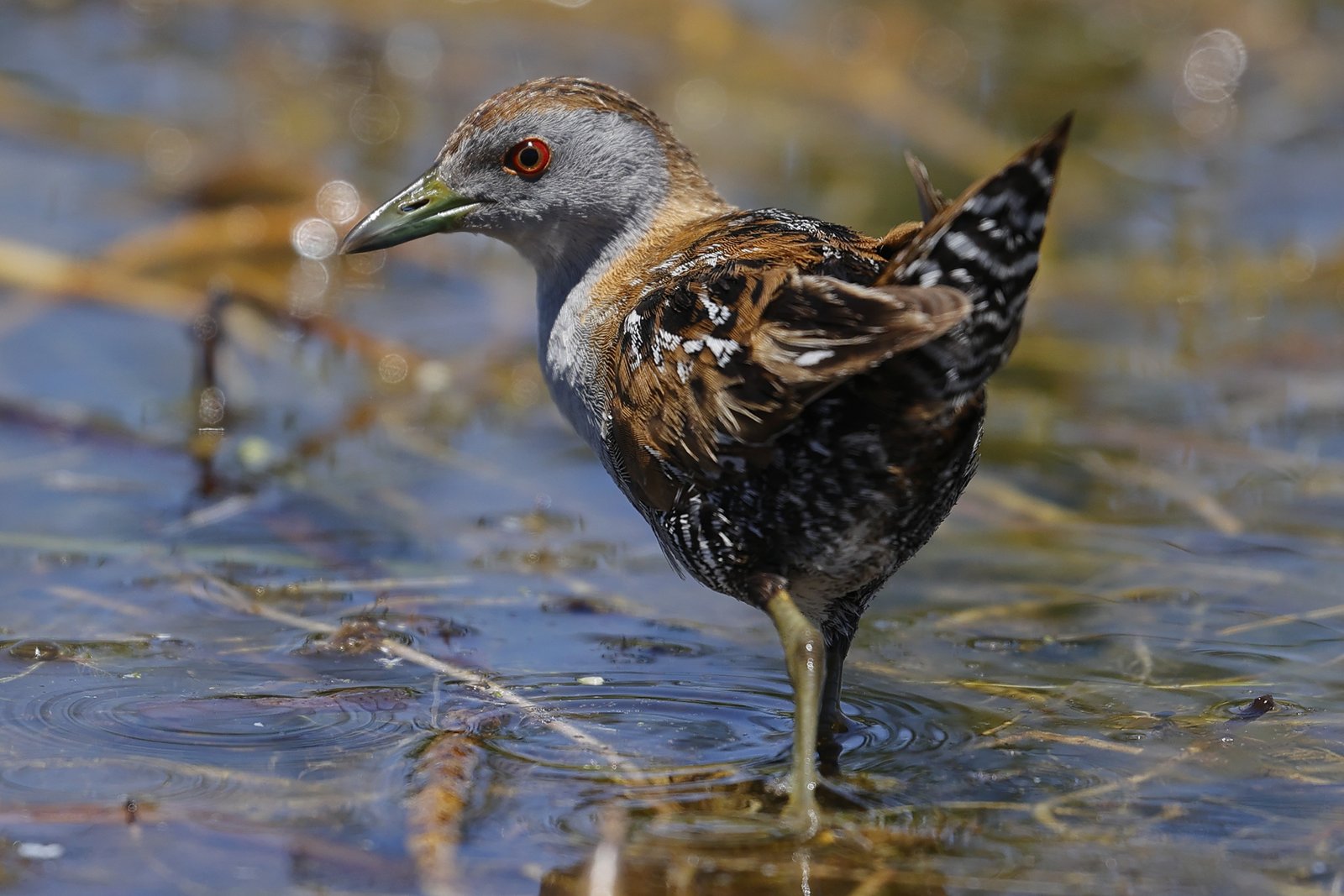
Small and compact, with a short tail, short wings barely reaching beyond the tertials and flesh-coloured to greenish-grey legs. Adults are slate-blue on the face and underparts, with a warm brown, black-streaked back full of irregular white flecks and streaks, and broad, sharp black-and-white barring on the flanks, belly and undertail. The bill is short and all green, without a red spot. Male and female are almost alike; the female has a slightly browner face. Young birds are brownish with a pale throat and barred flanks.
Confusion species
Little Crake (Zapornia parva) is slimmer, with a longer tail, long-projecting primaries, green legs, a red bill base and much less white on the back and flanks. Spotted Crake (Porzana porzana) is larger, spotted white all over and has a buff undertail. A running young Eurasian Moorhen (Gallinula chloropus) is black with a pale bill and lacks the white back markings.
Habitat
Shallow, densely vegetated marsh with sedge, rushes, low reed and floating vegetation; often in wet zones with fluctuating water levels, along lake edges, in rice fields and flooded meadows. On passage also in small reedbeds at oases, sewage works and irrigation channels.
Where the bird is most at home, classified by the habitats of North Africa and the Middle East.


Range and movements
In the Maghreb a scarce and local breeder, with breeding records in the wetlands of north-west Morocco (such as the Loukkos and Merja Zerga), north-east Algeria and Tunisia, as well as a passage migrant and winter visitor. Egypt: local in the Nile Delta and the Faiyum, where breeding is also known, and scarce on passage. Probably breeds in the marshes of southern Iraq. In the Levant, eastern Arabia and Yemen a scarce passage migrant, seen less often than Little Crake; in the Emirates and Oman a few each year in autumn and winter. Elsewhere patchily distributed from western and southern Europe to East Asia, and resident in sub-Saharan Africa, Madagascar and Australasia.
- Winter visitor (c. Apr–Sep)
- Passage (Mar–Apr, Oct–Nov)
- dark = core range, pale = thinly spread
How and when to look
On a still night in April or May, listen for the dry rattle at the edge of a shallow marsh in north-west Morocco or the Nile Delta. By day the best chance is at dawn at the edge of a small reedbed with open mud, or on passage at the sewage works of the Gulf states, where birds sometimes briefly emerge from under the vegetation.
Conservation status
Not globally threatened, but vulnerable in the region through the loss of shallow, natural marshes: drainage, water-level management and the disappearance of floodplains are the main threats. Because of its secretive habits, the true size of the breeding population in North Africa and Iraq is poorly known.
Scientific name
Zapornia pusilla | (Pallas, 1776) (GBIF: Porzana pusilla)
Pallas described the species in 1776 as Rallus pusillus; because it was later moved to another genus, the author and year stand in brackets. The genus Zapornia was introduced in 1816 by Leach. Zapornia is a near-anagram of Porzana, the genus of the French ornithologist Louis-Pierre Vieillot. pusilla is Latin for 'very small'; this is the smallest crake in Europe. The specimen the first description was based on came from Transbaikalia, Siberia.