All species › Hoopoes and hornbills › Hornbills › African Grey Hornbill
African Grey Hornbill | Lophoceros nasutus
Grijze tok | Toco piquinegro
The only hornbill of the region: a slender, grey-brown hornbill with a curved, dark bill and a broad white supercilium. It lives in the acacia wadis and thorn scrub of the Tihama and the foothills of south-west Saudi Arabia and western Yemen, the north-eastern outpost of a range that otherwise covers almost all of Africa south of the Sahara.

Voice
A series of plaintive, whistled notes, pee-pee-pee-pieuw-pieuw, rising and falling. When calling, the bird points its bill upwards and half-opens its wings with each note; pairs call like this in duet.
Recording: Magnus Wadstein — CC BY-NC-SA 4.0 · converted to mono · xeno-canto
Identification
About 46 cm, with a long tail and a long, curved bill. Head and upperparts grey-brown, the coverts narrowly pale-edged, and a narrow white stripe down the back, especially visible in flight. A broad whitish supercilium runs from the eye into the nape; the breast is grey-brown, the belly dirty white. The tail is dark with white tips to the outer feathers. The male has a black bill with a cream stripe along the base of the upper mandible and a small casque; in the female the upper mandible is largely cream with a reddish-brown tip. Arabian birds belong to the subspecies forskalii. Flight undulating, alternating flapping and gliding.
Confusion species
There are no other hornbills in Arabia, so it is hardly confusable there. At a distance and in flight its long tail and undulating flight may recall a cuckoo such as Great Spotted Cuckoo (Clamator glandarius), but the heavy curved bill and white supercilium rule that out.
Habitat
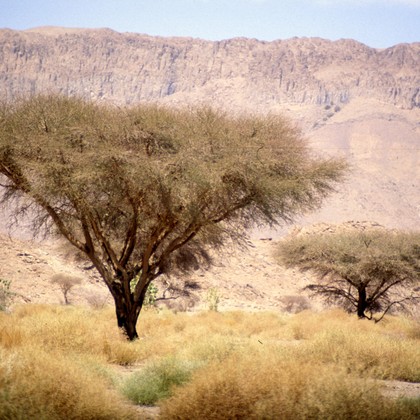
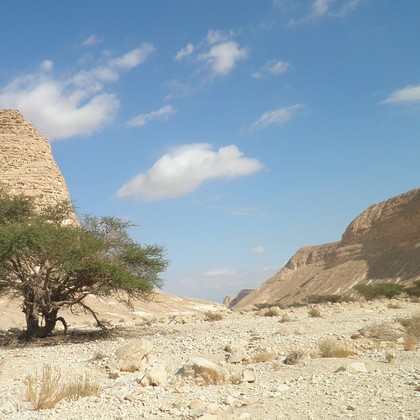
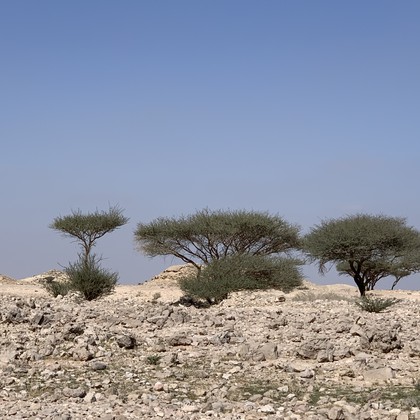
Acacia scrub and open acacia woodland in wadis and on the lower slopes of the western escarpment, from the Tihama up to about 2000 m, also wooded edges of terraced farmland. Feeds mainly in trees: grasshoppers, caterpillars and other insects, lizards and fruit, including figs. Nests in a natural tree hole, which the female seals with mud and droppings to a narrow slit.
Where the bird is most at home, classified by the habitats of North Africa and the Middle East.
Range and movements
Resident in south-west Saudi Arabia, in the foothills and wadis of Asir, Al Baha and Jizan and locally in the Tihama, and in western Yemen, along the western and southern slopes of the highlands into the hinterland of Aden. No certain modern records elsewhere in the region. Beyond the region across almost all of Africa south of the Sahara, from Senegal and Mauritania to Ethiopia and Somalia and south to northern South Africa.
- Resident
- Summer visitor (c. Apr–Sep)
- Winter visitor (c. Oct–Mar)
- Passage (Mar–Apr, Oct–Nov)
- dark = core range, pale = thinly spread
How and when to look
Look for it in the wooded wadis below the escarpment, for example around Abha and the wadis down to the Tihama, or near Taizz in Yemen. The plaintive, swelling whistles often give it away before you see it; in the morning pairs sit calling in the tops of the acacias.
Conservation status
Not globally threatened and common in Africa. In Arabia restricted to a narrow strip in the south-west, where it depends on old acacias and fig trees with holes; cutting for firewood and charcoal and overgrazing are local threats.
Scientific name
Lophoceros nasutus | (Linnaeus, 1766)
Linnaeus described the species in 1766 as Buceros nasutus; because it was later moved to another genus, the author and year stand in brackets. The genus Lophoceros was introduced in 1833 by Hemprich & Ehrenberg. Lophoceros comes from the Greek lophos, 'crest', and keras, 'horn' — for the ridge-like casque on the bill. nasutus is Latin for 'large-nosed' — for the large, curved bill. The specimen the first description was based on came from Senegal.