All species › Pigeons and doves › Pigeons and doves › African Olive Pigeon
African Olive Pigeon | Columba arquatrix
Olijfduif | Paloma ojigualda
A large, dark forest pigeon of African montane forests, which in the region occurs only in the juniper woods and wadis of the Asir and northern Yemen highlands. First recorded in Saudi Arabia in the mid-1980s, and still one of the least known pigeons of Arabia.
Voice
A deep, hoarse, growling coo, krroo… krroo-krroo-krroo, that speeds up and fades away; unobtrusive and easily missed. The wings clatter loudly on take-off.
Recording: Andrew Spencer — CC BY-NC-SA 4.0 · shortened to the first 60 s, mono · xeno-canto
Identification
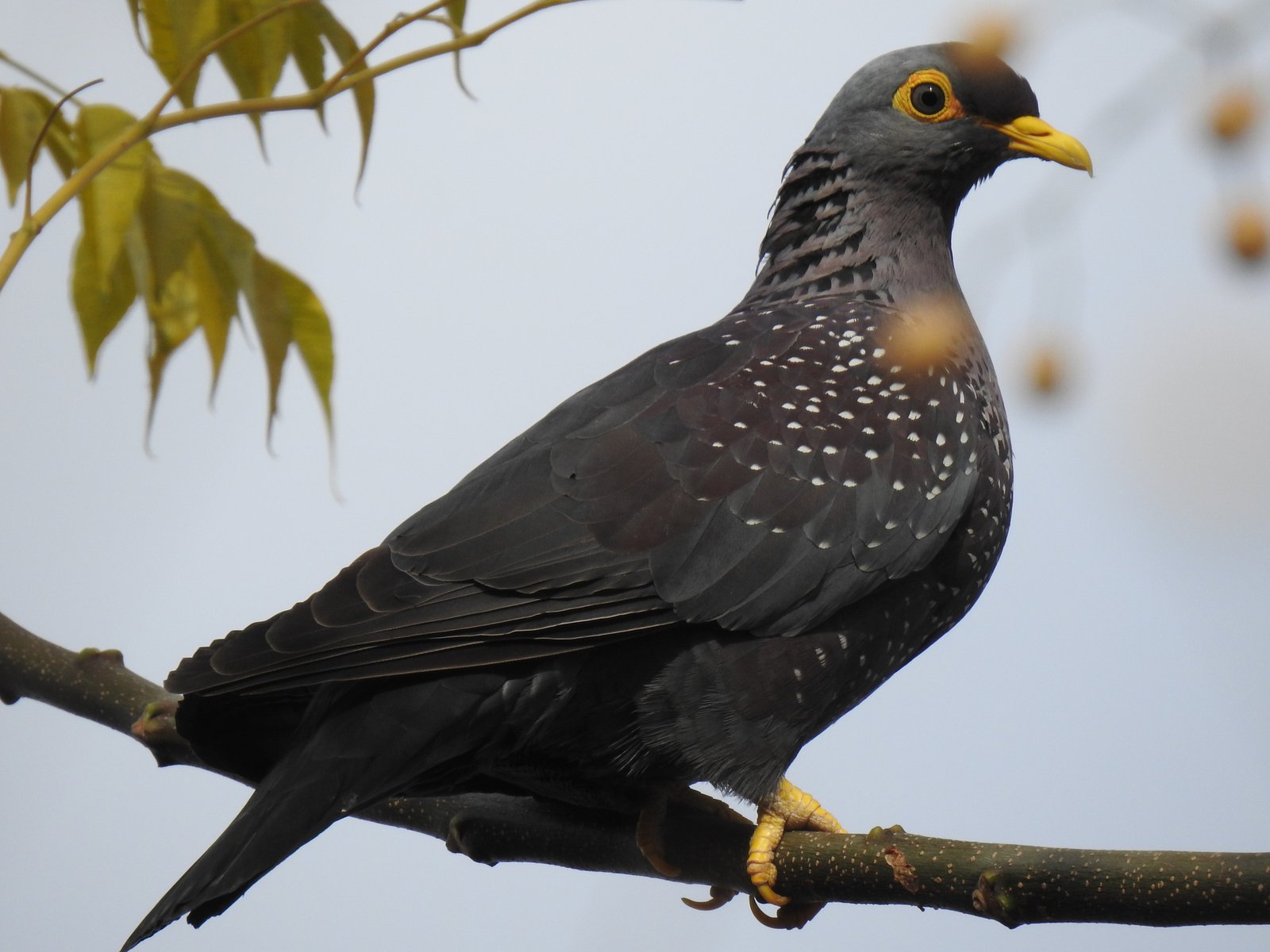
Bulky and dark, with a grey crown and grey face. Neck, mantle and underparts are dark wine-red to purple-chestnut, densely marked with small white spots on breast, belly and wing coverts. Bill, bare eye-ring and legs are bright yellow and stand out against the dark plumage. The tail is dark slate-grey. The female is slightly duller; young birds are browner, with fewer spots and a duller bill. Flies fast and straight with powerful beats, often high across a valley from one stand of trees to the next.
Confusion species
Rock Pigeon (Columba livia) is paler blue-grey, with black wing bars, a white rump and a dark bill, and lives on cliffs rather than in trees. Dusky Turtle Dove (Streptopelia lugens), in the same highlands, is much smaller and longer-tailed, with a black neck patch and rufous-edged wing coverts, and lacks the yellow bill and legs.
Habitat
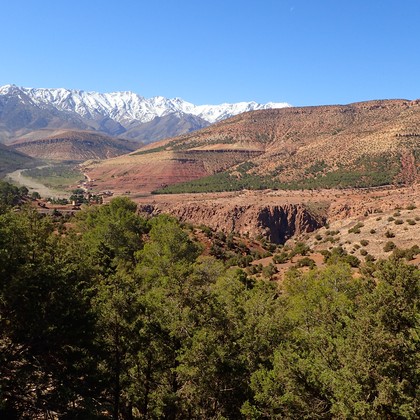
Juniper forest and wooded slopes of the highlands, especially in steep valleys and along the edge of the escarpments, between about 1800 and 3000 m. It feeds on fruit in junipers, wild figs and olives, and also visits terraced orchards and villages.
Where the bird is most at home, classified by the habitats of North Africa and the Middle East.

Range and movements
In the region only in the south-west of the Arabian Peninsula. Saudi Arabia: scarce and local in the Asir highlands, for example on the Raydah escarpment and at Jebel Souda near Abha, where it was first found in the mid-1980s. Yemen: in the northern highlands, adjoining the Saudi population; little is known about numbers. Probably resident, but there are hardly any winter records. Elsewhere in the montane forests of Ethiopia and East Africa south to South Africa and Angola.
- Summer visitor (c. Apr–Sep)
- Passage (Mar–Apr, Oct–Nov)
- dark = core range, pale = thinly spread
How and when to look
Look for it early in the morning on the Raydah escarpment near Abha, where birds fly from the juniper woods along the edge and land in fruiting trees. Listen for the clatter of birds taking off and watch for the yellow bill against the light.
Conservation status
Not globally threatened. In Arabia a small, isolated population dependent on the highland juniper forests, which suffer from drought die-back, cutting and overgrazing. Status and numbers are poorly known, and the literature treats it variously as a resident or a rare visitor.
Scientific name
Columba arquatrix | Temminck, 1808
Temminck described the species in 1808 and placed it straight away in the genus where it still stands. The genus Columba was introduced in 1758 by Linnaeus. Columba is Latin for 'dove' and goes back to Greek kolumbos 'diver', from kolumbaō 'to dive, to swim'; classical writers used it of the rock dove for the swimming stroke of its wings in flight. arquatrix is Modern Latin for 'female jaundice sufferer', from arquatus, 'jaundiced' (the skin turning the yellow of the rainbow; arcus, 'rainbow'); the name goes back to Levaillant's 'Rameron'. The specimen the first description was based on came from Knysna, South Africa.