All species › Pigeons and doves › Pigeons and doves › Rock Pigeon
Rock Pigeon | Columba livia
Rotsduif | Paloma bravía
The wild ancestor of the town pigeon, which in the region still lives in its original form in many places: in the gorges of the Atlas, on the cliffs of Sinai and Arabia, in the mountains of the Sahara and in desert wells. Feral and domestic birds are also everywhere, from the dovecotes of the Nile Delta to the minarets of every town.

Voice
A rolling, plaintive coo echoing off the cliff, oo-rooh-coo, stressed on the second syllable. Heard all year, most in spring. On take-off the wings clap hard together.
Recording: Stanislas Wroza — CC BY-NC-SA 4.0 · converted to mono · xeno-canto
Identification
Blue-grey pigeon with two sharp black wing bars, a green-purple glossed neck side, a dark terminal tail band and white underwings contrasting strongly with the dark primaries. Most wild birds show a white rump; in the east and south of the region, however, many wild birds have a grey rump. Desert forms in the Sahara and the Egyptian oases are strikingly pale. Feral town pigeons vary from black and red-brown to pied and white.
Confusion species
Stock Dove (Columba oenas) has a grey rump, dark eyes, only short broken wing bars and a dark trailing edge to the wing, without white underwings. Common Wood Pigeon (Columba palumbus) is larger, with a white neck patch and a broad white band across the wing. African Olive Pigeon (Columba arquatrix) in the Arabian highlands is dark wine-red with white spots and a yellow bill.
Habitat
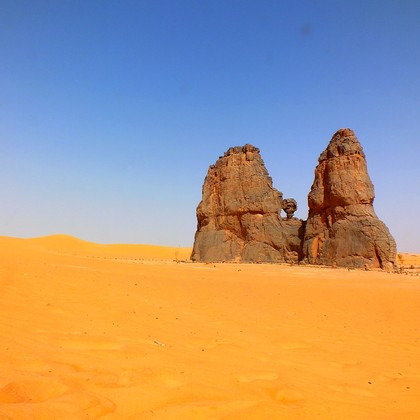
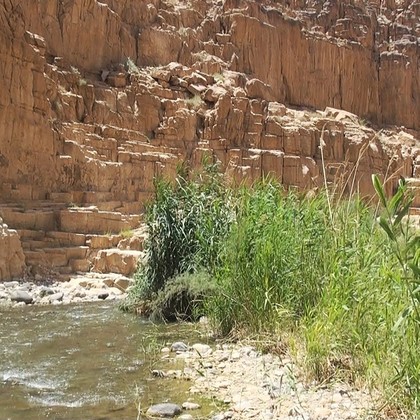
Sheer cliffs, gorges and canyons, sea cliffs and islets, and in the desert also wells, shafts and ruins where it nests; it feeds on fields, fallow land and in wadis. Wild birds drink daily and sometimes fly tens of kilometres to a spring, well or oasis. Feral birds in towns, villages, harbours and grain stores.
Where the bird is most at home, classified by the habitats of North Africa and the Middle East.

Range and movements
Throughout the region, wild or feral. Wild populations in the rocky parts of Morocco, Algeria, Tunisia and Libya, in the mountain massifs of the central Sahara such as the Hoggar, in the Egyptian oases and the desert mountains along the Nile and Red Sea, in Sinai, the Negev and Jordan, in the mountains of Syria and Iraq and across the Arabian Peninsula, from the Hejaz and Asir to the Hajar of Oman and the cliffs of Musandam. In the Nile Valley and Delta birds are kept en masse in mud dovecotes and wild and domestic birds can hardly be told apart. Beyond the region originally from southern Europe and the Atlantic coasts to Central Asia and India; as a feral pigeon worldwide.
- Resident
- Summer visitor (c. Apr–Sep)
- Winter visitor (c. Oct–Mar)
- Passage (Mar–Apr, Oct–Nov)
- dark = core range, pale = thinly spread
How and when to look
For wild birds, look in gorges away from villages, such as the Todra Gorge in Morocco or the wadis of Sinai and Petra, and watch for pigeons flying low in small groups to a well in the morning. A drive through the Nile Delta shows the characteristic dovecotes, where hundreds of birds come in at dusk.
Conservation status
Not globally threatened and very common. The pure wild form is threatened throughout the region by interbreeding with domestic and feral pigeons, which have settled deep in the desert and mountains as well. It is widely hunted, and pigeons are traditionally kept for meat and manure.
Scientific name
Columba livia | Gmelin, 1789
Gmelin described the species in 1789 and placed it straight away in the genus where it still stands. The genus Columba was introduced in 1758 by Linnaeus. Columba is Latin for 'dove' and goes back to Greek kolumbos 'diver', from kolumbaō 'to dive, to swim'; classical writers used it of the rock dove for the swimming stroke of its wings in flight. livia is a Medieval Latin variant of livida 'livid, bluish grey', Theodorus Gaza's rendering of Greek peleia 'dove', itself from pellos 'dark-coloured'. The specimen the first description was based on came from southern Europe.