All species › Pigeons and doves › Pigeons and doves › Stock Dove
Stock Dove | Columba oenas
Holenduif | Paloma zurita
A compact, blue-grey pigeon which in the region appears mainly as a winter visitor on the fields of the Maghreb and the Levant, often in flocks among Wood Pigeons and Rock Pigeons. As a breeder it is scarce and little known.

Voice
A muffled, two-syllable, slightly sighing oo-woop, oo-woop, stressed on the first syllable and repeated in series, more monotonous and hollow than the cooing of Common Wood Pigeon. Usually silent in winter quarters.
Recording: Beatrix Saadi-Varchmin — CC BY-NC-SA 4.0 · converted to mono · xeno-canto
Identification
Uniform blue-grey, with a green-glossed neck patch, a vinous breast and two short, broken black bars on the inner wing. The eye is dark and the bill yellow with a white cere. In flight the pale grey centre of the upperwing stands out, framed by a broad dark trailing edge and dark wingtips; the rump is grey and the underwing grey, not white. It flies fast and direct with rapid beats.
Confusion species
Rock Pigeon (Columba livia) has two long, unbroken black wing bars, white underwings and often a white rump. Common Wood Pigeon (Columba palumbus) is larger and longer-tailed, with a white neck patch and white wing bands.
Habitat
In winter on open fields, fallow land, stubble and grassland, often near olive groves or forest edges. It nests in holes in old trees such as cedars and oaks, and in rock crevices and buildings.
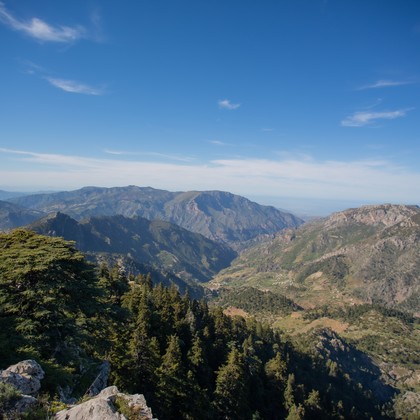
Where the bird is most at home, classified by the habitats of North Africa and the Middle East.


Range and movements
North-west Africa: winter visitor in Morocco, northern Algeria and Tunisia, scarce in northern Libya; breeds scarcely and locally in northern Morocco and Algeria. Middle East: winter visitor in Syria, Lebanon, Israel, Jordan and Iraq, most numerous in the north; possibly breeds locally in northern Syria and northern Iraq. Rare in Egypt, Kuwait and northern Saudi Arabia. Beyond the region it breeds in Europe and Turkey to western Siberia and, as a pale form, in Central Asia.
- Resident
- Summer visitor (c. Oct–Mar)
- Winter visitor (c. Apr–Sep)
- Passage (Mar–Apr, Oct–Nov)
- dark = core range, pale = thinly spread
How and when to look
In December and January check pigeon flocks on the fields of the Gharb in Morocco, the plain around Ichkeul in Tunisia, or the Hula Valley and Golan Heights in Israel, and look for the grey rump and dark trailing edge as they fly up.
Conservation status
Not globally threatened. In the region the breeding population is small and poorly known. Wintering birds suffer from hunting and from the loss of stubble and fallow land to more intensive farming.
Scientific name
Columba oenas | Linnaeus, 1758
Linnaeus described the species in 1758 and placed it straight away in the genus where it still stands. He introduced the genus Columba in that same work. Columba is Latin for 'dove' and goes back to Greek kolumbos 'diver', from kolumbaō 'to dive, to swim'; classical writers used it of the rock dove for the swimming stroke of its wings in flight. oenas is Ancient Greek oinas, the name of a pigeon. The specimen the first description was based on came from Sweden.