All species › Pigeons and doves › Pigeons and doves › Common Wood Pigeon
Common Wood Pigeon | Columba palumbus
Houtduif | Paloma torcaz
The largest pigeon of the region, a bird of the Mediterranean north: in the oak and cedar forests of the Atlas, the olive groves of Tunisia and the parks of Rabat and Marrakech. In the Middle East it has spread since the 1980s and has become a common urban bird in Israel.
Voice
Five syllables stressed on the second, doo-dooo-doo, doo-doo, repeated and then broken off abruptly with a short extra note. It sounds sleepy and muffled. It claps its wings loudly on take-off, and in display flight it climbs steeply, claps and glides down.
Recording: David Darrell-Lambert — CC BY-NC-SA 4.0 · converted to mono · xeno-canto
Identification
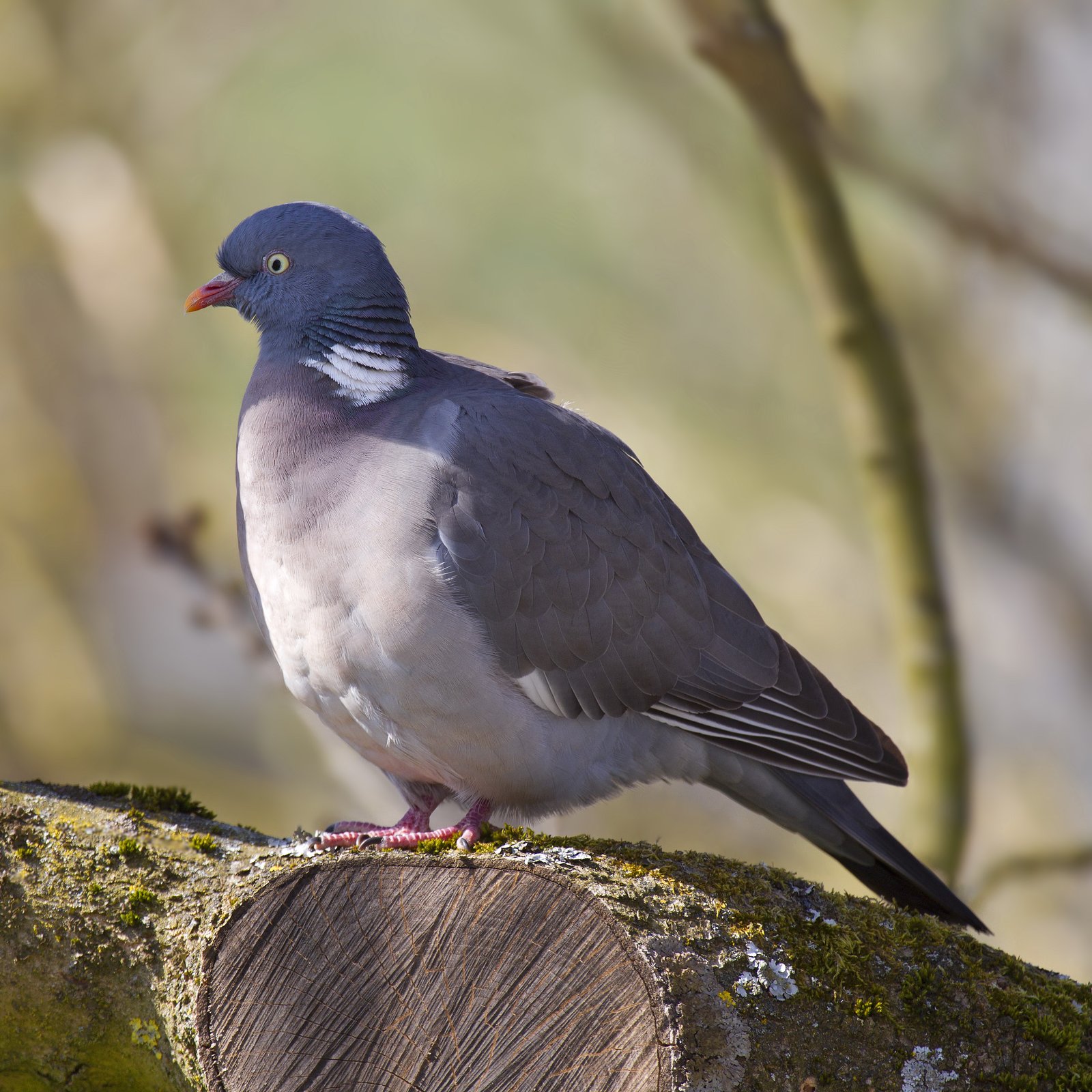
Heavy pigeon with a small head on a bulky body and a long tail. Adults have a white neck patch beside a green-purple glossed neck side, a vinous-pink breast, a pale yellow eye and a yellow and pink bill with a white cere. In flight a broad white band crosses each wing, the most conspicuous feature at range. Juveniles lack the white neck patch and have dull, dark eyes. Birds of the Atlas are slightly larger and darker.
Confusion species
Stock Dove (Columba oenas) is smaller and more compact, with no white on neck or wing, dark eyes and short black wing bars. Rock Pigeon (Columba livia) has two black wing bars and often a white rump. Eurasian Collared-Dove (Streptopelia decaocto) is much smaller, pale sandy, with a black half-collar.
Habitat
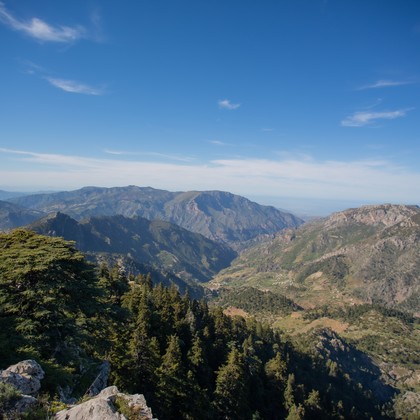
Mediterranean forest of holm oak, cork oak and cedar, maquis, olive groves and orchards, poplar lines and urban parks and gardens. It feeds on fields and in orchards on grain, acorns, olives and leaves. Winter visitors in the east mainly in farmland with trees and in river valleys.
Where the bird is most at home, classified by the habitats of North Africa and the Middle East.


Range and movements
North-west Africa: common in the north of Morocco, Algeria and Tunisia, from the coast to the cedar forests of the Middle Atlas, and local in Libya (Tripolitania and the Jebel Akhdar in Cyrenaica). In the Levant it breeds in Israel, Lebanon and western Syria and in northern Iraq; in Israel it has increased strongly and now also nests in towns. In winter northern birds reach Syria, Iraq, Israel and Jordan; rare in Egypt, Kuwait and northern Saudi Arabia and a vagrant elsewhere in Arabia. Beyond the region throughout Europe to western Siberia and Iran, with an isolated form in Central Asia.
- Resident
- Summer visitor (c. Apr–Sep)
- Winter visitor (c. Oct–Mar)
- Passage (Mar–Apr, Oct–Nov)
- dark = core range, pale = thinly spread
How and when to look
In Morocco it is easiest in the cedar forests around Ifrane and Azrou and the olive groves at the foot of the Atlas, and in the city parks of Rabat and Marrakech. In Israel the Hula Valley and the parks of Tel Aviv and Jerusalem are good sites.
Conservation status
Not globally threatened. In north-west Africa an important game bird with a long hunting tradition; even so, numbers there and in the Levant are increasing, partly because it increasingly breeds in towns and plantations.
Scientific name
Columba palumbus | Linnaeus, 1758
Linnaeus described the species in 1758 and placed it straight away in the genus where it still stands. He introduced the genus Columba in that same work. Columba is Latin for 'dove' and goes back to Greek kolumbos 'diver', from kolumbaō 'to dive, to swim'; classical writers used it of the rock dove for the swimming stroke of its wings in flight. palumbus is an alternative form of Latin palumbes, the word for the wood pigeon. The specimen the first description was based on came from Sweden.