All species › Pigeons and doves › Pigeons and doves › Namaqua Dove
Namaqua Dove | Oena capensis
Maskerduif | Tortolita rabilarga
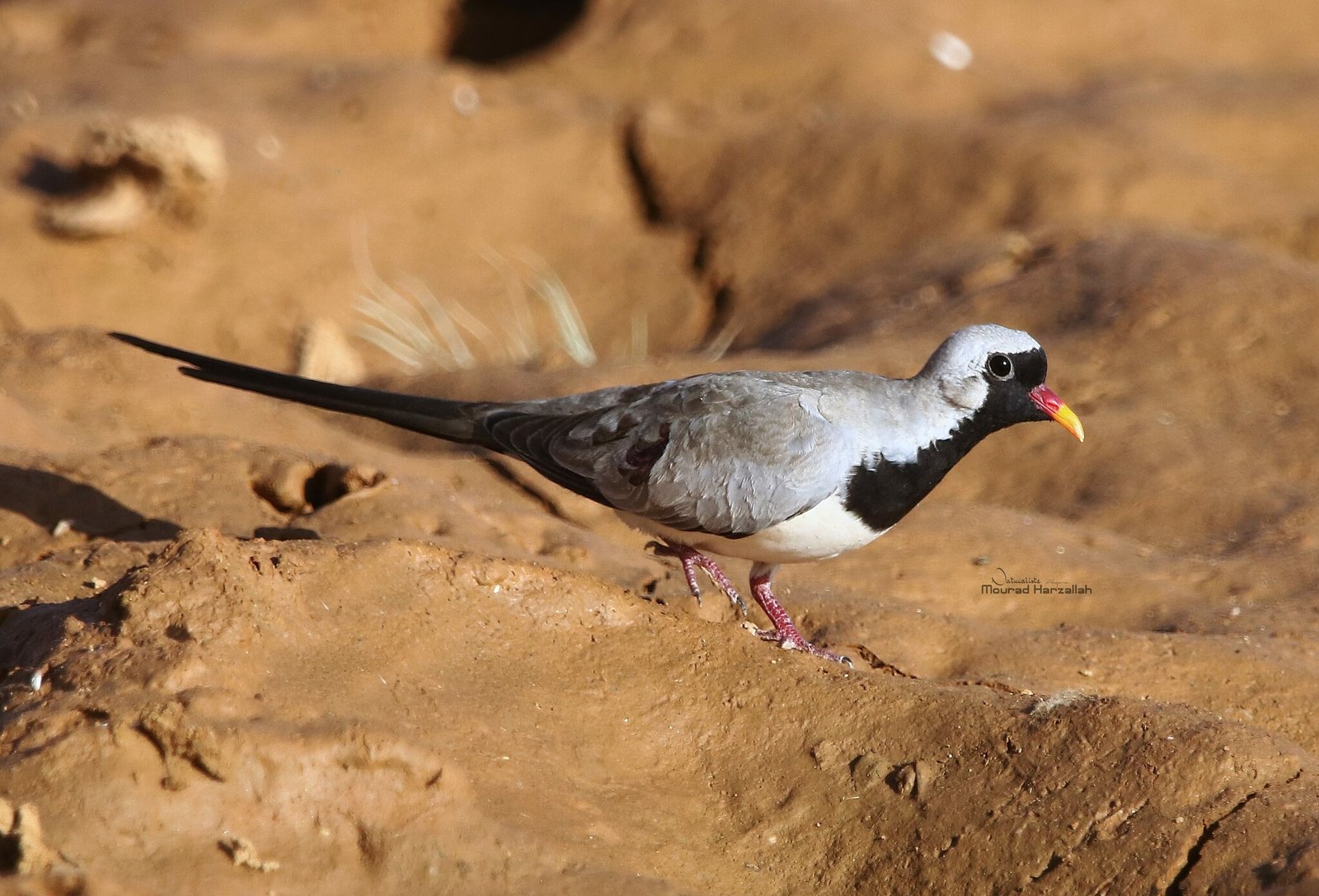
A tiny dove with a long, graduated tail that colonised the Arabian Peninsula in the 1970s and 1980s and has kept pushing north and west ever since, into Israel, Iraq and Western Sahara. In flight the rufous wings flash.
Voice
A soft, deep and mournful two-part coo, koo-hoooo, the second note drawn out and swelling slightly, repeated after long pauses. Despite the low pitch it carries far and is hard to locate; in the midday heat it is often the only sound coming from the scrub.
Recording: Stanislas Wroza — CC BY-NC-SA 4.0 · converted to mono · xeno-canto
Identification
Small and slim, with a long, graduated tail making up more than half its length. Upperparts sandy grey-brown, underparts paler with a white belly. The male has a black face, throat and centre of the breast and a red bill with a yellow tip. The female lacks the black mask and has a dark bill. A few glossy blue-purple spots mark the wing and two dark bands cross the lower back. In flight both sexes show rufous primaries and underwings. Young birds are finely barred brown and buff.
Confusion species
Laughing Dove (Spilopelia senegalensis) is larger and shorter-tailed, pinkish with a speckled neck band and blue-grey wing bend, without rufous in the wing. A female or young bird in flight may suggest a small thrush or a sandy shrike, but the long wedge-shaped tail and rufous wings are unique.
Habitat
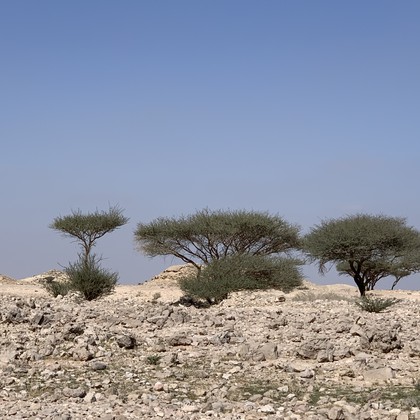
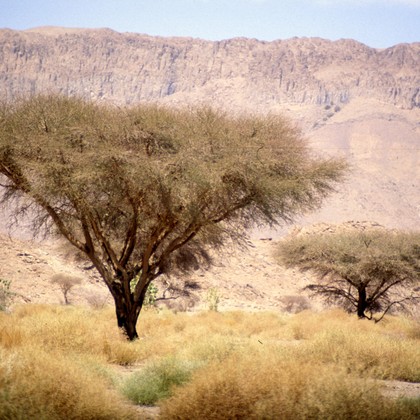
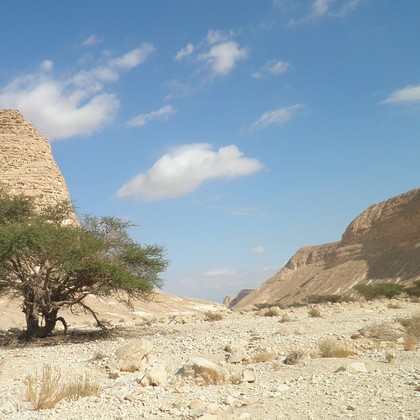
Dry acacia and thorn scrub, bushy wadis, field margins, date-palm groves and irrigated farmland in the desert, and the edges of villages and camps. It feeds on bare ground on small seeds, often in pairs or small groups, and drinks regularly. Along the Red Sea also in mangroves.
Where the bird is most at home, classified by the habitats of North Africa and the Middle East.
Range and movements
Arabian Peninsula: widespread in Yemen, western and southern Saudi Arabia, Oman and the United Arab Emirates, and scarce to rare in Qatar, Bahrain and Kuwait; the Arabian population was estimated at over 60,000 pairs around 2000. Israel: a scarce breeder in the Arava until the mid-1990s, now several hundred pairs in the Rift Valley from Eilat to Lake Hula, the Negev and along the coast. Jordan: in Wadi Araba and at Aqaba. Egypt: breeding since 2012 in the south-east, including the mangroves along the Red Sea. Iraq: since 2004, with about 50 pairs at the Dalmaj marshes in 2012; in Syria since 2003. Morocco: first breeding in 2016 near Dakhla in Western Sahara. Elsewhere in North Africa a rare vagrant. Beyond the region throughout sub-Saharan Africa and on Madagascar.
- Resident
- Summer visitor (c. Oct–Mar)
- Winter visitor (c. Apr–Sep)
- Passage (Mar–Apr, Oct–Nov)
- dark = core range, pale = thinly spread
How and when to look
At Eilat, in the Arava and at Aqaba you will find it in the field margins and scrub of kibbutzim and date plantations, especially early in the morning when pairs feed along the roadside. In Arabia it occurs in any vegetated wadi; watch for the rufous wings as it flies off low.
Conservation status
Not globally threatened and increasing in the region. Its spread is linked to the growth of irrigated farming and gardens in the desert. New footholds at the edge of the range are small and may disappear again.
Scientific name
Oena capensis | (Linnaeus, 1766)
Linnaeus described the species in 1766 as Columba capensis; because it was later moved to another genus, the author and year stand in brackets. The genus Oena was introduced in 1837 by Swainson. Oena is Greek, from oinas 'pigeon'. capensis denotes the Cape of Good Hope, where the type material came from. The specimen the first description was based on came from the Cape of Good Hope.