All species › Swifts › Swifts › African Palm Swift
African Palm Swift | Cypsiurus parvus
Afrikaanse palmgierzwaluw | Vencejo palmero africano
An extremely slender, drab swift that in the region occurs only on the hot coastal plain of south-west Arabia. It is wholly tied to fan palms: it glues its tiny nest with saliva into the hanging leaves of the Doum Palm, and the birds hunt around those palms in loose groups.
Voice
A high, thin, dry twittering trill, sirrrrr-sisisi, often in chorus from a party circling the nest palm. Thinner and softer than the rattle of Little Swift.
Recording: Tony Archer — CC BY-NC-SA 4.0 · converted to mono · xeno-canto
Identification
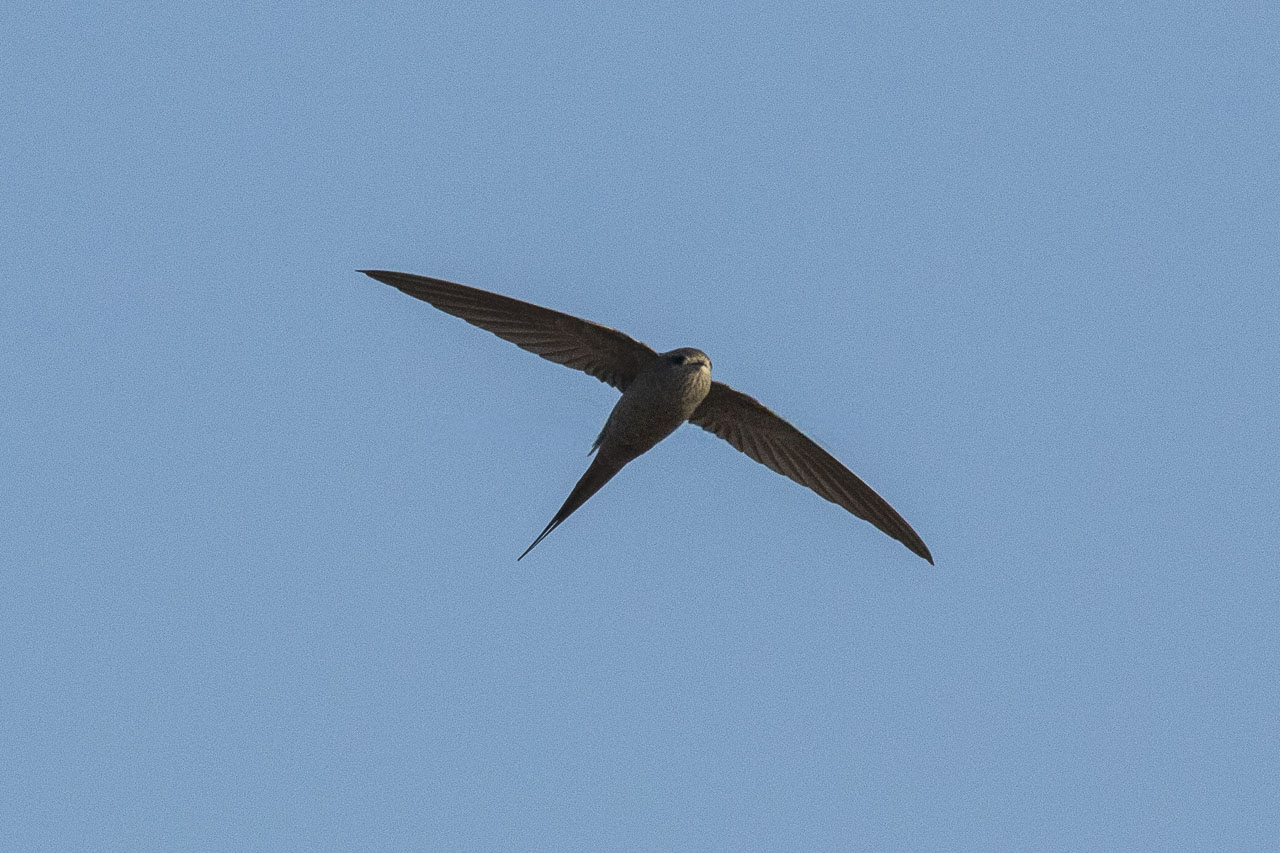
Small and extremely slim, with long, needle-thin wings and a long, deeply forked tail usually closed to a single thin point in flight; the silhouette is a thin cross. Plumage uniform grey-brown with no white rump or white throat patch; the throat is at most slightly paler grey. Flight is fast and fluttering, with sudden twists low around palm crowns and over fields.
Confusion species
Little Swift (Apus affinis) is stockier and darker, with a broad white rump and a square tail. Pallid Swift (Apus pallidus) and Common Swift (Apus apus) are larger and heavier, with broader wings and a short tail fork. Martins such as Pale Crag Martin (Ptyonoprogne obsoleta) have broader, blunter wings and a short square tail with white spots.
Habitat
Hot lowlands and low wadis with Doum Palms, date groves and planted fan palms in villages and towns. Hunts over irrigated fields, including centre-pivot fields, and over scrub and open water.
Where the bird is most at home, classified by the habitats of North Africa and the Middle East.


Range and movements
Saudi Arabia: a rather scarce resident of the Tihama and the low wadis at the foot of the Asir mountains, south from about al-Wasqah to the Jizan area. Yemen: in the Tihama along the whole Red Sea coast and in the lower wadis above it, locally fairly common. Virtually unknown elsewhere in the region; there are no confirmed records from Egypt or Oman. Beyond the region widespread in Africa south of the Sahara, from Senegal to Ethiopia and south to South Africa, and on Madagascar.
- Resident
- Summer visitor (c. Oct–Mar)
- Winter visitor (c. Apr–Sep)
- Passage (Mar–Apr, Oct–Nov)
- dark = core range, pale = thinly spread
How and when to look
In the Tihama, find a stand of Doum Palms or a row of fan palms in a village and wait there in the late afternoon, when birds fly in and out of the hanging leaves. Over the pivot fields near Jizan small parties often hunt low over the crop.
Conservation status
Not globally threatened and common in Africa. The small Arabian population depends on palms; the felling of Doum Palms is partly offset by ornamental palms planted in villages and along roads.
Scientific name
Cypsiurus parvus | (Lichtenstein, 1823)
Lichtenstein described the species in 1823 as Cypselus parvus; because it was later moved to another genus, the author and year stand in brackets. The genus Cypsiurus was introduced in 1843 by Lesson. Cypsiurus comes from Greek kupselos, 'swift', and oura, 'tail' — for the long, deeply forked tail. parvus is Latin for 'small' — a small, slender swift. The specimen the first description was based on came from Nubia (Sudan/Egypt).