All species › Swifts › Swifts › Alpine Swift
Alpine Swift | Tachymarptis melba
Alpengierzwaluw | Vencejo real
The largest swift of the region, a powerful flier with a white belly that races like a small falcon along cliffs and gorges. It breeds in the mountains of the Maghreb, the Levant and south-west Arabia, and crosses the whole region in flocks in spring and autumn.

Voice
A loud, fast, undulating trill that rises and falls, tititititi-ti-ti-ti-ti, often from a whole flock around the colony. More melodious than the scream of Common Swift.
Recording: Esperanza Poveda — CC BY-NC-SA 4.0 · converted to mono · xeno-canto
Identification
Large and heavily built, with long, broad sickle wings and a short, shallowly forked tail. Upperparts and underwing sandy-brown to grey-brown; belly and throat white, separated by a dark breast band, so that from below a white patch shows in the middle of the body. Wingbeats are slower and more powerful than in smaller swifts, with long glides and great speed along rock faces. Birds of Arabia and the Dead Sea (archeri) are smaller and paler than northern ones.
Confusion species
Hard to confuse given its size and white belly. Pallid Swift (Apus pallidus) and Common Swift (Apus apus) are much smaller, with no white belly and a pale throat. Falcons such as Eurasian Hobby (Falco subbuteo) have a different wing action, a longer tail and streaked underparts. Bank Swallow (Riparia riparia) also has a white belly with a breast band but is far smaller and flutters.
Habitat
Sheer cliffs, gorges and sea cliffs, from sea level high into the Atlas; in the Levant and North Africa also tall buildings, old city walls and bridges. Often hunts far from the colony, high over valleys, plateaux and coastal plains.
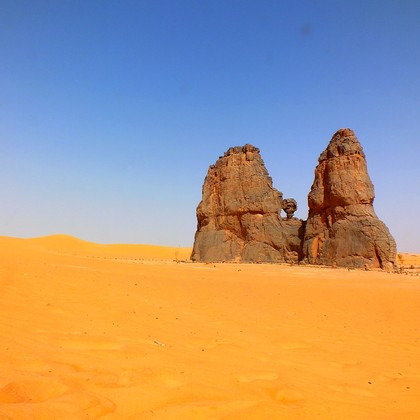
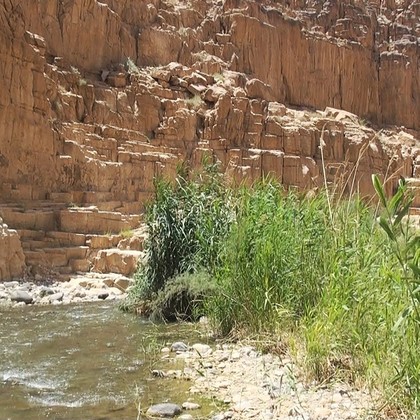
Where the bird is most at home, classified by the habitats of North Africa and the Middle East.

Range and movements
Morocco: scattered breeder in the Rif, Middle and High Atlas, Anti-Atlas and on the Atlantic sea cliffs. Algeria: in the Tell Atlas, the Aurès and the mountains of the Saharan Atlas. Tunisia: local in the north and the Dorsale. Libya: scarce, mainly in the Jebel Akhdar of Cyrenaica. Egypt: breeds in the mountains of Sinai, otherwise a passage migrant along the Nile and Red Sea. In the Levant it breeds in Israel, Samaria and Judea, Jordan, Lebanon and Syria, with a small resident population on the cliffs around the Dead Sea and the Jordan Valley. Iraq: breeds in the Kurdish mountains of the north. Saudi Arabia and Yemen: resident in the mountains of the Hejaz, Asir and the Yemen highlands. Oman: local in the Hajar and Dhofar; a scarce passage migrant in the Gulf states and Kuwait. Northern birds winter in Africa south of the Sahara. Beyond the region from southern Europe to Central Asia and India, and in East and southern Africa.
- Resident
- Summer visitor (c. Apr–Sep)
- Winter visitor (c. Oct–Mar)
- Passage (Mar–Apr, Oct–Nov)
- dark = core range, pale = thinly spread
How and when to look
On the cliffs of Ein Gedi and the canyons around the Dead Sea they can be seen all year; in the High Atlas the Todra and Dades gorges are good sites. On passage in March and April flocks sometimes pass low over Eilat and Sinai, especially with southerly winds and cloud.
Conservation status
Not globally threatened and stable. In urban colonies, renovation of old buildings can cost nest sites; elsewhere cliffs are little disturbed.
Scientific name
Tachymarptis melba | (Linnaeus, 1758)
Linnaeus described the species in 1758 as Hirundo Melba; because it was later moved to another genus, the author and year stand in brackets. The genus Tachymarptis was introduced in 1922 by Roberts. Tachymarptis is Greek, from takhus 'fast' and marptis 'seizer', after the bird that takes its prey from the air in swift flight. melba is of uncertain origin; possibly a short form of melanoalba, from Greek melas 'black' and Latin albus 'white', after the brown-and-white plumage. The specimen the first description was based on came from Gibraltar.