All species › Passerines › Monarch flycatchers › African Paradise Flycatcher
African Paradise Flycatcher | Terpsiphone viridis
Afrikaanse paradijsmonarch | Monarca colilargo africano
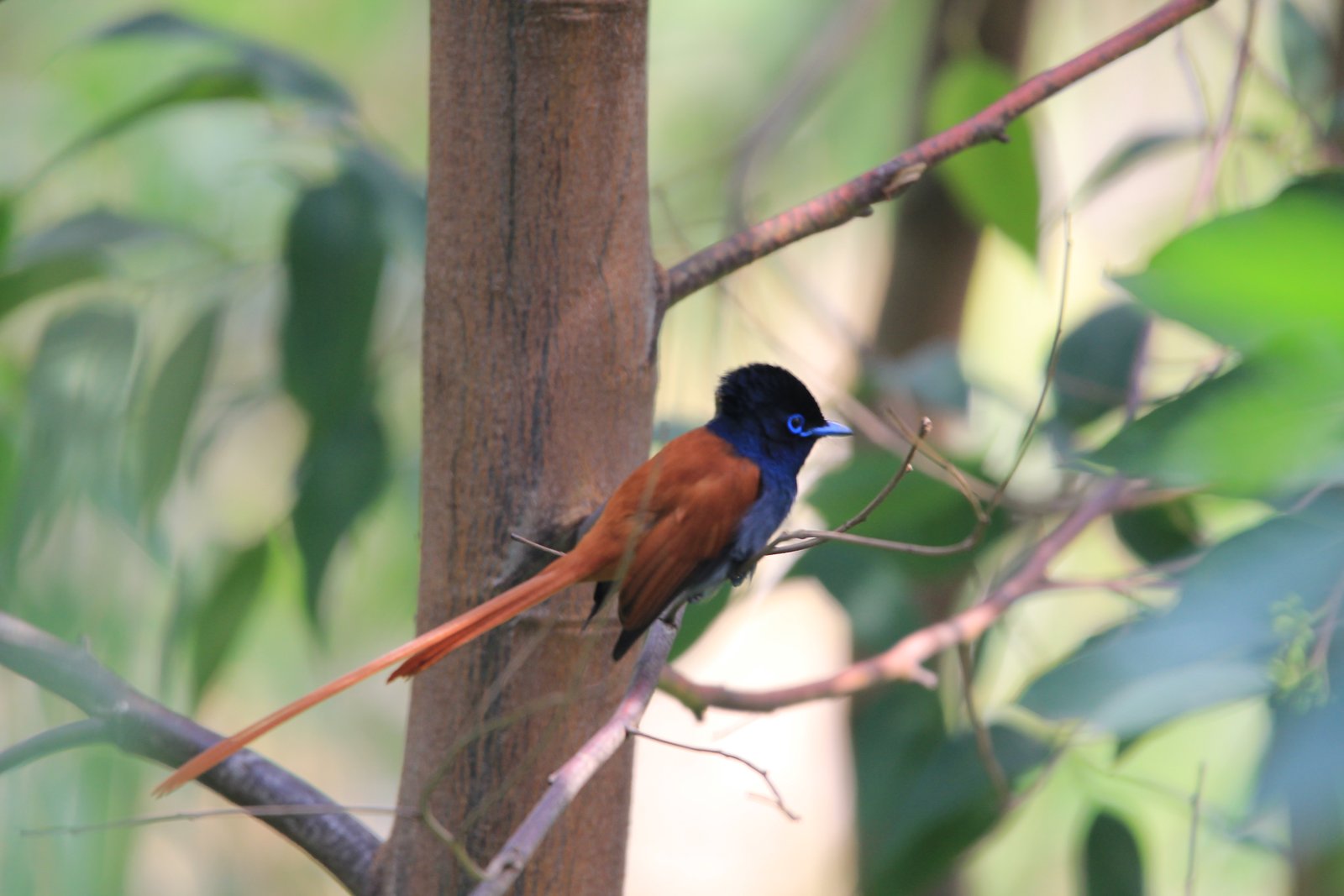
A small, restless flycatcher with a glossy black head, a rufous back and grey underparts, the male carrying long, ribbon-like central tail feathers. In the region it lives only in south-west Arabia, from the Asir mountains of Saudi Arabia through Yemen to Dhofar in Oman, in the Arabian subspecies harterti.
Voice
The call is a rasping, scolding zwee-zweet or shwee-shwee, often the first sign of its presence. The song is a rapid series of clear, whistled notes, twee-tiddly-ee-tee-tee.
Recording: Tim Cockcroft — CC BY-NC-SA 4.0 · converted to mono · xeno-canto
Identification
17–41 cm; the body measures 17–20 cm, the breeding male adding tail streamers sometimes more than 20 cm long. Head, crest and throat are glossy blue-black, with a narrow blue eye-ring and a blue bill. Mantle, wings and tail are warm rufous; breast and belly slate-grey, the undertail coverts paler. The female is duller, with a shorter crest and no streamers; young males have shorter streamers. White males, with white back and tail, hardly occur in Arabia. Constantly on the move, with drooped wings and fanned tail.
Confusion species
Hard to confuse in the region. Indian Paradise Flycatcher (Terpsiphone paradisi), a rare vagrant to Oman and the Emirates, has a white belly and undertail instead of grey underparts; white males in Arabia are more likely Indian than African. In poor views females may suggest Spotted Flycatcher (Muscicapa striata), but that is grey-brown and streaked, with no rufous and no black head.
Habitat
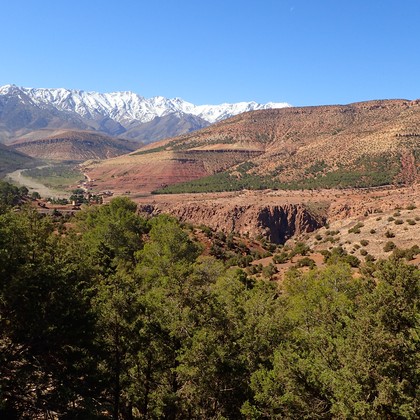
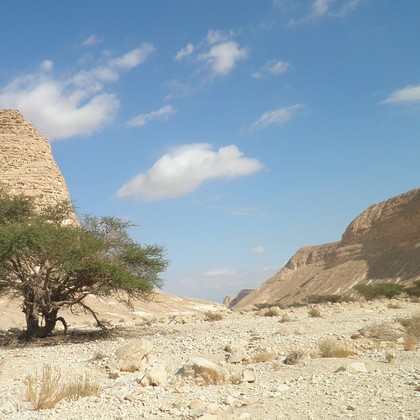
Juniper and other montane woodland in the Asir mountains and the Yemen highlands, wooded wadis with figs, tamarinds and acacias, and in Dhofar the monsoon woodland of the coastal mountains; also gardens, plantations and well-wooded villages. Seeks shade and water: in dry country tied to springs and streams with tall trees. Hunts flying insects in the mid-canopy. The nest is a small cup bound with spider web on a thin branch, often over water.
Where the bird is most at home, classified by the habitats of North Africa and the Middle East.

Range and movements
In Saudi Arabia in the Hejaz and Asir mountains and the wooded wadis at their foot, from around Taif south to the Yemen border. In Yemen widespread in the highlands and on the wooded slopes towards the Tihama and the south coast. In Oman only in Dhofar, in the wadis and monsoon woodland of the coastal mountains around Salalah. Not on Socotra. Outside the breeding season some move down to lower wadis and the coastal plain; elsewhere in Arabia it is very rare. Beyond the region it occurs throughout almost all of sub-Saharan Africa.
- Resident
- Summer visitor (c. Oct–Mar)
- Winter visitor (c. Apr–Sep)
- Passage (Mar–Apr, Oct–Nov)
- dark = core range, pale = thinly spread
How and when to look
In Dhofar, Ayn Razat, Ayn Hamran and Wadi Darbat near Salalah are classic sites: in the shade of the fig trees by the springs listen for the scolding call and look for a male with fluttering streamers. In Saudi Arabia the juniper woodland around Abha and the Raydah escarpment are good.
Conservation status
Not globally threatened and common in Africa. The Arabian population is confined to the mountains and wadis of the south-west, where it is locally common; juniper die-back, overgrazing, the drying-up of springs and felling of wadi trees may have local effects.
Scientific name
Terpsiphone viridis | (Müller, 1776)
Müller described the species in 1776 as Muscicapa viridis; because it was later moved to another genus, the author and year stand in brackets. The genus Terpsiphone was introduced in 1827 by Gloger. Terpsiphone comes from the Greek terpsis, 'delight', and phōnē, 'voice' — for the pleasant song of paradise flycatchers. viridis is Latin for 'green' — for the blue-green metallic gloss on head and breast. The specimen the first description was based on came from Senegal.