All species › Bustards › Bustards › Arabian Bustard
Arabian Bustard | Ardeotis arabs
Arabische trap | Avutarda árabe
A large, slender bustard of the Sahel that in the region lives only on the coastal plain along the Red Sea in south-western Arabia. It has become so rare there that every sighting counts. In Morocco, home to a subspecies of its own, it has not been seen with certainty since 1962.

Voice
Usually silent. The displaying male inflates its white neck and gives a deep, muffled oomp; disturbed birds sometimes give a hoarse, croaking call.
Recording: Andrew Spencer — CC BY-NC-SA 4.0 · converted to mono · xeno-canto
Identification
Large and long-legged, with a long, thin neck and a flat head. The crown has a black cap ending in a short crest at the rear, with a white supercilium edged black below it. The neck is finely vermiculated grey and looks plain pale grey at a distance. Upperparts warm sandy brown with fine dark vermiculation; the wing coverts carry black-and-white spots that together form a chequered band. Belly white. The male is clearly larger than the female. In flight: long, broad wings with little white in the primaries, the neck outstretched and slow, deep beats.
Confusion species
MacQueen's Bustard (Chlamydotis macqueenii), which may reach Yemen as a winter visitor, is much smaller, with a black stripe down the side of the neck and a large white patch on the primaries. Great Bustard (Otis tarda) does not occur in southern Arabia. In Africa it closely resembles Kori Bustard (Ardeotis kori), which is bulkier with coarser neck markings, but that species is absent from the region.
Habitat
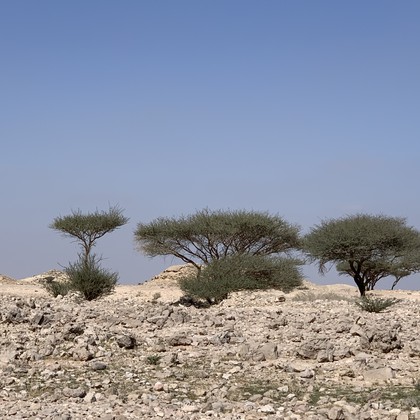
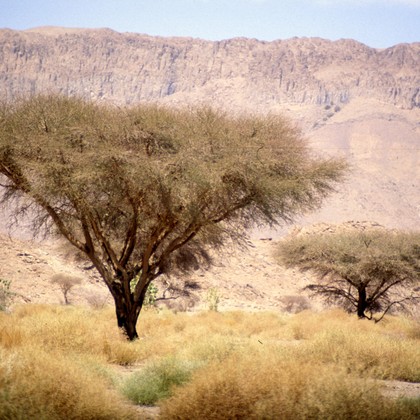
Open plains with scattered acacias and thorn scrub, dry grassland and the edges of sorghum and millet fields in the Tihama, up to the lower foothills of the mountains. Avoids dense vegetation and bare sand desert. Eats insects, especially locusts, small vertebrates, seeds and young shoots.
Where the bird is most at home, classified by the habitats of North Africa and the Middle East.

Range and movements
In the region only in the Tihama, the coastal plain along the Red Sea: in western Yemen, source of most recent records, and in south-western Saudi Arabia in Jizan province; the last reported Saudi record dates from 2017, from the Farasan Islands. Morocco held the subspecies lynesi, not recorded with certainty since 1962 and probably extinct. Outside the region widespread through the Sahel, from Senegal and Mauritania via Mali, Niger and Chad to Sudan, Eritrea, Ethiopia, Djibouti and Somalia.
- Resident
- Summer visitor (c. Oct–Mar)
- Winter visitor (c. Apr–Sep)
- Passage (Mar–Apr, Oct–Nov)
- dark = core range, pale = thinly spread
How and when to look
There is no longer a reliable site. In Yemen the southern Tihama offers the best chance, early in the morning on open plains with scattered acacias; in Saudi Arabia the species has all but vanished. Every record in Arabia is valuable: note place and date and take a photograph if possible.
Conservation status
Near Threatened. In 2026 BirdLife recommended uplisting the species to Vulnerable; the new global list is expected at the end of 2026. In Saudi Arabia it is nationally Critically Endangered, and the same is assumed for Yemen. Hunting, disturbance and the conversion of the Tihama to farmland and buildings have all but wiped out the Arabian population; in Saudi Arabia a captive-breeding programme has been proposed for reintroduction into protected areas along the Tihama.
Scientific name
Ardeotis arabs | (Linnaeus, 1758)
Linnaeus described the species in 1758 as Otis arabs; because it was later moved to another genus, the author and year stand in brackets. The genus Ardeotis was introduced in 1853 by Le Maout. Ardeotis combines the Latin ardea, 'heron', with the Greek otis, 'bustard' — a name that emphasises the heron-like height of the largest bustards. arabs is Latin for 'Arab' or 'Arabian', after Arabia. The specimen the first description was based on came from Mocha (Al-Makha), Yemen.