All species › Bustards › Bustards › MacQueen's Bustard
MacQueen's Bustard | Chlamydotis macqueenii
Oostelijke kraagtrap | Hubara asiática
The bustard of the Arabian deserts and the Levant, for centuries the favourite quarry of falconers on the Arabian Peninsula. Wild breeding birds have become scarce; what you see in winter are partly migrants from Central Asia and partly captive-bred, released birds.

Voice
Almost silent. A displaying male gives at most a low, muffled booming audible only at close range; on flushing sometimes a soft, hoarse kraa.
Recording: David Darrell-Lambert — CC BY-NC-SA 4.0 · converted to mono · xeno-canto
Identification
Medium-sized, long-legged bustard with a long neck and a short, broad body. Upperparts pale sandy with fine dark vermiculation and arrowheads, underparts white. Down the side of the grey neck hangs a band of loose, elongated black feathers that broadens downwards; on the crown a short crest of white, black-tipped feathers. In display the male throws the neck plumes over its head and runs about like a white ball. In flight a large white patch at the base of the black primaries, the neck outstretched and slow, supple beats.
Confusion species
African Houbara (Chlamydotis undulata), west of the Nile, is darker and warmer brown, with a mainly black crest and a shorter neck ruff; in the field range is the main separator. Arabian Bustard (Ardeotis arabs) and Great Bustard (Otis tarda) are much larger and lack the black neck stripe. A houbara in flight may recall a large raptor at a distance because of the white wing patch, but the outstretched neck and straight, low flight give it away.
Habitat
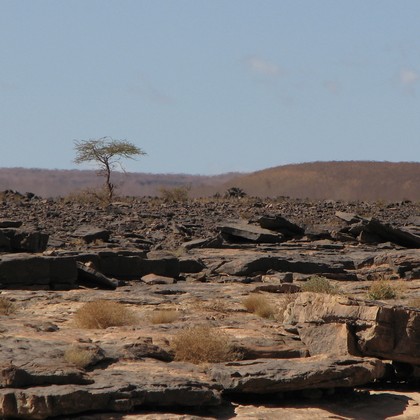
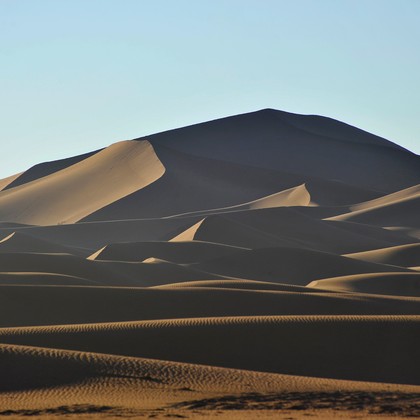
Flat to gently rolling stony and gravel desert and semi-desert with scattered low shrubs, herbaceous steppe and sandy plains with sparse vegetation; in winter also fallow fields on the desert edge. Avoids rocky mountains and dense scrub. Lives secretively and presses itself flat to the ground when threatened.
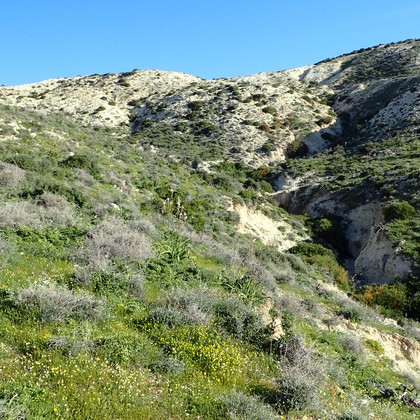
Where the bird is most at home, classified by the habitats of North Africa and the Middle East.
Range and movements
Breeds in small numbers in the Negev and northern Arava in Israel, Sinai, the eastern desert of Jordan, the Syrian Badia and the western desert of Iraq; in Saudi Arabia it has been reintroduced into protected areas such as Mahazat as-Sayd and Harrat al-Harrah. As a winter visitor spread across the Arabian Peninsula, from Iraq and Kuwait through the Saudi interior to the Gulf states, Oman and Yemen. In Saudi Arabia, the United Arab Emirates and elsewhere large numbers of captive-bred birds are released every year. Outside the region it breeds in Iran, Afghanistan, Pakistan and Central Asia, from Kazakhstan to western China and Mongolia; winters south to Pakistan and north-west India.
- Resident
- Summer visitor (c. Apr–Sep)
- Passage (Mar–Apr, Oct–Nov)
- dark = core range, pale = thinly spread
How and when to look
The most reliable site is the western Negev in Israel, around Nizzana, early in the morning from February to April, when the males display. Scan the plains from the road with a telescope: a standing houbara is almost invisible on the sandy plain, but a displaying male is a moving white dot.
Conservation status
Vulnerable. Over-hunting by falconers, illegal trapping for the falcon trade and the loss of desert steppe to overgrazing and agriculture have caused declines across much of its range. Large-scale captive-breeding and release programmes in Saudi Arabia, the Emirates and Central Asia keep numbers up, but make it hard to say how many wild birds remain.
Scientific name
Chlamydotis macqueenii | (Gray, 1832)
Gray described the species in 1832 as Otis Macqueenii; because it was later moved to another genus, the author and year stand in brackets. The genus Chlamydotis was introduced in 1839 by Lesson. Chlamydotis is Greek, from khlamus, a horseman's cloak with weights sewn into the corners, and otis 'bustard'. macqueenii honours General Thomas MacQueen (1792–1840), an officer in the British East India Company's Bengal Army who presented the first specimen to the British Museum. The specimen the first description was based on came from the Himalayas.