All species › Passerines › Waxbills › Arabian Waxbill
Arabian Waxbill | Estrilda rufibarba
Arabische astrild | Estrilda árabe
The Arabian Waxbill is a small, grey-brown, finely barred waxbill with a red eye mask, found only in the mountains of south-western Arabia. Flocks keep to the dense vegetation of wadis and terraced fields and give themselves away mainly by their fine squeaking.

Voice
A fine, high tsip or tseet, repeated constantly by birds in a flock; on take-off a quick, shrill tseet-tseet. The song is a short, nasal and somewhat scratchy ditty.
Recording: David Darrell-Lambert — CC BY-NC-SA 4.0 · converted to mono · xeno-canto
Identification
10–11 cm, slender, with a long, graduated dark tail. The whole plumage is grey-brown, densely and finely barred dark above and below; the head is greyer. A bright red stripe runs from the base of the bill through the eye, and the bill is black. Throat and cheeks are paler, off-white; the belly lacks the pink patch of related waxbills and the undertail coverts are dark. Sexes alike. Juveniles are less distinctly barred and have a less red mask.
Confusion species
Common Waxbill (Estrilda astrild), which appears in the region only as an escaped cage bird, has a red bill, warmer brown plumage and a rosy-red belly patch. African Silverbill (Euodice cantans) is just as finely barred but has a thick silvery-blue bill, no red on the face and a black rump. Other small seed-eaters of the highlands, such as Yemen Serin (Crithagra menachensis), lack the barring and red mask.
Habitat
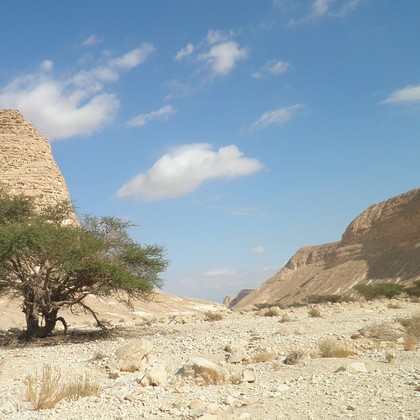
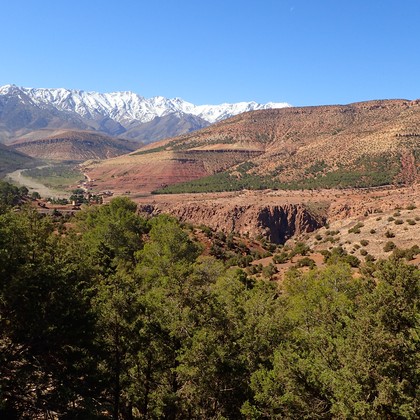
Dense rank grass, reeds, riverside bushes and vegetation along springs and running water in highland wadis, terraced fields with hedges, gardens and village edges, roughly between 1,000 and 2,800 m. Lives in small flocks that feed low in vegetation and on the ground on seeds, mainly of grasses; never far from water.
Where the bird is most at home, classified by the habitats of North Africa and the Middle East.

Range and movements
Endemic to south-western Arabia: in Saudi Arabia in the highlands of Asir and southern Hijaz (including around Abha and Al Baha), and in Yemen in the western highlands and their slopes, from Saada to Ta'izz and Ibb. Occurs nowhere else.
- Resident
- Summer visitor (c. Apr–Sep)
- Passage (Mar–Apr, Oct–Nov)
- dark = core range, pale = thinly spread
How and when to look
Search around Abha at springs and in vegetated wadis with water, or around the terraced fields of the Yemeni highlands. Listen for the fine squeaking from rank vegetation and reeds and wait for a flock to come to the edge; the red mask is then the best feature.
Conservation status
Not globally threatened and locally common within its small range. Because it depends on vegetated wadis with water, water extraction, overgrazing and the abandonment of terraced farming may reduce numbers locally. Little is known about the current situation in Yemen.
Scientific name
Estrilda rufibarba | (Cabanis, 1851)
Cabanis described the species in 1851 as H[abropyga] rufibarba; because it was later moved to another genus, the author and year stand in brackets. The genus Estrilda was introduced in 1827 by Swainson. Estrilda was formed from astrild, the epithet Linnaeus gave the common waxbill; the origin of that word is uncertain — perhaps a German or Dutch avicultural term for a waxbill, perhaps a misprint for Estrilda. rufibarba is Latin for 'red-bearded', from rufus 'red' and barba 'beard'. The specimen the first description was based on came from Arabia.