All species › Passerines › Waxbills › Red-Billed Firefinch
Red-Billed Firefinch | Lagonosticta senegala
Vuurvinkje | Amaranta senegalesa
The Red-billed Firefinch is a small, rosy-red waxbill with a red bill and a yellow eye-ring, found hopping around every village in Africa south of the Sahara. In the region it lives only in a handful of oases in the Algerian Sahara, where it was introduced in the 1940s and has since spread; elsewhere it is a great rarity.
Voice
A short, rising whistle, fweet, and a sharp chik-chik in flight. The song is a simple series of soft whistles, chew-weet-chew-weet, interspersed with a soft trill. Male Village Indigobirds mimic these calls and song.
Recording: Bernard BOUSQUET — CC BY-NC-SA 4.0 · converted to mono · xeno-canto
Identification
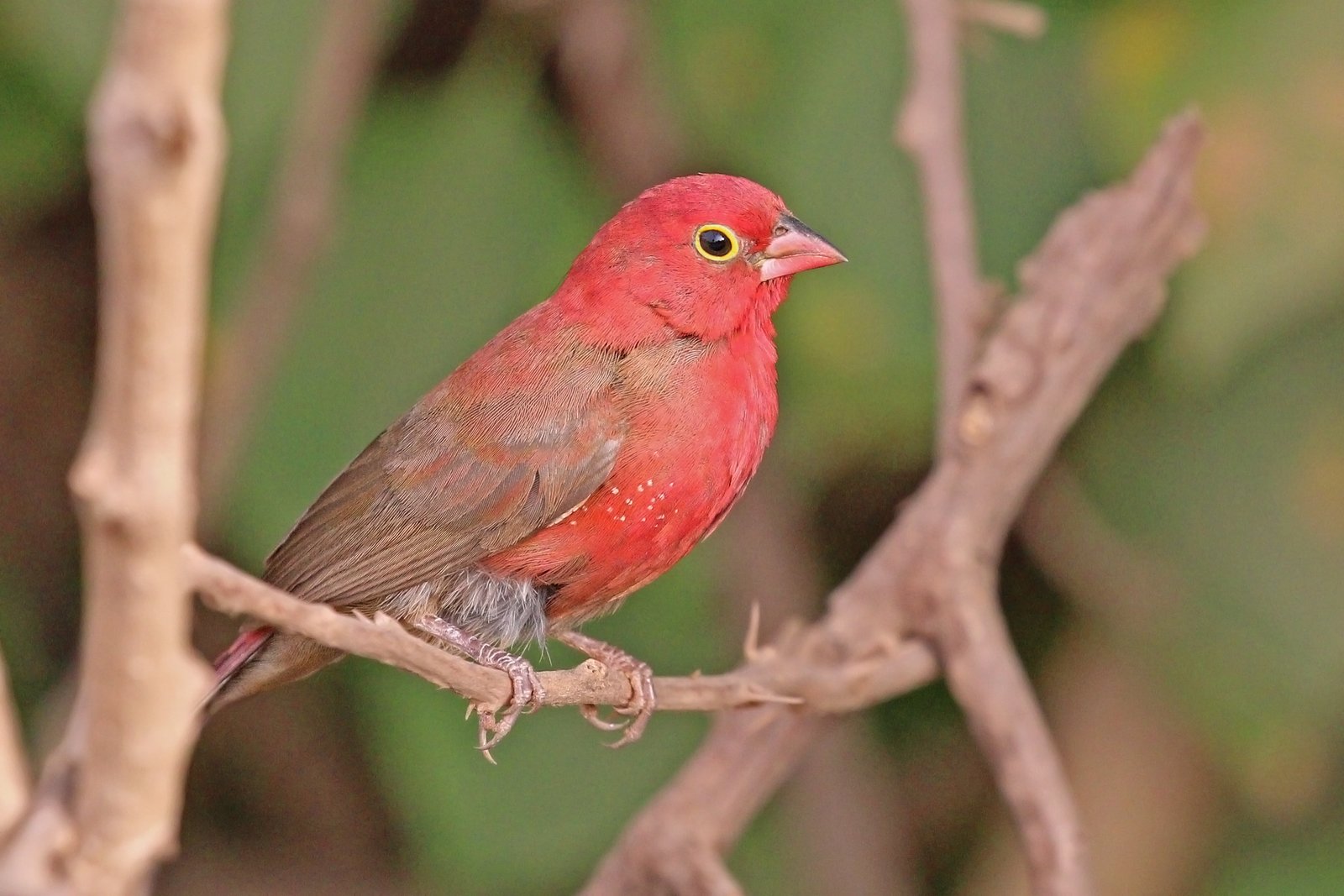
9–10 cm, with a red bill with a dark culmen and a narrow yellow eye-ring. The male is largely rosy red on head and underparts, with a few tiny white spots on the breast sides, brown back and wings, a red rump and a dark tail; lower belly and undertail coverts pale brownish, not black. The female is plain brown with a red loral spot, a red rump, white spots on the breast sides and a pink bill. Juveniles resemble the female but lack the red lore and have a dark bill.
Confusion species
In the Sahara no other small bird combines rosy red, a red bill and a yellow eye-ring. Red Avadavat (Amandava amandava), introduced in Egypt and Bahrain, has numerous white spots on the wing, a black lore and a black tail. Escaped firefinches of other species have a bluish-grey bill and usually a black lower belly. The female Village Indigobird (Vidua chalybeata), which lays its eggs in firefinch nests, is sparrow-like and streaked on head and back.
Habitat
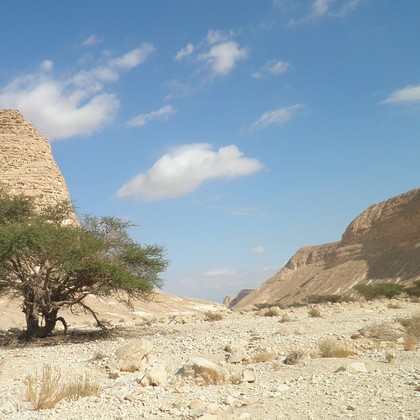
In the Sahara mainly oases, palm groves, small irrigated plots and gardens in and around villages and towns, usually close to water; also vegetated wadis. Moves in small groups over bare ground in search of small grass seeds, and likes to nest in thatched roofs and dense bushes near houses.
Where the bird is most at home, classified by the habitats of North Africa and the Middle East.


Range and movements
In the region established only in the Algerian Sahara: at Tamanrasset in the Hoggar (since the 1940s, reputedly introduced by a French garrison commander) and Outoul, at El Goléa (since about 1972), In Salah and Hassi Moumene, and at Djanet and the villages of the Tassili n'Ajjer, where the species may have arrived on its own. The population is expanding; whether through natural spread or further releases is unclear. A population formerly introduced in Egypt has died out. Beyond the region in almost all of Africa south of the Sahara, from Mauritania and Senegal to Ethiopia and south to South Africa; the nearest natural populations are in Niger and Mali.
- Resident
- Summer visitor (c. Oct–Mar)
- Winter visitor (c. Apr–Sep)
- Passage (Mar–Apr, Oct–Nov)
- dark = core range, pale = thinly spread
How and when to look
At Tamanrasset easy to see in hotel gardens and palm groves, where small groups shuffle over the ground under the trees and nest in thatched shelters. At Djanet and in the Tassili n'Ajjer look around the gardens and irrigation channels of the villages.
Conservation status
Not globally threatened and one of the commonest waxbills in Africa. In the region an introduced, now self-sustaining population that has expanded strongly in recent decades; it is the only place in the Western Palearctic where the species occurs.
Scientific name
Lagonosticta senegala | (Linnaeus, 1766)
Linnaeus described the species in 1766 as Fringilla Senegala; because it was later moved to another genus, the author and year stand in brackets. The genus Lagonosticta was introduced in 1851 by Cabanis. Lagonosticta comes from the Greek lagōn, 'flank', and stiktos, 'spotted' — for the white spots on the flanks of firefinches. senegala refers to Senegal, where the described specimen came from. The specimen the first description was based on came from Senegal.