All species › Passerines › Larks › Bar-Tailed Lark
Bar-Tailed Lark | Ammomanes cinctura
Rosse woestijnleeuwerik | Terrera colinegra
The Bar-tailed Lark is a small, round, plain rufous-sandy lark of flat desert, so well camouflaged that it only catches the eye when it scurries off. Its best feature is at the end of the tail: a sharply cut black terminal band.

Voice
The song consists of short, thin, rather sad whistles, see-oo-lee, endlessly repeated in an undulating song flight high above the plain, recalling a creaking door in the distance. The call is a soft, short chew or dzheet.
Recording: Stanislas Wroza — CC BY-NC-SA 4.0 · converted to mono · xeno-canto
Identification
13–14 cm, small and compact, with a round head, a short conical yellowish to pinkish-horn bill and fairly short legs. The plumage is entirely unstreaked: pale rufous-sandy above, paler still below, the breast with at most a faint warm wash. In flight the tail is rufous with a narrow, sharply defined black terminal band, also visible on the ground as a dark T-pattern; the primaries are rufous with dark tips. Sexes alike. Arabian birds are often duller and greyer than the rufous Saharan birds.
Confusion species
Desert Lark (Ammomanes deserti) is larger, with a longer, heavier bill, a gradually darker tail without a sharp band and a greyer tone, and prefers slopes and rocks. Short-toed larks such as Mediterranean Short-toed Lark (Alaudala rufescens) are streaked on the back or breast. Female Black-crowned Sparrow-Lark (Eremopterix nigriceps) is smaller, with a thicker bill and dark underwings.
Habitat
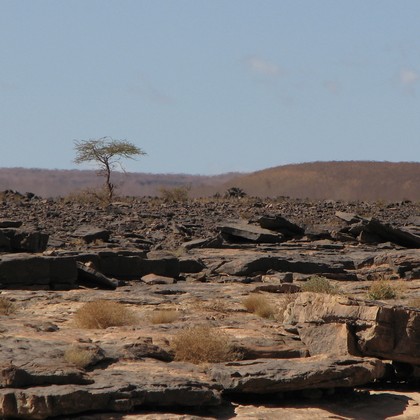
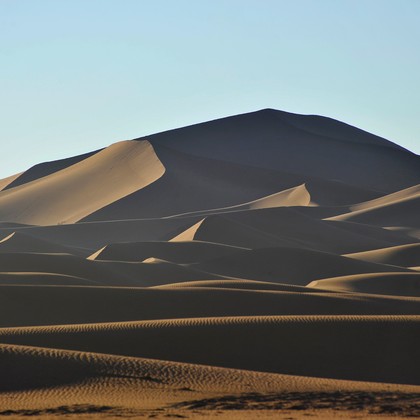
Flat, open gravel and sand desert with scattered low tussocks, sandy plains between dunes, bare steppe after drought and the edges of dry wadis. It avoids rocky slopes and high dunes. In winter, after rain, it joins flocks of other larks where fresh seeds are available.
Where the bird is most at home, classified by the habitats of North Africa and the Middle East.
Range and movements
From Western Sahara and Morocco south of the Atlas through the Algerian, Tunisian and Libyan Sahara to Egypt's Western Desert and Sinai, the Negev and Arava, Jordan, Saudi Arabia, Kuwait, western Iraq and the Syrian desert; scarcer in Qatar, the Emirates and northern Oman. Largely absent from southern Yemen. Beyond the region it occurs on the Cape Verde Islands and in the Sahel, and east to Iran, Afghanistan and Pakistan.
- Resident
- Winter visitor (c. Apr–Sep)
- Passage (Mar–Apr, Oct–Nov)
- dark = core range, pale = thinly spread
How and when to look
Scan open gravel plains from the car with the engine off: a small, rufous bird walking in short spurts and pressing into the shade of a bush. Make it fly and check the tail; the black terminal band is the quickest feature. Easy to see around Merzouga, in the Arava and in the deserts of northern Saudi Arabia and Kuwait.
Conservation status
Not threatened. The range is large and the species follows the rainfall. Habitat is lost locally to grazing and farming at the desert edge, but most of its world is unsuitable for other uses.
Scientific name
Ammomanes cinctura | (Gould, 1839)
Gould described the species in 1839 as Melanocorypha cinctura; because it was later moved to another genus, the author and year stand in brackets. The genus Ammomanes was introduced in 1851 by Cabanis. Ammomanes is Greek, from ammos 'sand' and -manēs 'passionately fond of', from mania: the sand-lover. cinctura is Latin for 'girdle, band', from cingere 'to gird', after the dark band at the tip of the tail. The specimen the first description was based on came from Santiago, Cape Verde.