All species › Passerines › Larks › Desert Lark
Desert Lark | Ammomanes deserti
Woestijnleeuwerik | Terrera sahariana
The Desert Lark is the lark of rocky desert: a plain, rather chunky bird exactly the colour of the ground beneath it. On pale limestone it is pale sandy, on black lava fields almost sooty grey. From the Atlas to Oman it is often the commonest bird of hills, wadis and mountain slopes.

Voice
The song is a melodious, rather wistful series of low whistles and trills, choo-choo-chirrr, from a rock or in an undulating song flight, often well before dawn. The call is a soft, drawn-out chirr or a double chee-wee.
Recording: David Darrell-Lambert — CC BY-NC-SA 4.0 · converted to mono · xeno-canto
Identification
15–17 cm, sturdy, with a fairly large head and a substantial, slightly curved conical bill with a yellow or pink base. The plumage is unstreaked or at most faintly streaked on the breast; colour varies between populations from pale sand and rufous to grey and dark slate, always matching the rock the bird lives on. The tail is brown, gradually darker towards the tip, without a sharp band; the primaries are rufous. Sexes alike. Juveniles show pale fringes to the upperpart feathers.
Confusion species
Bar-tailed Lark (Ammomanes cinctura) is smaller, with a shorter bill and a sharply defined black tail band, and lives on flat gravel and sand plains. Female Thick-billed Lark (Ramphocoris clotbey) has a much thicker bill and a white trailing edge to the wing. Crested Lark (Galerida cristata) and Thekla's Lark (Galerida theklae) have a crest and a streaked breast.
Habitat
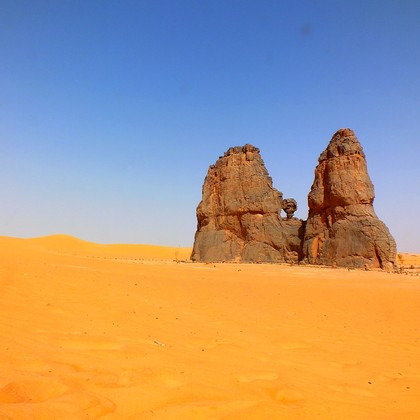
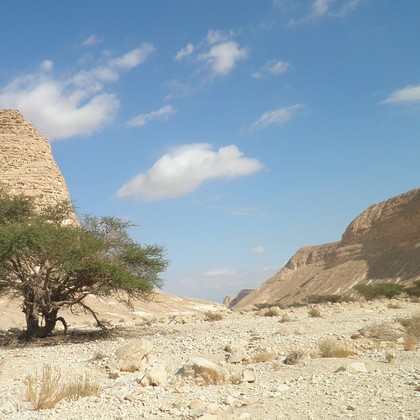
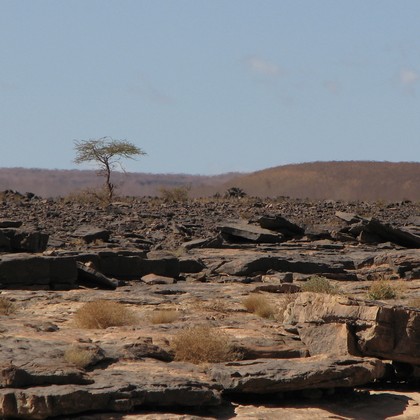
Bare hills and mountain slopes with stones and boulders, wadis and dry river valleys, gorges, scree fans at the foot of mountains and stony hamada, from sea level to over 2000 m. Also around abandoned buildings, ruins and villages at the desert edge. It rarely visits flat sand plains or dunes.
Where the bird is most at home, classified by the habitats of North Africa and the Middle East.
Range and movements
One of the most widespread desert birds of the region: Morocco south of the High Atlas and Western Sahara, the Algerian and Tunisian Sahara including the Hoggar and Tassili, Libya, Egypt including the Eastern Desert and Sinai, the Negev, Arava and Dead Sea, Jordan, the Syrian desert, western and southern Iraq, the whole Arabian Peninsula from Saudi Arabia to the mountains of Yemen, Oman (Hajar and Dhofar) and the Emirates. Absent from Socotra. Beyond the region it occurs in the Sahel, Sudan and the Horn of Africa, and east to Iran, Afghanistan and Pakistan.
- Resident
- Summer visitor (c. Oct–Mar)
- Winter visitor (c. Apr–Sep)
- Passage (Mar–Apr, Oct–Nov)
- dark = core range, pale = thinly spread
How and when to look
Almost any stony wadi in the region will do: in Morocco the Todra and Dadès gorges, in Israel and Jordan the slopes around the Dead Sea, Eilat and Petra, in the Emirates Jebel Hafeet, in Oman the wadis of the Hajar. It is often tame and walks around picnic sites. Note the colour differences between birds from different substrates.
Conservation status
Not threatened. Widespread and usually common; its rocky habitat is little used by people. Habitat is lost locally to quarrying and road building.
Scientific name
Ammomanes deserti | (Lichtenstein, 1823)
Lichtenstein described the species in 1823 as Alauda deserti; because it was later moved to another genus, the author and year stand in brackets. The genus Ammomanes was introduced in 1851 by Cabanis. Ammomanes is Greek, from ammos 'sand' and -manēs 'passionately fond of', from mania: the sand-lover. deserti is the genitive of Latin desertum 'desert, waste', from deserere 'to abandon'. The specimen the first description was based on came from Upper Egypt.