All species › Passerines › Larks › Black-Crowned Sparrow-Lark
Black-Crowned Sparrow-Lark | Eremopterix nigriceps
Zwartkruinvinkleeuwerik | Terrera negrita
The Black-crowned Sparrow-Lark is a tiny, sparrow-like lark of the hot desert plains of Arabia and the southern Sahara. The male is unmistakable with his black-and-white head and black belly; the female is an inconspicuous sandy bird. Small flocks appear suddenly where rain has fallen and are gone again when it dries.

Voice
The song is a short, simple phrase of a few clear whistles, chee-choo-wee, repeated over and over in a fluttering, undulating song flight on slow wingbeats, after which the bird drops steeply. Also from a stone. The call is a short, dry prrt or chip.
Recording: David Darrell-Lambert — CC BY-NC-SA 4.0 · converted to mono · xeno-canto
Identification
11.5–12.5 cm, compact, with a short tail and a thick, pale, finch-like bill. The male has a black crown, throat and eye-stripe, a white forehead and a large white cheek patch, and black underparts from throat to belly contrasting sharply with white flanks and pale sandy-grey upperparts. The female is plain sandy with faint pale streaks on head and breast; non-breeding males and juveniles resemble her. In flight both sexes show blackish underwings and a dark tail with pale outer feathers.
Confusion species
For the male no other species in the region is possible. Females recall a small Bar-tailed Lark (Ammomanes cinctura), which has a thinner bill, a sharp black tail band and pale underwings. Desert Sparrow (Passer simplex) and female House Sparrow (Passer domesticus) have longer tails, perch in trees and bushes and show different wing patterns. Mediterranean Short-toed Lark (Alaudala rufescens) is larger, streaked and thinner-billed.
Habitat
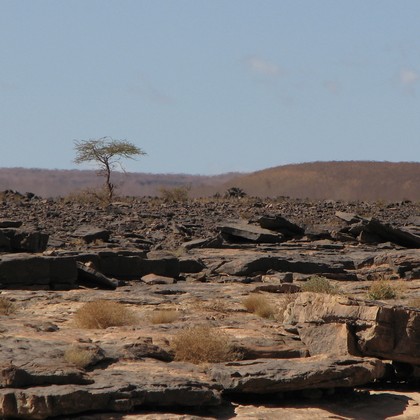
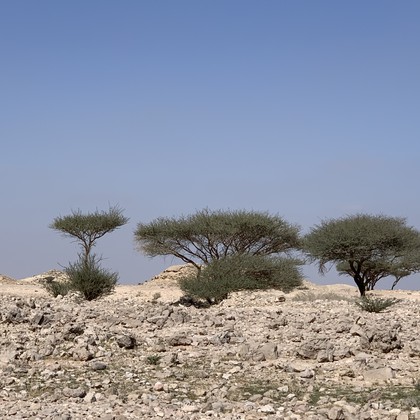
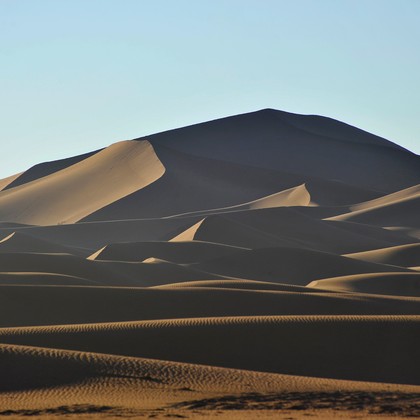
Flat, hot gravel and sand plains with scattered grasses and low shrubs, dry coastal plains, the edges of acacia scrub and sandy wadis. It also appears on fallow land, mown fields and around irrigation circles. It depends strongly on rain: a good downpour brings an abundance of seeds and insects, and then it breeds in large numbers.
Where the bird is most at home, classified by the habitats of North Africa and the Middle East.
Range and movements
Widespread in Arabia: Saudi Arabia (especially the east, the central interior and the Tihama), Yemen including the Tihama and Hadhramaut, Oman, the Emirates, Qatar and Kuwait; scarce in Bahrain. In the Levant an irregular breeder and wanderer in the Arava and the southern Negev; very rare in Jordan. In Africa it occurs in Western Sahara and the far south of Morocco (mainly after rain around Aousserd and Dakhla), in the southern Algerian Sahara and rarely in south-eastern Egypt. Beyond the region it ranges from the Cape Verde Islands through the whole Sahel from Mauritania to Sudan and the Horn of Africa, and east to Iran, Pakistan and north-west India.
- Resident
- Summer visitor (c. Apr–Sep)
- Winter visitor (c. Oct–Mar)
- Passage (Mar–Apr, Oct–Nov)
- dark = core range, pale = thinly spread
How and when to look
In Arabia search flat, lightly vegetated gravel plains and irrigation projects, as in inland Emirates and Oman, especially after winter or spring rain. In Western Sahara it is a sought-after target of birding trips along the Dakhla–Aousserd road; there its occurrence varies greatly from year to year.
Conservation status
Not threatened. Large range and locally numerous, although numbers fluctuate with rainfall. The spread of irrigated farming even provides new food sources locally.
Scientific name
Eremopterix nigriceps | (Gould, 1839)
Gould described the species in 1839 as Pyrrhalauda nigriceps; because it was later moved to another genus, the author and year stand in brackets. The genus Eremopterix was introduced in 1836 by Kaup. Eremopterix comes from the Greek erēmos, 'desert', and pterux, 'wing' — birds of dry, open country. nigriceps is Latin for 'black-headed', from niger 'black' and -ceps 'headed'. The specimen the first description was based on came from Santiago, Cape Verde.