All species › Passerines › Larks › Singing Bush Lark
Singing Bush Lark | Mirafra javanica
Zangstruikleeuwerik | Alondra cantante
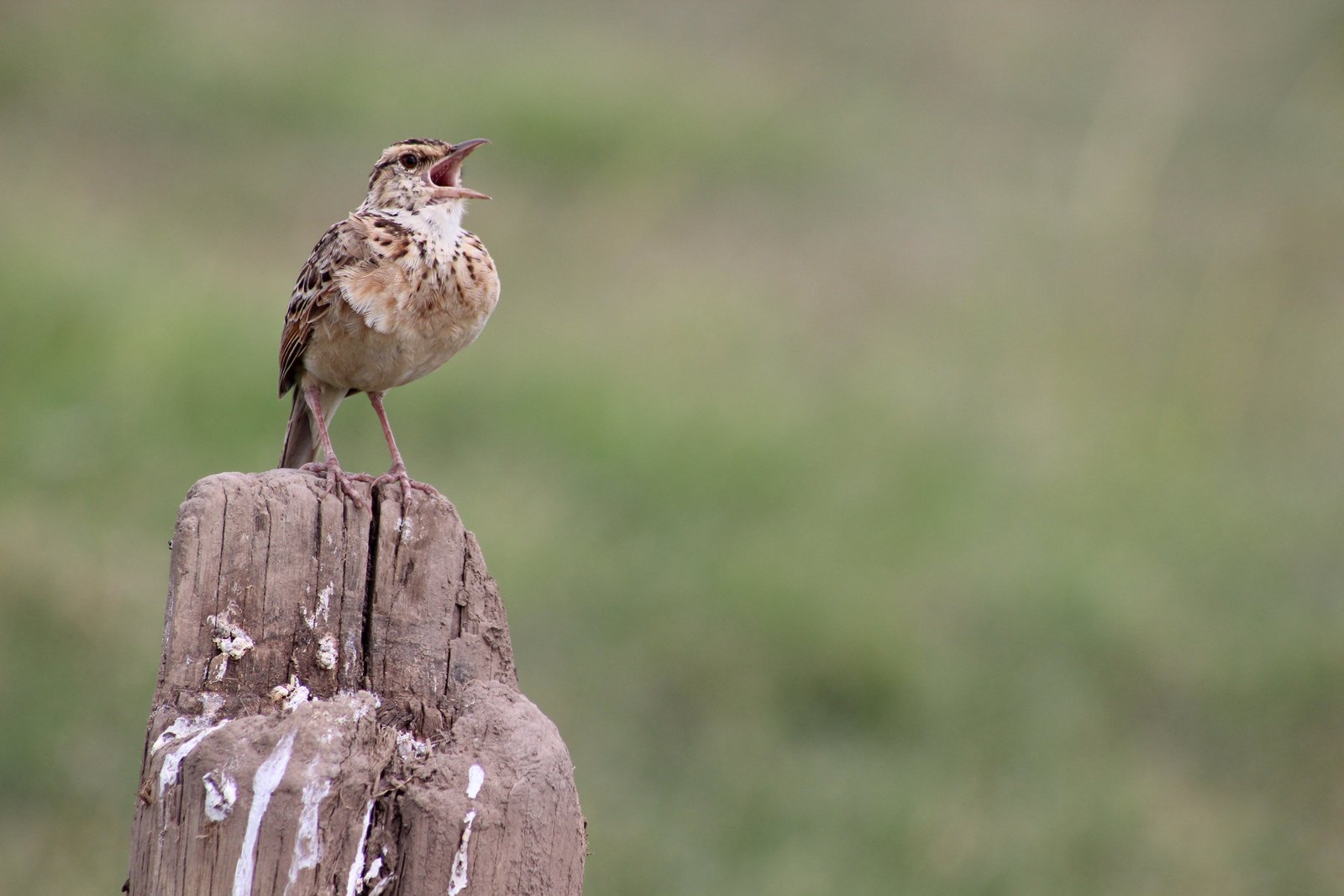
In the region the Singing Bush Lark is an Afro-Asian outpost: a compact, short-tailed lark with rufous wings found only in the grassy plains of south-western and southern Arabia. Arabian birds belong to the form cantillans, formerly treated as a separate species.
Voice
The song is a lively, dry series of short phrases, rich in imitations of other birds, delivered from a bush or post and in a fluttering song flight low over the grass, sometimes at night. The call is a short, dry chirp.
Recording: Stanislas Wroza — CC BY-NC-SA 4.0 · converted to mono · xeno-canto
Identification
13–14 cm, compact, with a short tail, a fairly short, thick conical bill and a pale supercilium. Brown above with dark feather centres, pale sandy below with a warm breast and fine dark spots forming a half-collar. The best feature is the rufous patch in the closed wing, which shows in flight as a warm panel in the primaries. The tail is dark with white outer feathers. Sexes alike.
Confusion species
Greater Short-toed Lark (Calandrella brachydactyla), present here on passage and in winter, is paler, lacks the rufous wing and often shows dark neck patches. Eurasian Skylark (Alauda arvensis) and Oriental Skylark (Alauda gulgula) are longer and more streaked, with a small crest and a white (in the latter sandy) trailing edge to the wing. Crested Lark (Galerida cristata) has an obvious crest and a longer bill.
Habitat
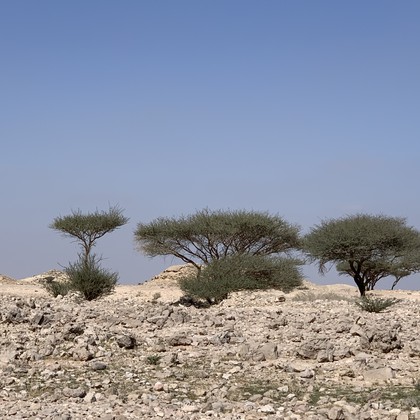
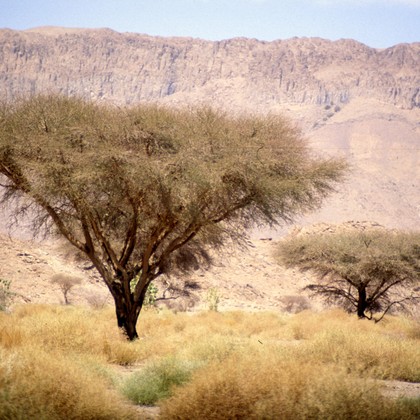
Grassy plains with scattered bushes and acacias, dry savanna on the coastal plains, field margins and dry irrigation fields, and in Dhofar the grassy plain around Salalah that turns green with the monsoon. It avoids bare desert.
Where the bird is most at home, classified by the habitats of North Africa and the Middle East.

Range and movements
In the region only in south-western and southern Arabia: the Tihama and lower slopes of Asir in south-western Saudi Arabia, the Tihama and southern lowlands of Yemen, and in Oman the Salalah plain and the low-lying grasslands of Dhofar. In Yemen it is certainly more widespread than the scarce records suggest. Beyond the region it occurs in a broad belt through the African savanna from Senegal to Ethiopia and Kenya, and in Asia from Pakistan and India to South-East Asia, Indonesia and Australia.
- Resident
- dark = core range, pale = thinly spread
How and when to look
In Dhofar birds sing from August into autumn over the green grassy plains east of Salalah; winter visitors will find them among short-toed larks on dry fields and the margins of irrigation fields. In flight look for the rufous wing panel.
Conservation status
Not globally threatened. Local in Arabia; loss of grassland to building and overgrazing around Salalah and in the Tihama may affect the small populations.
Scientific name
Mirafra javanica | Horsfield, 1821
Horsfield described the species in 1821 and placed it straight away in the genus where it still stands. He introduced the genus Mirafra in that same work. The origin of Mirafra is unknown; Horsfield gave no explanation, and according to Jobling it is probably a word from a native language, though not a known Javanese name. javanica refers to Java, Indonesia. The specimen the first description was based on came from Java, Indonesia.