All species › Passerines › Larks › Wood Lark
Wood Lark | Lullula arborea
Boomleeuwerik | Totovía
In this region the Wood Lark is a bird of the Mediterranean northern fringe: from the cedar and oak forests of the Atlas to the olive groves of Galilee. It is smaller and shorter-tailed than Eurasian Skylark and is mostly given away by its song, a descending series of soft, fluting notes.

Voice
The song is a series of flowing, descending phrases of soft, clear notes, loo-loo-loo-loo-loo and dlee-dlee-dlee, delivered in a circling song flight high above the woods, from a treetop or at night. The call is a soft, melodious dloo-eet.
Recording: Lionel FREDERIC — CC BY-NC-SA 4.0 · converted to mono · xeno-canto
Identification
13.5–15 cm, compact, with a strikingly short tail and a fine bill. Warm brown above with dark streaks, white below with a finely streaked, yellowish breast. The head shows long white supercilia almost meeting on the nape and a rufous cheek with a dark border. The best feature is the black-and-white mark at the bend of the wing, on the primary coverts. The tail is dark with white tips. A short, round crest can be raised. Sexes alike. Birds from North Africa and the Middle East (pallida) are somewhat paler and greyer than European ones.
Confusion species
Eurasian Skylark (Alauda arvensis) is larger, longer-tailed, lacks the black-and-white wing mark and has white tail sides and a white trailing edge to the wing. Crested Lark (Galerida cristata) and Thekla's Lark (Galerida theklae) have a spiky crest and rufous underwings. Pipits such as Tree Pipit (Anthus trivialis) are slimmer with a longer tail and thinner bill.
Habitat
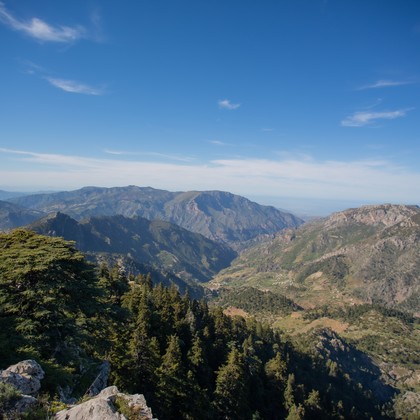
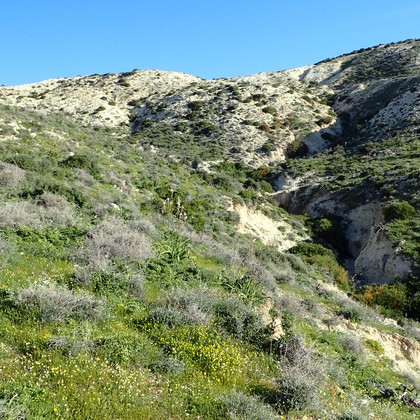
Open woodland of oak, cedar, pine or juniper with bare or short-grass patches, forest edges, maquis and garrigue with scattered trees, olive groves and orchards, and hill pastures with bushes. In winter also stubble and fallow fields in the lowlands.
Where the bird is most at home, classified by the habitats of North Africa and the Middle East.

Range and movements
In the Maghreb it breeds in northern and central Morocco including the Rif, Middle and High Atlas, in northern Algeria and northern Tunisia; in Libya only in the green Jebel Akhdar. In the Levant it breeds in northern Israel and the West Bank, Lebanon, western Syria and north-western Jordan, and in the mountains of northern Iraq. In winter birds appear lower and further south, reaching central Iraq, Kuwait and northern Saudi Arabia; very scarce in Egypt. Beyond the region it occurs in almost all of Europe, Turkey, the Caucasus and Iran.
- Resident
- Summer visitor (c. Apr–Sep)
- Winter visitor (c. Oct–Mar)
- Passage (Mar–Apr, Oct–Nov)
- dark = core range, pale = thinly spread
How and when to look
In the Middle Atlas Wood Larks sing in spring over the cedar forests near Ifrane and Azrou; in Israel they can be heard in the olive groves and oak woods of Galilee and Mount Carmel. Listen especially at dusk, when the song flight is high and long-lasting.
Conservation status
Not threatened. In North Africa and the Levant suitable habitat is lost to agricultural intensification, scrub encroachment of open patches and forest fires, but the species remains widespread.
Scientific name
Lullula arborea | (Linnaeus, 1758)
Linnaeus described the species in 1758 as Alauda arborea; because it was later moved to another genus, the author and year stand in brackets. The genus Lullula was introduced in 1829 by Kaup. Lullula is onomatopoeic, echoing the song, after the French lulu, Buffon's name for the bird. arborea comes from Latin arbor 'tree', after the trees from which the bird rises to sing. The specimen the first description was based on came from Sweden.