All species › Passerines › Larks › Eurasian Skylark
Eurasian Skylark | Alauda arvensis
Veldleeuwerik | Alondra común
In this region the Eurasian Skylark is above all a winter bird: from October to March large flocks fill the fields, steppes and coastal plains from the Maghreb to the Gulf. As a breeder it is confined to the cooler high plateaux and mountains of north-west Africa and the Levant, where its endless song high in the sky announces the spring.
Voice
The song is an unbroken stream of trills, rolling and whistled notes and mimicry lasting minutes, delivered in a rising song flight in which the bird hangs high in the sky. The call, often heard from passing winter flocks, is a rolling prrreet or chirr-up.
Recording: Philippe Grange — CC0 · converted to mono · xeno-canto
Identification
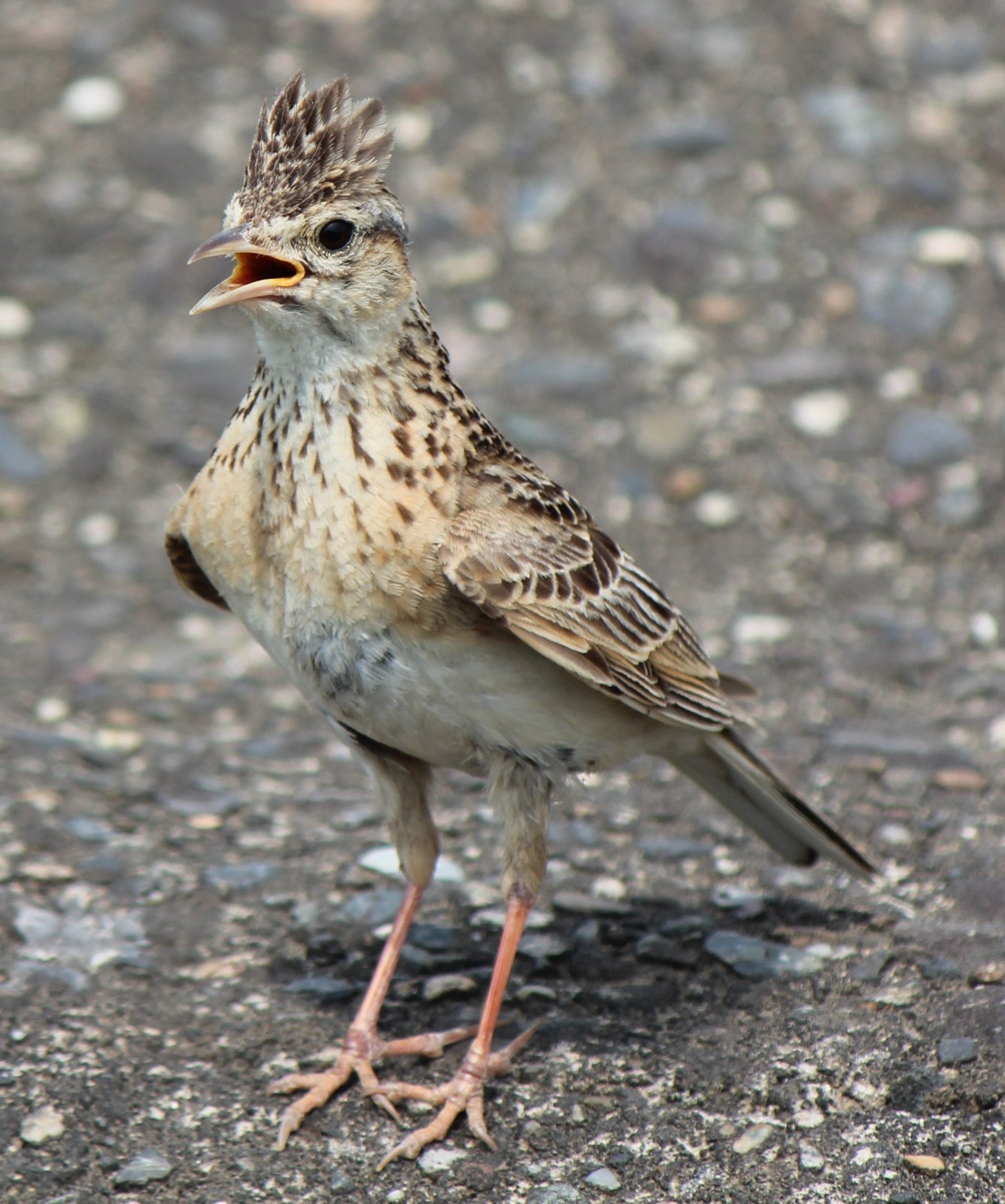
18–19 cm, a sturdy, brown-streaked lark with a fairly long tail and a short, blunt crest that is often raised. Upperparts grey-brown to warm brown with black streaks; buff breast with fine, sharply defined streaks contrasting with the white belly. Brown cheek with a pale surround and an indistinct pale supercilium. In flight the white trailing edge to the secondaries and the white outer tail feathers are the best features. Sexes alike. Breeders in North Africa and the Levant average slightly paler and greyer than winter visitors from Europe.
Confusion species
Oriental Skylark (Alauda gulgula) is smaller and shorter-tailed, with a rufous wing panel, a sandy rather than white trailing edge to the wing and a buzzing call. Wood Lark (Lullula arborea) has a much shorter tail, a black-and-white mark at the bend of the wing and long white supercilia. Crested Lark (Galerida cristata) has a pointed crest, rufous underwings and no white trailing edge. Greater Short-toed Lark (Calandrella brachydactyla) is smaller and paler, with an unstreaked breast and a dark patch on the neck side.
Habitat
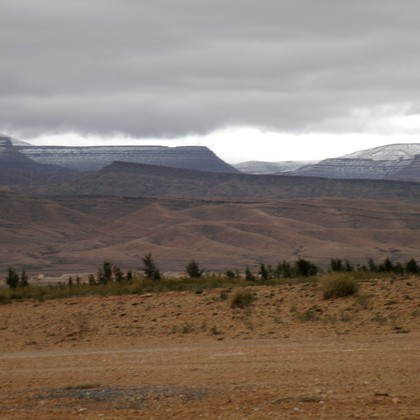
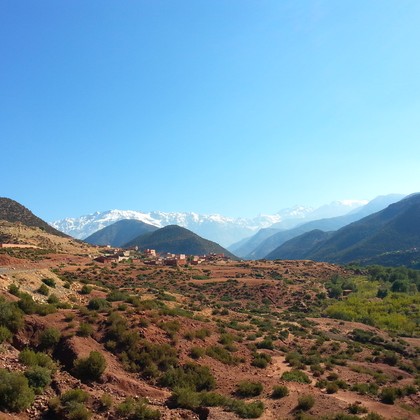
Breeds in short grassland, alfa steppe, mountain pastures and fields on high plateaux and in the mountains; in Morocco mainly above 1000 m. In winter on cereal fields, stubble, fallow land and pastures, in steppe and semi-desert, on coastal plains and in the Gulf states on irrigated fields and grassy areas.
Where the bird is most at home, classified by the habitats of North Africa and the Middle East.

Range and movements
Breeds in Morocco (Middle and High Atlas and the eastern high plateaux), on the high plateaux of northern Algeria and locally in northern Tunisia; in the Levant in the mountains of Lebanon, the Anti-Lebanon and Mount Hermon and in western Syria, and in the mountains of northern Iraq. As a winter visitor numerous throughout the Maghreb, northern Libya, northern Egypt including the Nile Delta and Sinai, Israel, Jordan, Syria and Iraq; less numerous southwards to Kuwait, Saudi Arabia, Bahrain, Qatar, the Emirates and northern Oman. Rare in Yemen. Beyond the region it breeds from Europe and Turkey to East Asia.
- Resident
- Summer visitor (c. Apr–Sep)
- Winter visitor (c. Oct–Mar)
- Passage (Mar–Apr, Oct–Nov)
- dark = core range, pale = thinly spread
How and when to look
In winter it can be found in any open farmland; check the flocks for Oriental Skylark too, especially in the Hula Valley and the Emirates. To hear the song, visit the high plateaux of the Middle Atlas around Ifrane and Timahdite in May and June.
Conservation status
Not threatened. In Europe the breeding population has declined steeply through agricultural intensification, which also reduces the number of winter visitors. Within the region larks are still trapped or shot locally, for example in Lebanon and along the Egyptian coast.
Scientific name
Alauda arvensis | Linnaeus, 1758
Linnaeus described the species in 1758 and placed it straight away in the genus where it still stands. He introduced the genus Alauda in that same work. Alauda is the Latin word for 'lark'; Pliny held it to be of Celtic origin. arvensis is Latin for 'of the field', from arvum 'ploughed land', after the open farmland where the bird breeds. The specimen the first description was based on came from Uppsala, Sweden.