All species › Passerines › Larks › Oriental Skylark
Oriental Skylark | Alauda gulgula
Kleine veldleeuwerik | Alondra oriental
The Oriental Skylark is the Asian counterpart of Eurasian Skylark and reaches the western edge of its winter range in this region. Among large flocks of Eurasian Skylarks on fields and damp meadows it is a challenge for the advanced birder: smaller, shorter-tailed and with a different call.

Voice
The call is the most useful: a dry, buzzing baz-baz or dzheeb, clearly different from the rolling prrreet of Eurasian Skylark. It rarely sings in winter quarters; the song is a long, varied series like that of Eurasian Skylark, but with more dry, buzzing notes.
Recording: João Ferreira Tomás — CC BY-NC-SA 4.0 · converted to mono · xeno-canto
Identification
14–16 cm, a small, compact version of Eurasian Skylark with a shorter tail, shorter primary projection and a slightly longer, finer bill. Brown above with dark streaks, buff breast with fine streaks, rather plain cheek. A short crest can be raised. The best features are a warm rufous panel in the wing formed by rusty fringes to the primaries, a sandy rather than white trailing edge to the secondaries and sandy rather than white outer tail feathers. Sexes alike.
Confusion species
Eurasian Skylark (Alauda arvensis) is larger, with a longer tail and longer primary projection, a white trailing edge to the wing and white tail sides. Wood Lark (Lullula arborea) has a black-and-white mark at the bend of the wing and an even shorter tail. Singing Bush Lark (Mirafra javanica) also has rufous wings but a thick bill and no crest, and occurs only in southern Arabia. Short-toed larks such as Greater Short-toed Lark (Calandrella brachydactyla) are paler and unstreaked on the breast.
Habitat
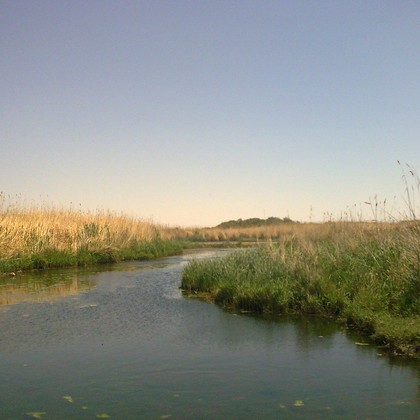
Short, damp grassland, the edges of fishponds and wet meadows, irrigated fodder crops and cereal fields, and in the Gulf states lawns and alfalfa fields with sprinklers. Often among flocks of Eurasian Skylarks and pipits.
Where the bird is most at home, classified by the habitats of North Africa and the Middle East.

Range and movements
In the region a scarce but regular winter visitor to Israel, especially the Hula Valley, the Beit She'an Valley and the coastal plain, and to the Emirates, Kuwait and northern Oman; rare in Saudi Arabia, Qatar and Bahrain and a vagrant to north-eastern Egypt. Possibly also in Iraq, where data are lacking. It breeds from Central Asia and Iran through the Indian subcontinent to China and South-East Asia.
- Winter visitor (c. Apr–Sep)
- dark = core range, pale = thinly spread
How and when to look
In winter walk short, wet grassland in the Hula Valley or along irrigated fields in the Emirates and listen for the different, buzzing call among the Eurasian Skylarks. A bird that flushes with a sandy rather than white trailing edge to the wing is worth checking.
Conservation status
Not threatened. One of the most numerous larks of Asia. Within the region the winter visitor is scarce and probably partly overlooked through confusion with Eurasian Skylark.
Scientific name
Alauda gulgula | Franklin, 1831
Franklin described the species in 1831 and placed it straight away in the genus where it still stands. The genus Alauda was introduced in 1758 by Linnaeus. Alauda is the Latin word for 'lark'; Pliny held it to be of Celtic origin. gulgula is of uncertain origin: perhaps a reference to the song, from Latin gula 'throat', or to the colour of a gulgula, a sweet made in central India. The specimen the first description was based on came from between Calcutta and Varanasi.