All species › Passerines › Larks › Crested Lark
Crested Lark | Galerida cristata
Kuifleeuwerik | Cogujada común
Crested Lark is the most widespread lark in the guide: from the village edges of Morocco through the Nile Delta to the town margins and islands of the Gulf. It is often tame, walks along road verges and across car parks, and for many visitors is the first lark they see in the region. That is exactly why it is the yardstick against which the other species are measured.

Voice
The call is a plaintive, whistled dwee-dwee-dwoo or tee-tee-too-ee, often heard as a bird flushes. The song is a varied series of whistles and mimicry, delivered from the ground, a post or a roof, or in a high song flight.
Recording: Stanislas Wroza — CC BY-NC-SA 4.0 · shortened to the first 60 s, mono · xeno-canto
Identification
17–19 cm, sturdy, with a long, pointed crest that projects as a spike from the rear of the head even at rest. The bill is fairly long and slightly curved. Upperparts sandy to grey-brown with faint streaks, breast with rather diffuse brown streaks on a buff ground. In flight the broad wings, pale rufous underwings and short dark tail with rusty-buff sides stand out. Sexes alike. Colour matches the ground, from pale sandy in the Sahara and Arabia to greyer brown in the north. On the high plateaux and at the Saharan edge of Morocco and Algeria lives a large form with a strikingly thick, long bill (macrorhyncha), which some lists treat as a separate species, Maghreb Lark.
Confusion species
Thekla's Lark (Galerida theklae) is smaller, with a shorter, fan-shaped crest, a shorter bill, sharper breast streaks, a rufous rump and grey underwings; it occurs only in the Maghreb. Eurasian Skylark (Alauda arvensis) has a blunt crest, a white trailing edge to the wing and white tail sides. Desert Lark (Ammomanes deserti) lacks a crest and has a plain, unstreaked breast. Greater Short-toed Lark (Calandrella brachydactyla) is smaller, with a short conical bill and an unstreaked breast.
Habitat
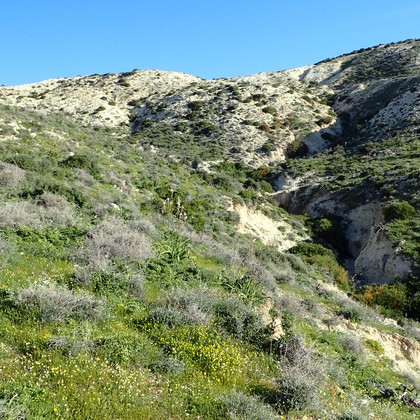
Almost any open, dry terrain with bare patches: fields and fallow land, road verges, village and town edges, building sites, oases and date gardens, semi-desert with low shrubs and coastal plains. Absent from dense forest, high mountains and true sand seas.
Where the bird is most at home, classified by the habitats of North Africa and the Middle East.


Range and movements
Common throughout the Maghreb, from the Mediterranean coast to the oases on the northern edge of the Sahara, and in Libya along the coast and in the oases. In Egypt in the Nile Valley and Delta, in the oases of the Western Desert, along the north coast and in Sinai. In the Levant common in Israel, Judea and Samaria, Jordan, Lebanon and Syria, and widespread over almost all of Iraq. On the Arabian Peninsula in Kuwait, Saudi Arabia outside the deep sand deserts, Bahrain, Qatar, Oman and Yemen; in the Emirates very common over almost the whole country, having colonised islands such as Das and Abu al-Abyad and remote desert since the 1990s. Absent from Socotra. Beyond the region from Europe through the Sahel and Central Asia to China and Korea.
- Resident
- Summer visitor (c. Oct–Mar)
- Winter visitor (c. Apr–Sep)
- Passage (Mar–Apr, Oct–Nov)
- dark = core range, pale = thinly spread
How and when to look
It is everywhere; use that to learn its shape and call well, as this helps with Thekla's Lark in Morocco and with the many other larks of the desert. In eastern Morocco and Algeria look out for the thick-billed birds of the steppe.
Conservation status
Not threatened. A clear decline has been recorded in Europe, but in the region it is common and benefits from arable farming, irrigation and building; in the Emirates the population may be increasing.
Scientific name
Galerida cristata | (Linnaeus, 1758)
Linnaeus described the species in 1758 as Alauda cristata; because it was later moved to another genus, the author and year stand in brackets. The genus Galerida was introduced in 1828 by Boie. Galerida is Latin for a crested lark, from galerum 'cap', after the upright crest. cristata is Latin for 'crested', from crista 'crest'. The specimen the first description was based on came from Vienna.