All species › Passerines › Larks › Thekla's Lark
Thekla's Lark | Galerida theklae
Theklaleeuwerik | Cogujada montesina
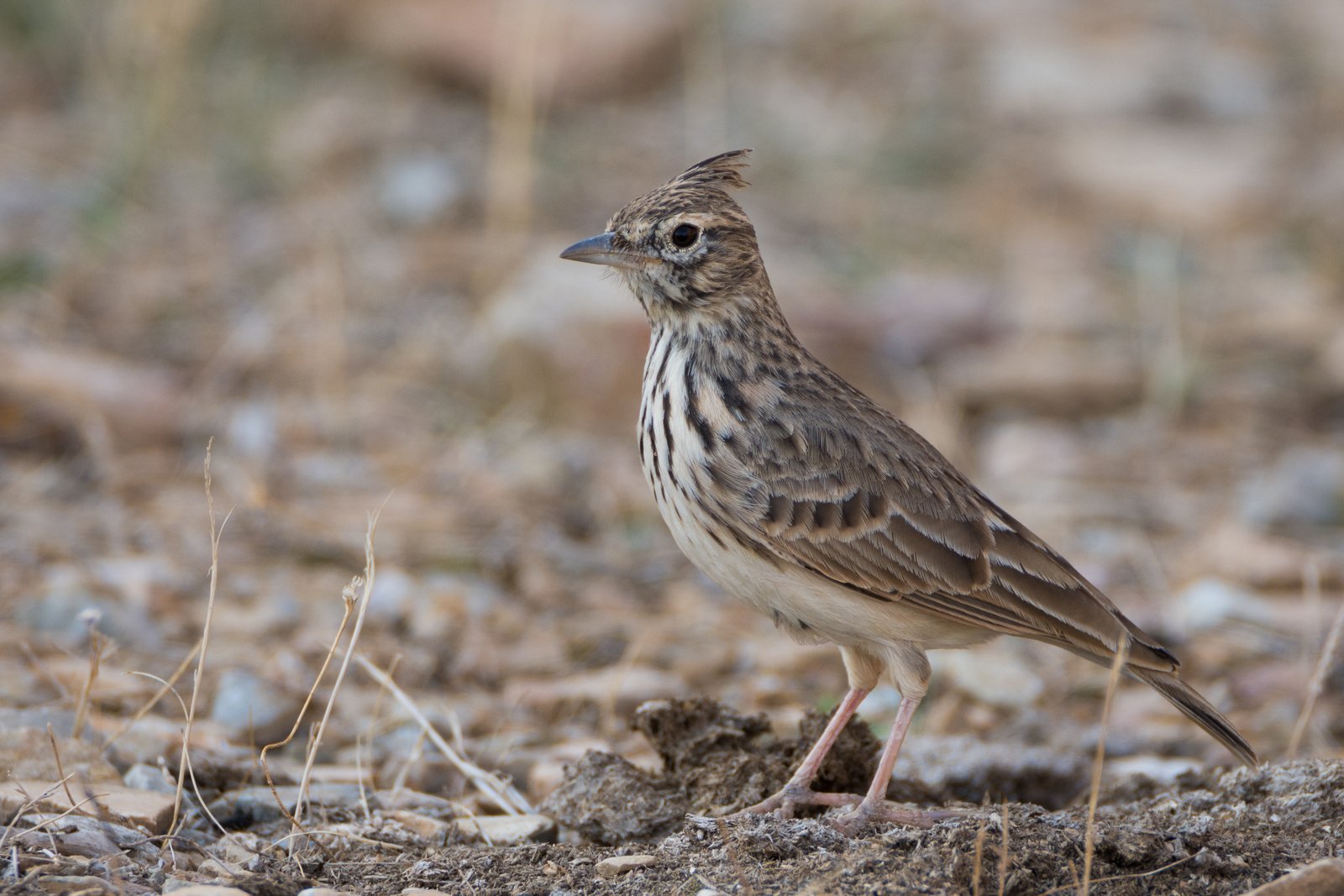
Thekla's Lark is the sibling species of Crested Lark, and in the Maghreb the two often live side by side. Where Crested Lark chooses plains, fields and village edges, Thekla's Lark sits on rocky slopes, in garrigue and in steppe with low shrubs. Separating them is a classic puzzle for the advanced birder in Morocco.
Voice
The song is softer, richer and more melodious than that of Crested Lark, with whistled phrases and much mimicry, often delivered from a bush or rock or in a high song flight. The call is a soft, fluty too-too-tee-too, less plaintive than in Crested Lark.
Recording: Guido O. Keijl — CC BY-NC-SA 4.0 · shortened to the first 60 s, mono · xeno-canto
Identification
15–17 cm, slightly smaller and more compact than Crested Lark. The crest is shorter, broader and more fan-shaped, the bill shorter with a straight lower edge to the lower mandible. The breast carries sharper, darker and rounder streaks that stand out clearly against the white ground, and the upperparts are greyer and more clearly streaked. The rump is warm rusty-brown and contrasts with the greyer back. In flight the underwings are grey, not rufous. Sexes alike. The ground colour matches the soil, ranging from grey in the north to warmer brown on red ground.
Confusion species
Crested Lark (Galerida cristata) is larger, with a longer, pointed crest, a longer bill with a slightly curved lower edge, more diffuse breast streaks, plainer sandy upperparts without a contrasting rump and pale rufous underwings; the large, thick-billed form of interior Morocco and Algeria is even less like Thekla's. Wood Lark (Lullula arborea) has a short rounded crest, long white supercilia and a black-and-white wing mark. Eurasian Skylark (Alauda arvensis) has a white trailing edge to the wing and white tail sides.
Habitat
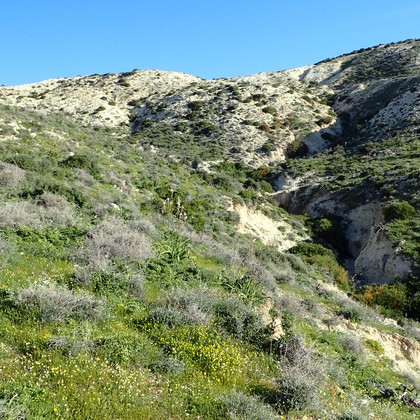
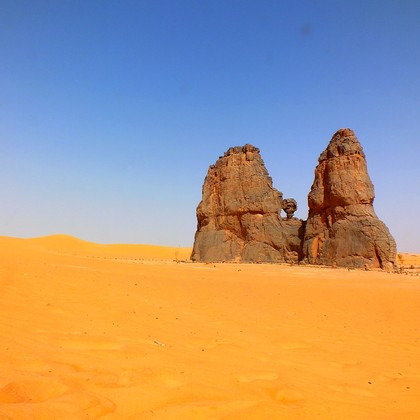
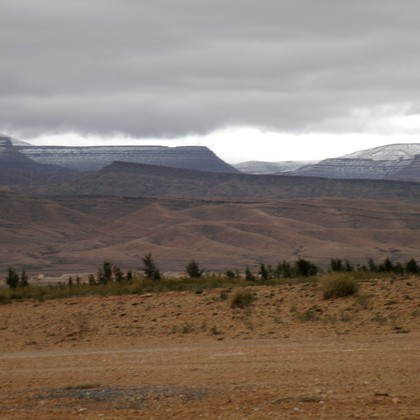
Rocky and stony slopes with low shrubs, garrigue and open maquis, alfa steppe and hill country with scattered juniper, from sea level to above 2000 m in the Atlas. Usually avoids dense settlement and flat farmland.
Where the bird is most at home, classified by the habitats of North Africa and the Middle East.
Range and movements
Common in almost all of Morocco outside the true desert, from the Rif through the Atlas and Anti-Atlas to the eastern high plateaux; in northern Algeria in the Tell, on the high plateaux and in the Saharan Atlas; in northern and central Tunisia; in Libya in the mountains of Tripolitania (Jebel Nafusa) and in the Jebel Akhdar of Cyrenaica. Absent from Egypt and the Middle East. Beyond the region it occurs in Iberia, southern France and the Balearics, and in isolation in the Horn of Africa, where the birds are sometimes treated as a separate species.
- Resident
- Summer visitor (c. Oct–Mar)
- Winter visitor (c. Apr–Sep)
- Passage (Mar–Apr, Oct–Nov)
- dark = core range, pale = thinly spread
How and when to look
In Morocco look where fields meet a rocky slope, as around Midelt, Zaida or the Tagdilt plateau: both species are often within a hundred metres of each other. Flush a bird and check the colour of the underwing and the rufous rump.
Conservation status
Not threatened. Common in North Africa; in Europe a decline has been recorded through loss of steppe and garrigue. Overgrazing and scrub encroachment may degrade habitat locally.
Scientific name
Galerida theklae | Brehm, 1857
Brehm described the species in 1857 and placed it straight away in the genus where it still stands. The genus Galerida was introduced in 1828 by Boie. Galerida is Latin for a crested lark, from galerum 'cap', after the upright crest. theklae commemorates Thekla Brehm (1833–1857), the recently deceased sister of the German zoologist Alfred Brehm. The specimen the first description was based on came from Xàtiva near Valencia, Spain.