All species › Passerines › Larks › Horned Lark
Horned Lark | Eremophila alpestris
Strandleeuwerik | Alondra cornuda
Horned Lark is one of the most widespread larks in the world, but in this region it is a true mountain bird. It breeds only on the bare summits of the High Atlas and the highest mountains of the Levant, far above the tree line, where it searches for insects and seeds among snow patches and cushion plants.

Voice
The song is a high, tinkling and twittering verse, often repeated, given from a stone or in a high, circling song flight. The call is a thin, high tsee-ee or tsee-choo.
Recording: Meena Haribal — CC BY-NC-SA 4.0 · shortened to the first 60 s, mono · xeno-canto
Identification
14–17 cm, elongated, with fairly long wings and tail. Upperparts pinkish-brown with fine streaks, underparts white. The face is white with a black lore and cheek patch and a black breast band; in Levant birds the black cheek mask runs down to the breast band. The male has a black band across the forecrown with two short black horns, best seen in the breeding season. The female is duller, with less black and smaller horns. In flight a dark tail with white sides. Birds of the Atlas (atlas) and the Levant (penicillata) have a white, not yellow, face as in the northern forms.
Confusion species
Temminck's Lark (Eremophila bilopha) is smaller and paler, with plain pinkish-sandy upperparts and a black cheek patch that is separate from the breast patch; it lives in lowland desert. Other larks of the high mountains, such as Eurasian Skylark (Alauda arvensis) and Bimaculated Lark (Melanocorypha bimaculata), lack the black-and-white face mask.
Habitat
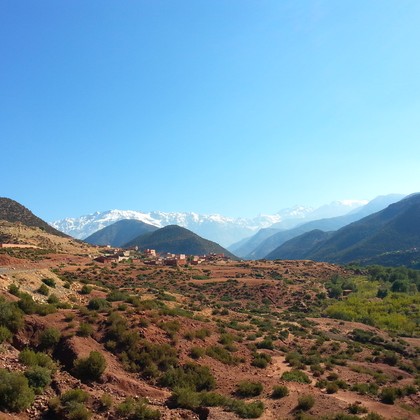
Bare, stony ridges, alpine grassland and plateaux with cushion plants above the tree line, in the High Atlas from about 2300 m to the summits, on Mount Hermon from 1900 m. In winter also lower on bare slopes and high plateaux.
Where the bird is most at home, classified by the habitats of North Africa and the Middle East.

Range and movements
In Morocco breeds in the High Atlas and locally on the highest parts of the Middle Atlas. In the Levant breeds on Mount Hermon, in the Lebanon range and the Anti-Lebanon and in the highest mountains of Syria, and in the mountains of northern Iraq. In winter birds move down to lower slopes and plateaux; elsewhere very rare. Beyond the region widespread across Europe, Asia and North America, with isolated populations in the Balkans, Turkey, the Caucasus and Central Asia.
- Resident
- Summer visitor (c. Apr–Sep)
- Winter visitor (c. Oct–Mar)
- Passage (Mar–Apr, Oct–Nov)
- dark = core range, pale = thinly spread
How and when to look
In Morocco Oukaïmeden in the High Atlas, an hour's drive from Marrakech, is the well-known site: in May and June the birds walk around the ski runs and car parks. In Israel look for it in summer on the highest parts of Mount Hermon.
Conservation status
Not threatened. In Israel the species is assessed as Vulnerable; an estimated 50 pairs breed on the Israeli part of Mount Hermon (2013 survey). As a bird of the mountain tops it is sensitive to climate warming and to disturbance from ski areas and grazing.
Scientific name
Eremophila alpestris | (Linnaeus, 1758)
Linnaeus described the species in 1758 as Alauda alpestris; because it was later moved to another genus, the author and year stand in brackets. The genus Eremophila was introduced in 1828 by Boie. Eremophila is Ancient Greek, from erēmos, 'desert', and phileō, 'to love'. alpestris is Latin for 'of the high mountains', from Alpes, the Alps. The specimen the first description was based on came from the coast of South Carolina.