All species › Waterfowl › Ducks, geese and swans › Bewick's Swan
Bewick's Swan | Cygnus columbianus
Kleine zwaan | Cisne chico
The smallest and most goose-like of the white swans, with a black bill and a rounded yellow patch at the base. It breeds on the Siberian tundra and winters among other places by the Caspian Sea; the odd wanderer reaches Iraq, Arabia or Israel.

Voice
Higher, softer and more babbling than Whooper Swan: a nasal, rolling koo-koo-kooloo and in flight a cheerful kow-kow. A flock sounds like continuous chatter.
Recording: Flemming H. Nielsen — CC BY-NC-SA 4.0 · converted to mono · xeno-canto
Identification
115–127 cm, all white with black legs and a shorter neck and rounder head than Whooper Swan. The bill is black with a yellow basal patch that fills the lores and ends rounded or square at the front, usually level with or before the nostril, without a sharp point. The yellow pattern differs between individuals. First-winters are dirty grey with a pink bill base that later turns yellow. In flight slimmer and faster than Whooper Swan.
Confusion species
Whooper Swan (Cygnus cygnus) is larger, longer-necked, has a more angular head profile and a yellow bill patch reaching forward in a sharp wedge past the nostril. Mute Swan (Cygnus olor) has an orange bill with a black knob and an S-curved neck. With a lone bird in the region always compare the proportion of yellow to black on the bill and the length of the neck.
Habitat
Winters on shallow lakes, flooded grassland and winter cereal fields, roosting on open water. Vagrants in the region stay on lakes, marshes and reservoirs, sometimes among geese.
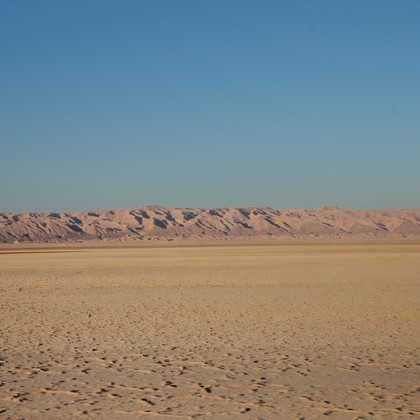
Where the bird is most at home, classified by the habitats of North Africa and the Middle East.


Range and movements
Within the region a vagrant, with records in Iraq, Saudi Arabia, Oman and Israel; these are usually single birds from the Caspian wintering grounds. Beyond the region the Eurasian form breeds on the Arctic tundra of northern Russia and Siberia and winters in north-west Europe, on the Caspian and in East Asia; the North American form breeds in Alaska and northern Canada.
How and when to look
A rarity for which harsh winters in the Caspian region offer the best conditions. Examine every white swan in Iraq or Arabia carefully: note the shape of the yellow bill patch and photograph the head in profile, as that pattern is decisive against Whooper Swan.
Conservation status
Not globally threatened, although the population wintering in north-west Europe is declining sharply. In the region a very rare vagrant with no settled season of occurrence; only a handful of records are known.
Scientific name
Cygnus columbianus | (Ord, 1815)
Ord described the species in 1815 as Anas Columbianus; because it was later moved to another genus, the author and year stand in brackets. The genus Cygnus was introduced in 1764 by De Garsault. Cygnus is Latin for 'swan', a variant of cycnus and borrowed from Greek kyknos with the same meaning. columbianus refers to the Columbia River in western North America, the type locality. The specimen the first description was based on came from The Dalles, Oregon.