All species › Waders, gulls and terns › Plovers and lapwings › Black-Bellied Plover
Black-Bellied Plover | Pluvialis squatarola
Zilverplevier | Chorlito gris
A large, stocky plover of mudflats and tidal flats that winters along almost every coast of the region. In breeding plumage it is a striking black, white and silver, but here most birds are seen in grey winter plumage, scattered and often feeding alone on the mud.
Voice
A characteristic, plaintive three-note whistle, tlee-oo-ee, dipping in the middle; often heard from birds taking off and from flocks passing over at night.
Recording: MERCIER Christophe — CC BY-NC-SA 4.0 · converted to mono · xeno-canto
Identification
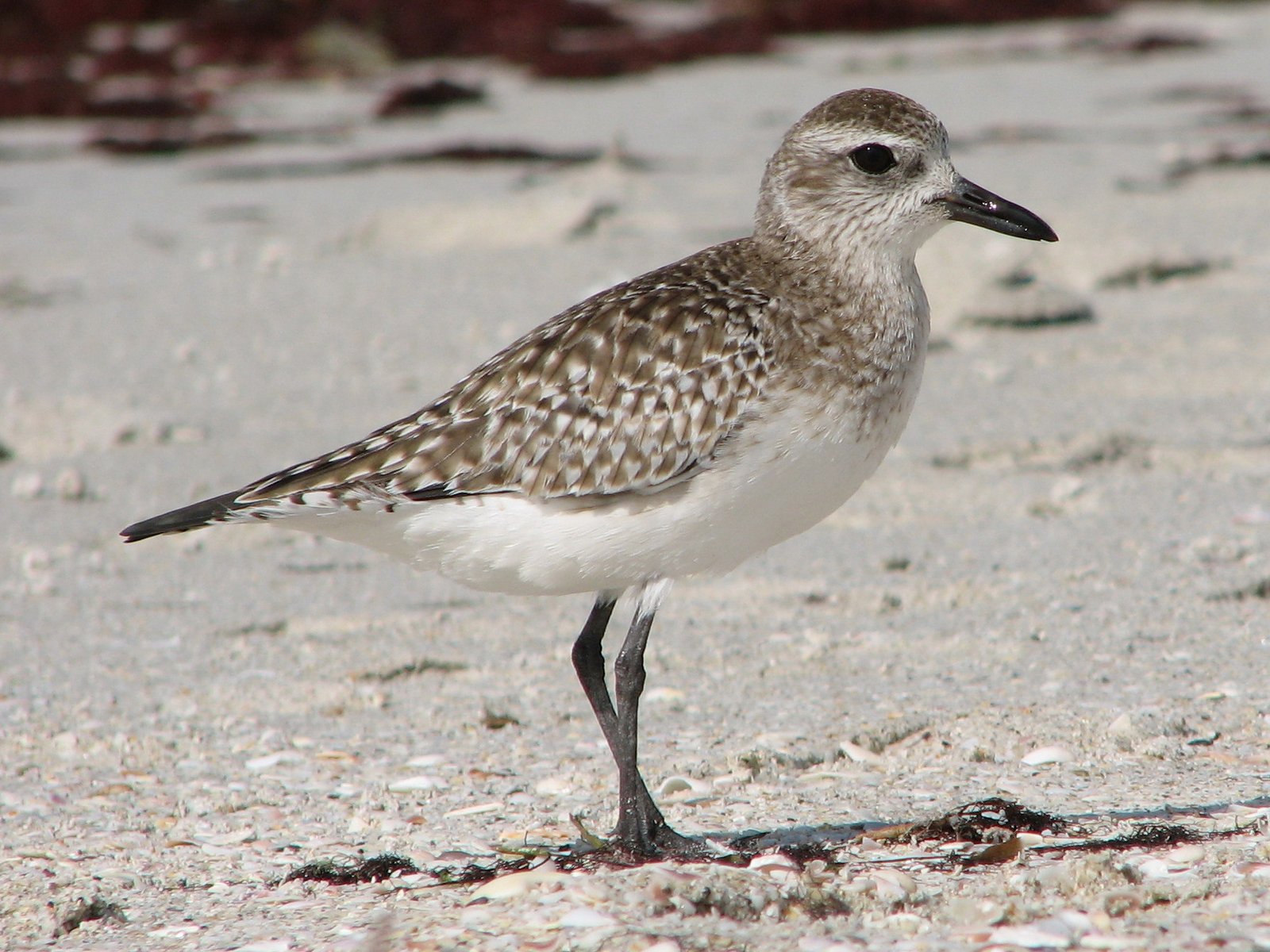
Large plover with a heavy, rounded head, big black eyes and a short, thick black bill. Winter plumage: upperparts grey-brown with fine white spots, underparts dirty white with a greyish-streaked breast; at a distance it looks uniformly grey. Breeding plumage (from April, on migrants in May and August): face, throat, breast and belly black, separated from the silver-grey and black chequered upperparts by a broad white band from forehead to breast side; the undertail stays white. Juveniles are spotted more yellowish-buff. In flight the best feature: black axillaries under an otherwise white wing, a white rump and an obvious white wing bar.
Confusion species
European Golden-Plover (Pluvialis apricaria) is smaller, slimmer and warm golden-brown spotted, with white axillaries, a faint wing bar and no white rump. Pacific Golden-Plover (Pluvialis fulva) is smaller, longer-legged and more golden, with grey axillaries; it winters alongside Black-bellied Plover on the Arabian coasts. American Golden-Plover (Pluvialis dominica) is a rare vagrant, also with grey axillaries. Red Knot (Calidris canutus) is just as grey but has a longer, thinner bill and shorter legs and feeds in tight flocks.
Habitat
Tidal flats, mudflats, sandy beaches, coastal lagoons and salt pans; in Arabia also mangrove coasts and coral platforms exposed at low tide. It feeds spread out and often territorially in classic plover style: stand, run a few steps, peck. At high tide it rests with other waders at roosts. Scarce inland, except on passage along large lakes, the Nile and reservoirs.
Where the bird is most at home, classified by the habitats of North Africa and the Middle East.



Range and movements
Winter visitor to the coasts of the whole region. Morocco: the Atlantic coast from Merja Zerga via Oualidia and Sidi Moussa to the lagoons of Khnifiss and Dakhla in Western Sahara, locally in hundreds. Along the Mediterranean in smaller numbers in Algeria, Tunisia (Gulf of Gabès and the Sfax salt pans), Libya and Egypt (delta lakes and Bardawil). Scattered along both the African and Arabian shores of the Red Sea, the Gulf of Aden and Socotra; common along the Persian Gulf from Kuwait via Bahrain and Qatar to the Emirates, and above all in Oman at Barr al Hikman and Masirah. On passage also inland in Iraq, Israel and Jordan. Breeds on the Arctic tundra of Russia, Alaska and Canada; also winters along the coasts of western Europe, Africa, South Asia, Australia and the Americas.
- Resident
- Winter visitor (c. Oct–Mar)
- Passage (Mar–Apr, Oct–Nov)
- dark = core range, pale = thinly spread
How and when to look
Look for it on a rising tide at Barr al Hikman, at Khor Kalba and Abu Dhabi, or in Morocco at Oualidia and Khnifiss. Watch for the black 'armpits' as birds take off: the quickest way to tell it from the golden plovers. In April and May birds in full breeding plumage pass along the coasts of the Gulf and the Red Sea.
Conservation status
Vulnerable. Since 2024 the species has been listed globally as Vulnerable owing to a steep decline along several flyways, partly through the loss of intertidal habitat in East Asia and changes on the Arctic breeding grounds. In the region, land reclamation and coastal development in the Gulf, pollution and disturbance threaten the mudflats where it winters.
Scientific name
Pluvialis squatarola | (Linnaeus, 1758)
Linnaeus described the species in 1758 as Tringa Squatarola; because it was later moved to another genus, the author and year stand in brackets. The genus Pluvialis was introduced in 1760 by Brisson. Pluvialis is Latin for 'relating to rain', from pluvia 'rain', from the old belief that these plovers flocked when rain was imminent. squatarola is a Latinised form of sgatarola, a Venetian name for some kind of plover. The specimen the first description was based on came from Sweden.