All species › Waders, gulls and terns › Oystercatchers › Eurasian Oystercatcher
Eurasian Oystercatcher | Haematopus ostralegus
Scholekster | Ostrero euroasiático
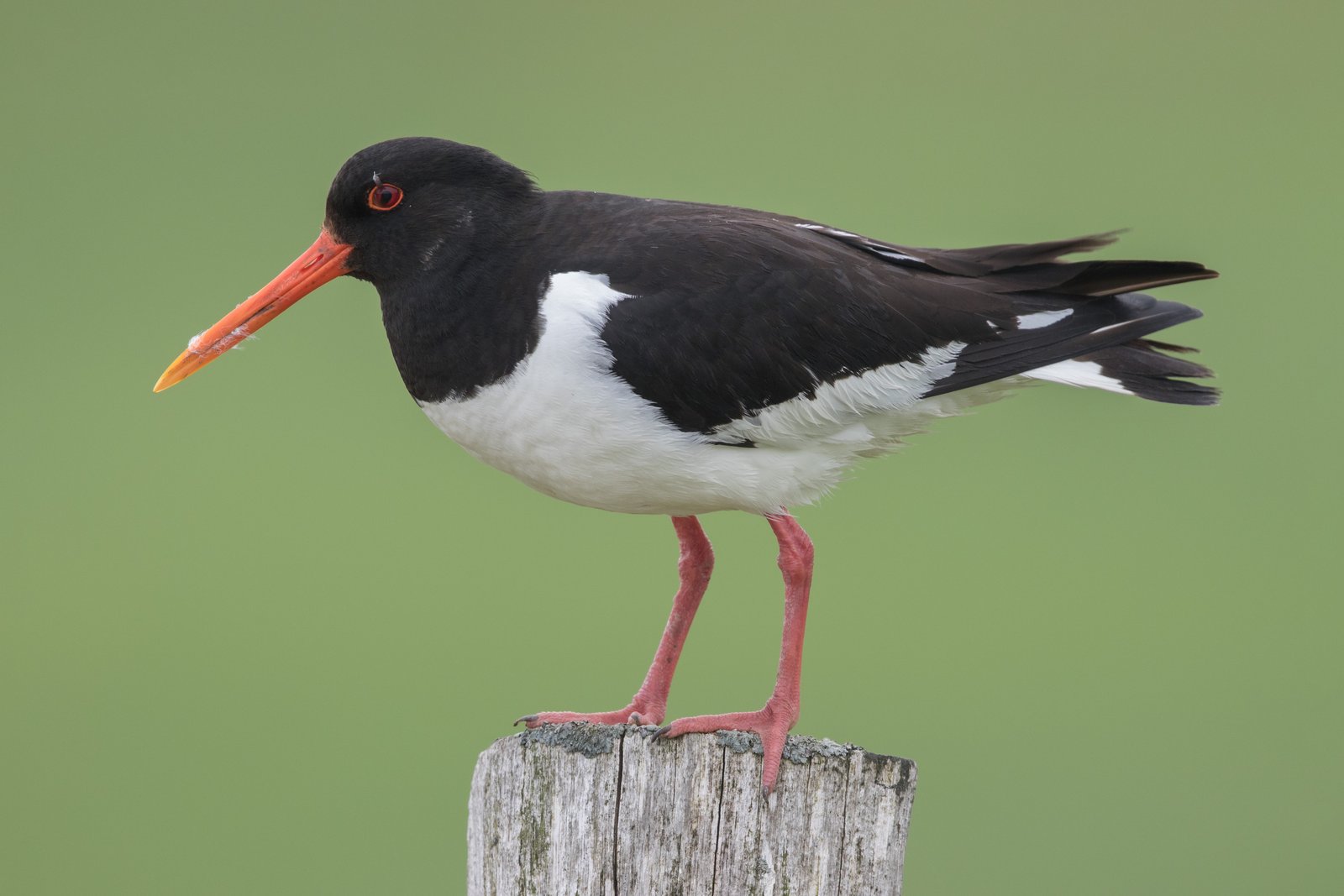
A sturdy black-and-white shorebird with a bright orange-red bill, which does not breed in the region but occurs as a winter visitor along almost all its coasts. On the Mediterranean and Morocco's Atlantic coast these are European birds; on the Red Sea, the Arabian Sea and the Gulf they belong to the eastern subspecies longipes from Russia and Central Asia.
Voice
A loud, piercing kleep or kubeek, especially in flight; flocks sometimes give a fast, excited trilling. Quieter in winter quarters than on the breeding grounds.
Recording: Stanislas Wroza — CC BY-NC-SA 4.0 · converted to mono · xeno-canto
Identification
Stocky and powerful, with black head, breast and upperparts and white underparts. The long, straight bill is bright orange-red, the eye red with an orange orbital ring, and the fairly short, sturdy legs pink. In winter plumage most birds show a white neck collar. Immatures are browner black, with a dark bill tip and duller legs. In flight: a broad white wingbar and a white rump extending as a wedge up the back. The eastern longipes is slightly longer-legged and browner-backed.
Confusion species
Hard to confuse within the region. Crab-Plover (Dromas ardeola) is also black and white and shares the same Arabian coasts, but has a white head and a heavy black bill. Pied Avocet (Recurvirostra avosetta) is slimmer, with a thin upturned black bill and blue-grey legs. At long range small flocks on a beach can recall pied gulls until the orange bills show.
Habitat
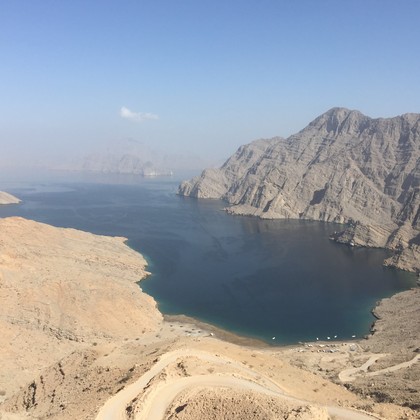
Rocky shores, tidal flats, sandy beaches with shell banks, coastal lagoons and wadi mouths; in Arabia also mangrove coasts and coral flats at low tide. It feeds on shellfish, crabs and worms, which it prises open or pulls from the substrate with its bill. Rarely inland, except as a migrant along large rivers and lakes.
Where the bird is most at home, classified by the habitats of North Africa and the Middle East.

Range and movements
Winter visitor along Morocco's Atlantic coast, mainly from Tangier to the lagoons of Khnifiss and Dakhla, and more sparsely along the Mediterranean coast of Algeria, Tunisia (Gulf of Gabès), Libya and Egypt. On the Arabian coasts of the Red Sea and the Gulf of Aden, including Socotra, and especially on the coast of Oman (Barr al Hikman and Masirah) and in the Emirates, Qatar, Bahrain and Kuwait, the subspecies longipes winters, in places in hundreds to thousands. On passage also inland in Iraq, Syria and Israel. Beyond the region it breeds from Iceland and western Europe to western Siberia and Central Asia, and separately in Kamchatka and north-east China; winters south to West Africa, East Africa and India.
- Resident
- Summer visitor (c. Oct–Mar)
- Winter visitor (c. Apr–Sep)
- Passage (Mar–Apr, Oct–Nov)
- dark = core range, pale = thinly spread
How and when to look
Barr al Hikman and Masirah Island in Oman are the best sites in the region: in winter large flocks stand on the flats there, together with Crab-Plovers. In Morocco they are easily seen at Oualidia, Sidi Moussa and in the Dakhla lagoon. Look on a rising tide, when birds gather at high-tide roosts.
Conservation status
Near Threatened. The species has been listed globally as Near Threatened since 2015 because of a steep decline in Europe, caused among other things by overfishing of shellfish, agricultural intensification and loss of breeding habitat. In the region, coastal development, land reclamation in the Gulf and disturbance threaten the wintering sites.
Scientific name
Haematopus ostralegus | Linnaeus, 1758
Linnaeus described the species in 1758 and placed it straight away in the genus where it still stands. He introduced the genus Haematopus in that same work. Haematopus is Greek, from haima 'blood' and pous 'foot', after the red legs. ostralegus is Latin, from ostrea 'oyster' and legere 'to gather'. The specimen the first description was based on came from Öland, Sweden.