All species › Kingfishers, bee-eaters and rollers › Bee-eaters › Blue-Cheeked Bee-Eater
Blue-Cheeked Bee-Eater | Merops persicus
Groene bijeneter | Abejaruco persa
The bee-eater of the desert edge: grass green, with a rufous throat and long streamers, breeding in oases, by chotts and in the river valleys of the Sahara, the Nile, Mesopotamia and the Gulf. Flocks hunt high and noisily over palm groves and reedbeds.

Voice
A rolling prreep or dirrip, repeated in series and audible from afar, but drier, hoarser and more disyllabic than the liquid prruup of European Bee-Eater. Flocks call almost continuously while hunting; at the colony there is a harsh rattle.
Recording: David Darrell-Lambert — CC BY-NC-SA 4.0 · converted to mono · xeno-canto
Identification
Slim, long-winged and long-tailed, with a long, thin, slightly decurved black bill. The length of 27–31 cm includes the central tail feathers, which project 6–8 cm; without them the bird is hardly larger than European Bee-Eater. The plumage is mainly grass green, including crown and nape. Forehead and supercilium are white and pale blue, below the black eye-stripe runs a blue-and-white cheek patch, the chin is yellow and the throat rufous. In flight the underwing glows warm coppery with a dark trailing edge. Juveniles are duller, with a pale throat and no long streamers.
Confusion species
European Bee-Eater (Merops apiaster) has a chestnut crown and mantle, golden scapulars, a yellow throat and turquoise underparts. Arabian Green Bee-Eater (Merops cyanophrys) and African Green Bee-eater (Merops viridissimus) are much smaller, with a blue or green throat and a black breast band. Olive Bee-Eater (Merops superciliosus), not certainly recorded in the region, has an olive-brown crown and a whitish chin.
Habitat
Warm, dry lowlands near water: oases and date-palm groves, edges of chotts and sebkhas, river banks, reedbeds, irrigation canals and sewage works, and sandy coastal plains. Breeds in colonies in low sandy banks or in flat sand, often closer to water than European Bee-Eater. Hunts dragonflies, bees and locusts high in the air, and likes to perch on wires and dead branches.
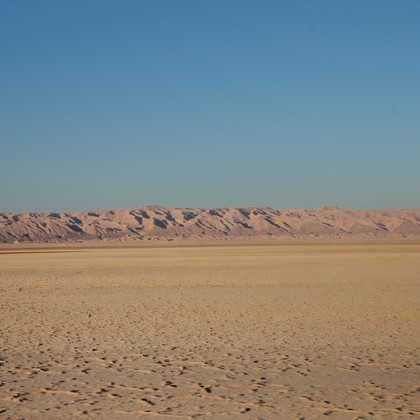
Where the bird is most at home, classified by the habitats of North Africa and the Middle East.


Range and movements
Breeds along the northern edge of the Sahara: in Morocco in the Draa and Ziz valleys and the Tafilalt, around Merzouga and south into Western Sahara (Saguia el Hamra); in Algeria in the oases of the northern Sahara (Biskra, Ouargla, El Goléa, Béni Abbès); in Tunisia around the Chott el Djerid and the oases of Tozeur and Kebili; in Libya locally in the oases. In Egypt it breeds in the Nile Delta, Faiyum and the Nile Valley; in the east along the Jordan Valley and the Dead Sea (Israel and Jordan), the Euphrates in Syria, throughout Mesopotamia in Iraq, and in Kuwait, eastern Saudi Arabia, Bahrain, Qatar and the United Arab Emirates. On passage, April – May and August – October, throughout the region, including Yemen and Oman, with a few wintering in southern Arabia. Elsewhere breeds from south-east Turkey and Iran to Kazakhstan and Pakistan, and in southern Mauritania and Senegal; winters in tropical Africa.
- Resident
- Summer visitor (c. Oct–Mar)
- Winter visitor (c. Apr–Sep)
- Passage (Mar–Apr, Oct–Nov)
- dark = core range, pale = thinly spread
How and when to look
Visit the palm groves of Merzouga, Tozeur or Faiyum in May and June and listen for the hoarse prreep high overhead; early in the morning birds perch on wires along the fields. Large flocks pass through the Arava and the Hula Valley in April and September, and in the Emirates they breed locally at sewage works and irrigation schemes.
Conservation status
Not globally threatened. Locally numerous in the region and spreading in places thanks to irrigation, but vulnerable to the drying-out of oases and chotts, the levelling of sandy banks and insecticide use. In Egypt and elsewhere it is sometimes persecuted by beekeepers.
Scientific name
Merops persicus | Pallas, 1773
Pallas described the species in 1773 and placed it straight away in the genus where it still stands. The genus Merops was introduced in 1758 by Linnaeus. Merops is Greek and means 'bee-eater'. persicus is Latin for 'Persian', after the eastern part of the breeding range. The specimen the first description was based on came from the shores of the Caspian Sea.