All species › Kingfishers, bee-eaters and rollers › Bee-eaters › Arabian Green Bee-Eater
Arabian Green Bee-Eater | Merops cyanophrys
Arabische kleine groene bijeneter | Abejaruco esmeralda árabe
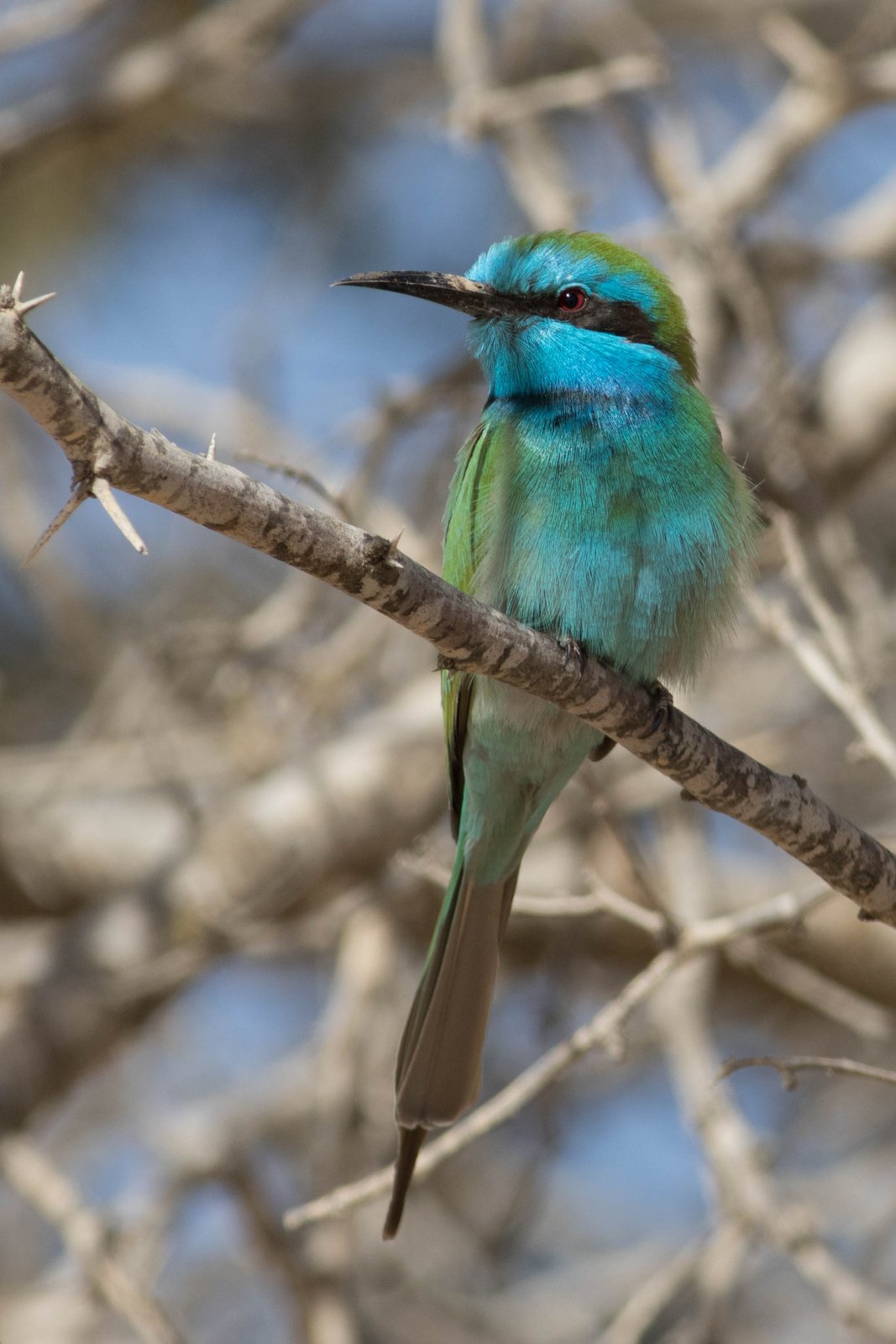
A tiny emerald-green bee-eater with a bright blue face, the common bee-eater of Arabian wadis, gardens and palm groves. It hunts from a low acacia branch or a wire and returns to the same perch after each sally.
Voice
A dry, high, rolling tree-tree-tree or tit-tit-tit, thinner and sharper than the full proo-proo of European Bee-Eater and rarely far-carrying. Heard all year; when disturbed the notes run together into a fast rattle.
Recording: David Darrell-Lambert — CC BY-NC-SA 4.0 · converted to mono · xeno-canto
Identification
Small and slender, with a thin, slightly decurved black bill, pointed wings and two needle-thin central tail feathers projecting only about 2 cm; the length above includes them. The plumage is grass green with a coppery sheen on wings and tail. Forehead, supercilium, chin and throat are bright sky blue, and a narrow black crescent crosses the upper breast. The iris is red. The eastern subspecies muscatensis (central and eastern Arabia) is paler, with a yellowish-green belly. Juveniles are duller, without streamers or black breast band.
Confusion species
Blue-cheeked Bee-Eater (Merops persicus) breeds partly in the same areas but is about one and a half times as long, with a yellow chin, a rufous throat and streamers of 6–8 cm. European Bee-Eater (Merops apiaster) is larger still and chestnut and gold. Asian Green Bee-eater (Merops orientalis) of Iran has longer streamers and less blue on the face; African Green Bee-eater (Merops viridissimus) of the Nile Valley has streamers 8–10 cm long and a greener throat.
Habitat
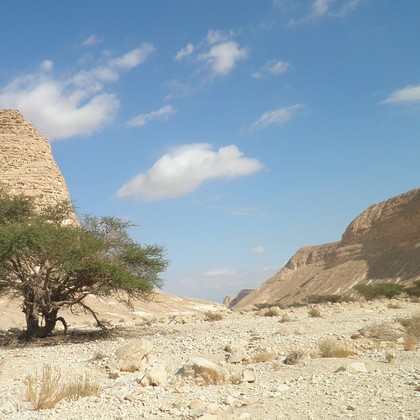
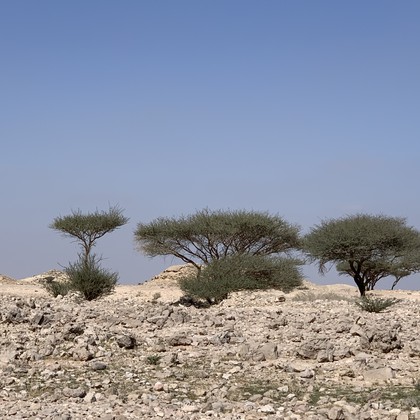
Open desert and semi-desert valleys with scattered acacias and tamarisks, wadis, date-palm gardens, irrigated fields, parks and the edges of ponds and sewage works, from sea level high into the Arabian mountains. It avoids completely barren desert. The nest burrow is dug into a low sandy bank or simply into flat sand.
Where the bird is most at home, classified by the habitats of North Africa and the Middle East.

Range and movements
Common over most of the Arabian Peninsula. The nominate form cyanophrys breeds in southern Israel (Arava, Dead Sea, Eilat, and spreading north up the Jordan Valley), western Jordan (Wadi Araba, Aqaba, Dead Sea), a small part of Sinai, western and southern Saudi Arabia (Hejaz, Asir, Tihama) and Yemen; the form muscatensis lives in central and eastern Saudi Arabia, the United Arab Emirates, where it is very common, and Oman. It is virtually absent from Egypt outside Sinai, from Iraq and from Kuwait. The species does not occur outside the region: since 2021 it has been recognised as a species in its own right, separate from the African and Asian green bee-eaters.
- Resident
- Summer visitor (c. Oct–Mar)
- Passage (Mar–Apr, Oct–Nov)
- dark = core range, pale = thinly spread
How and when to look
In the Emirates and Oman it sits in almost every park, on golf courses and by every field; in Israel a morning in the Arava (Yotvata, Neot Semadar, Lotan) almost guarantees it. In the summer heat the first and last hours of light are best; in winter birds sun themselves on wires until late morning.
Conservation status
Not threatened and increasing. Irrigated farming, gardens and reservoirs have brought insects and perches into the desert, allowing the species to spread. The levelling of sandy banks and insecticides on fields harm it locally.
Scientific name
Merops cyanophrys | (Cabanis & Heine, 1860)
Cabanis & Heine described the species in 1860 as Philothrus cyanophrys; because it was later moved to another genus, the author and year stand in brackets. The genus Merops was introduced in 1758 by Linnaeus. Merops is Greek and means 'bee-eater'. cyanophrys is Greek, from kuanos 'dark blue' and ophrus 'eyebrow', after the blue stripe above the eye. The specimen the first description was based on came from Al Qunfudhah, Saudi Arabia.