All species › Kingfishers, bee-eaters and rollers › Bee-eaters › African Green Bee-Eater
African Green Bee-Eater | Merops viridissimus
Afrikaanse kleine groene bijeneter | Abejaruco esmeralda africano
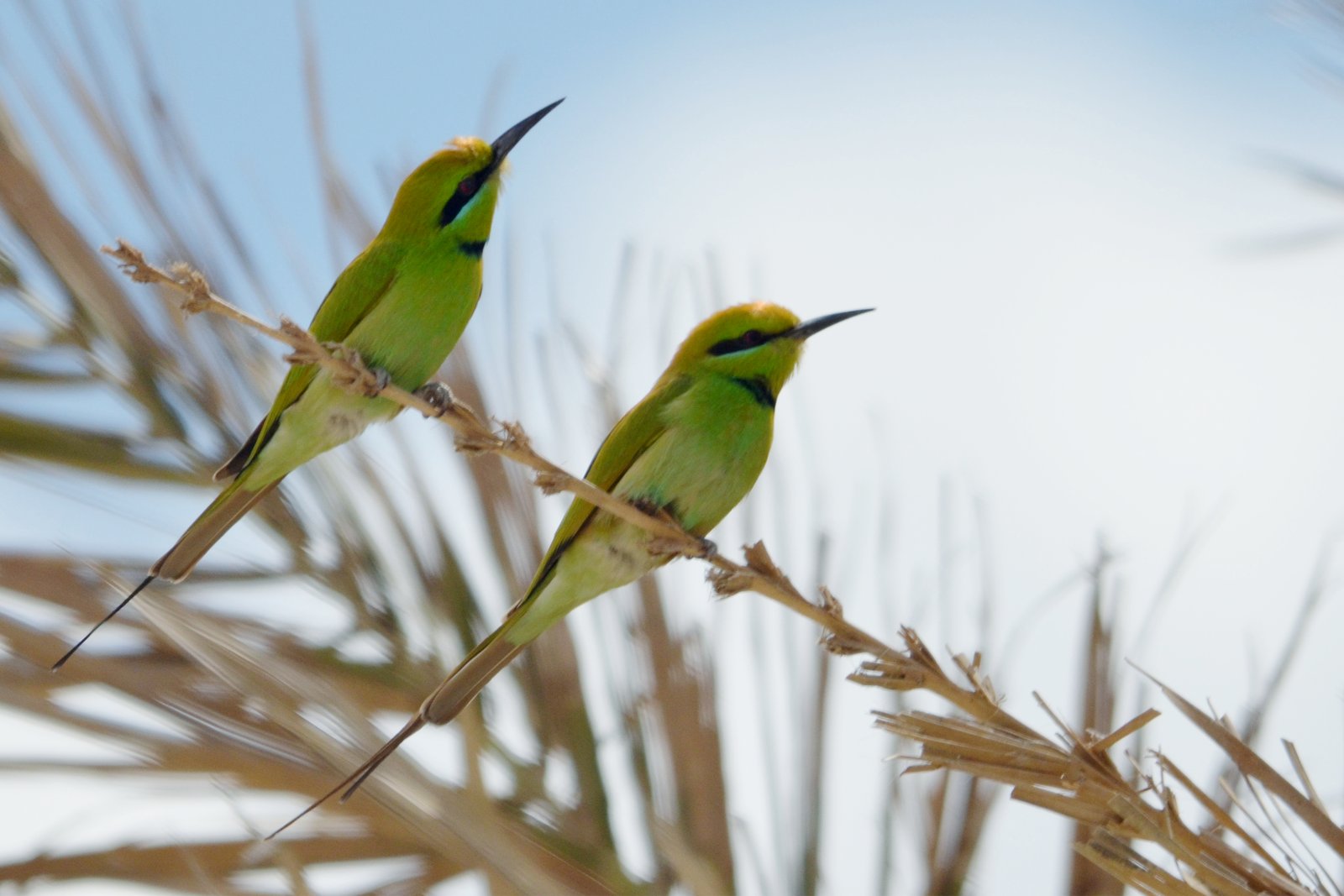
A small, grass-green bee-eater with long, needle-thin tail streamers, found within the region only in the Nile Valley of Egypt. There it sits on almost every wire along the fields and canals, from Aswan far into the Delta.
Voice
A dry, high, rolling tree-tree-tree or quick tit-tit-tit, thin and not far-carrying, quite unlike the full prruup of the larger bee-eaters. When excited it runs into a quick trill.
Recording: Sun Madakan — CC BY-NC-SA 4.0 · converted to mono · xeno-canto
Identification
The body is 16–18 cm, with central tail feathers projecting 8–10 cm. The plumage is bright grass green; crown and nape have a golden-brown wash and the cheeks a pale blue sheen below a thin black eye-stripe. Chin and throat are green to blue-green and closed off by a narrow black breast band. In flight the wings show an ochre glow with a dark trailing edge. Egyptian birds (subspecies cleopatra) are somewhat paler than those of the Sahel. Juveniles lack the streamers and the black breast band.
Confusion species
Arabian Green Bee-Eater (Merops cyanophrys), east of the Gulf of Suez, has a much brighter blue face and throat and streamers of only about 2 cm; their ranges do not meet. Blue-cheeked Bee-Eater (Merops persicus) also breeds in the Nile Valley but is much larger, with a yellow chin, a rufous throat and a blue-and-white cheek patch, and hunts high up in calling flocks.
Habitat
Farmland of the Nile Valley: fields, irrigation canals, date-palm groves and orchards, village edges and banks with low sandy faces in which it digs its nest burrow. Hunts like a flycatcher from a low branch, wire or post and keeps returning to the same perch.
Where the bird is most at home, classified by the habitats of North Africa and the Middle East.


Range and movements
Within the region only in Egypt: common in the Nile Valley from Lake Nasser and Aswan north via Luxor to the Cairo area and Faiyum, and in recent decades spreading north into the Nile Delta. In the far south of Algeria, on the borders with Niger and Mali, birds of the Sahel forms are occasionally reported. Outside the region along the Nile in northern Sudan and across the Sahel belt from Senegal to Ethiopia.
- Resident
- Summer visitor (c. Oct–Mar)
- Winter visitor (c. Apr–Sep)
- Passage (Mar–Apr, Oct–Nov)
- dark = core range, pale = thinly spread
How and when to look
Around Aswan, Kom Ombo and on the west bank at Luxor you will find it on almost any power line along the fields if you look carefully. In winter birds often sun themselves in the morning, a few sitting close together; in the breeding season check low sandy banks along canals and roads.
Conservation status
Not globally threatened. Common in Egypt and spreading north, probably helped by irrigated farming. Locally it suffers from the digging-out of canal banks and from insecticide use.
Scientific name
Merops viridissimus | Swainson, 1837
Swainson described the species in 1837 and placed it straight away in the genus where it still stands. The genus Merops was introduced in 1758 by Linnaeus. Merops is Greek and means 'bee-eater'. viridissimus is Latin for 'greenest' or 'very green', the superlative of viridis 'green'. The specimen the first description was based on came from Senegal.