All species › Birds of prey › Hawks, eagles and kites › Booted Eagle
Booted Eagle | Hieraaetus pennatus
Dwergarend | Águila calzada
The Booted Eagle is the smallest eagle of the region, hardly larger than a buzzard, but with the feathered legs and flying skill of a true eagle. It breeds in the forests of the Atlas and the Rif and crosses the Strait of Gibraltar in large numbers; in the Middle East it is a passage migrant and a small winter visitor in parks and oases.

Voice
Fairly vocal in the breeding area: a high, shrill, wader-like kli-kli-kli and a drawn-out, descending keeeeh.
Recording: Stanislas Wroza — CC BY-NC-SA 4.0 · shortened to the first 60 s, mono · xeno-canto
Identification
42–51 cm, wingspan 113–138 cm. Occurs in a pale and a dark morph, with intermediates. The pale morph has creamy-white underparts and underwing coverts, sharply contrasting with uniformly black flight feathers, with a pale wedge in the inner primaries. The dark morph is uniformly dark brown to rufous-brown below, with a paler tail. Both morphs show from above a pale band across the median coverts, a pale U on the rump and, seen head-on, two white spots where the wing joins the body (the 'landing lights'). The tail is fairly long, square-cut and slightly translucent. Wings with six fingers, held flat or slightly drooped.
Confusion species
Common Buzzard (Buteo buteo) and Long-legged Buzzard (Buteo rufinus) have dark carpal patches, a barred or pale rusty tail and no 'landing lights'. The dark morph resembles Black Kite (Milvus migrans), but that has a forked tail and a paler panel on the inner wing. Short-toed Snake-Eagle (Circaetus gallicus) is much larger, with a barred, pale underwing. European Honey-Buzzard (Pernis apivorus) has a small head and a tail with a broad dark terminal band.
Habitat
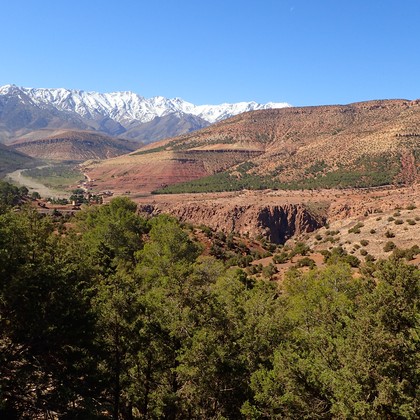
Varied woodland with clearings: oak, cedar and pine forests in the mountains, riverine woodland and wooded valleys next to open country. On migration and in winter also wooded parks, oases, plantations and irrigated farmland, where it hunts pigeons and small birds.
Where the bird is most at home, classified by the habitats of North Africa and the Middle East.


Range and movements
In Morocco a fairly common breeder in the Rif, the Middle Atlas and the High Atlas and in the north-west; also in northern Algeria and northern Tunisia, rare in Libya. At the Strait of Gibraltar thousands of birds pass to Africa in autumn. In Israel a fairly common passage migrant in both seasons, with up to a few thousand birds in autumn, and a small winter visitor. In Egypt a passage migrant and winter visitor in the Nile Valley. On the Arabian Peninsula a scarce passage migrant in all parts and a small winter visitor in the Emirates, Oman and Yemen. Beyond the region from Iberia and north-west Africa to Central Asia; winters in Africa south of the Sahara and in South Asia.
- Resident
- Summer visitor (c. Oct–Mar)
- Winter visitor (c. Apr–Sep)
- Passage (Mar–Apr, Oct–Nov)
- dark = core range, pale = thinly spread
How and when to look
In the Middle Atlas around Ifrane and Azrou breeding pairs show well over the cedar forests in May and June. In winter it pays to search the green parks of Al Ain and Dubai in the Emirates; a Booted Eagle then often sits quietly in a tall tree.
Conservation status
Not globally threatened. Locally vulnerable through felling of old forest, disturbance of nest sites, electrocution and shooting on migration.
Scientific name
Hieraaetus pennatus | (Gmelin, 1788)
Gmelin described the species in 1788 as Falco pennatus; because it was later moved to another genus, the author and year stand in brackets. The genus Hieraaetus was introduced in 1844 by Kaup. Hieraaetus is Greek, from hierax 'hawk' and aetos 'eagle'. pennatus is Latin for 'feathered', after the legs feathered down to the toes. The specimen the first description was based on came from not stated in the original description.