All species › Birds of prey › Hawks, eagles and kites › Steppe Eagle
Steppe Eagle | Aquila nipalensis
Steppearend | Águila esteparia
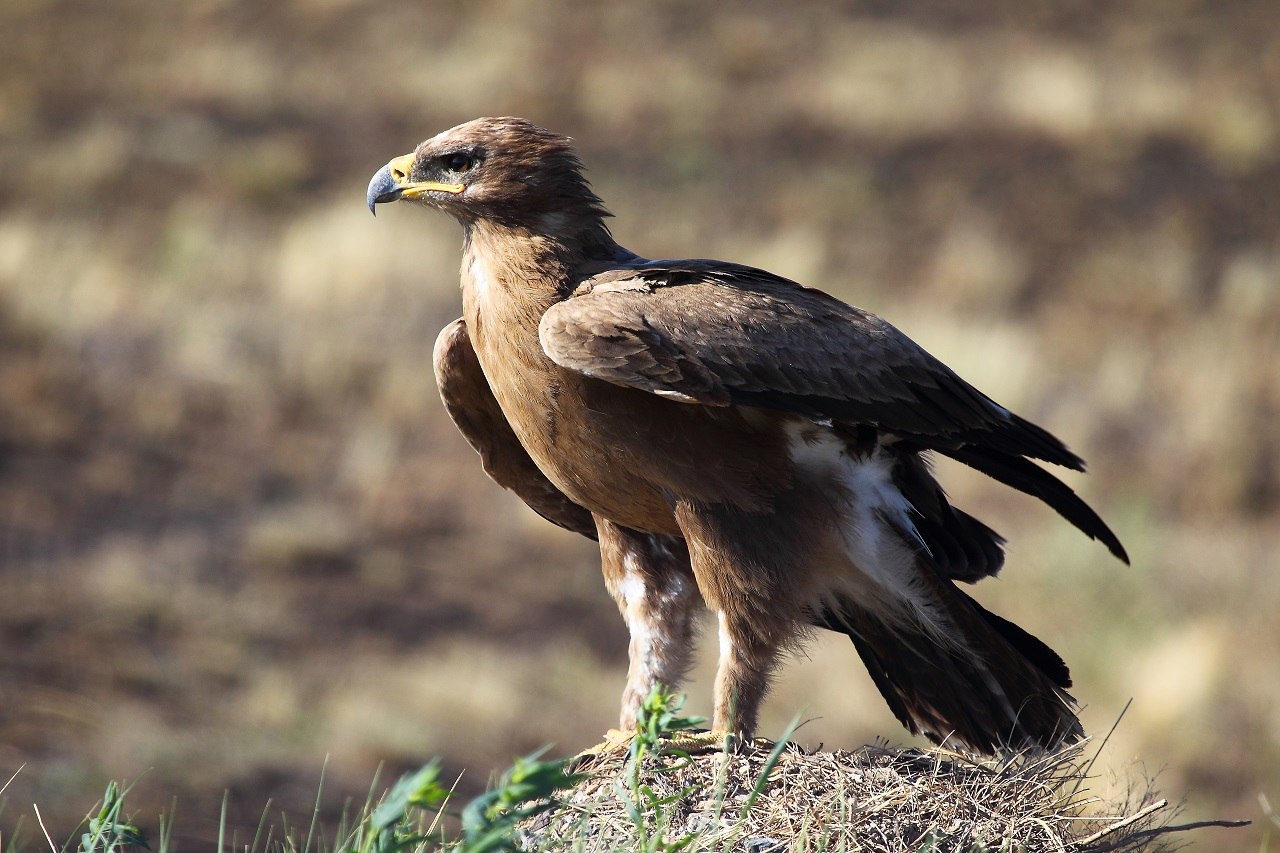
The Steppe Eagle is a large, dark eagle from the steppes of Central Asia that passes through the Middle East in large numbers on its way to and from East and southern Africa. A large share of the world population now winters on the Arabian Peninsula, where up to thousands of birds gather at rubbish dumps.
Voice
Usually silent. Sometimes a harsh, crow-like bark, kyak, especially in squabbles at dumps.
Recording: Bo Shunqi 薄顺奇 — CC BY-NC-SA 4.0 · shortened to the first 60 s, mono · xeno-canto
Identification
62–81 cm, wingspan 165–214 cm. A heavy eagle with long, broad, parallel-edged wings with long fingers, a fairly long, rounded tail and a small head. The adult is uniformly dark brown, in flight with finely barred greyish flight feathers with a dark trailing edge, often a rusty nape patch and a pale throat patch. Characteristic is the long yellow gape, which extends to behind the eye. The juvenile is paler, cold greyish-brown, with a broad white band across the underwing along the greater coverts, a white trailing edge to wing and tail and a white U on the rump; immatures retain remnants of these bands.
Confusion species
Tawny Eagle (Aquila rapax) is smaller and usually warmer tawny, with a gape reaching only to the middle of the eye and no white band under the wing. Greater Spotted Eagle (Clanga clanga) and Lesser Spotted Eagle (Clanga pomarina) are smaller and more compact, with shorter wings and a round nostril. Young Imperial Eagles (Aquila heliaca) are pale and streaked, with a pale wedge in the inner wing; Golden Eagle (Aquila chrysaetos) has a longer tail and, in young birds, white wing patches and a white tail base.
Habitat
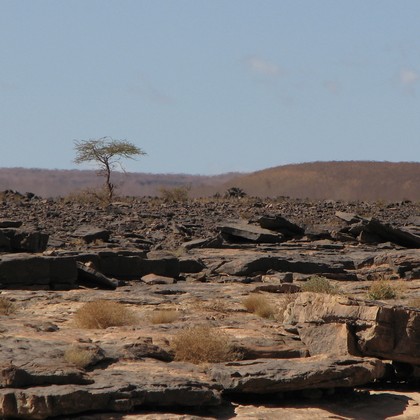
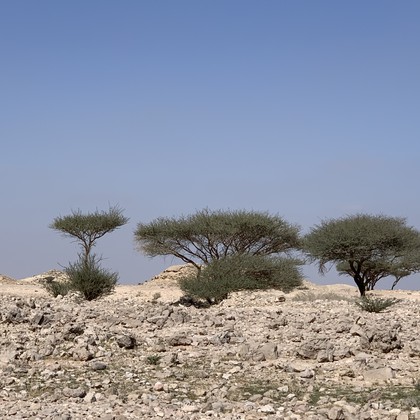
In winter open desert, semi-desert and thorn scrub, farmland and above all rubbish dumps and animal waste sites, where it sits in groups on the ground. On migration over ridges and desert plains.
Where the bird is most at home, classified by the habitats of North Africa and the Middle East.

Range and movements
In spring thousands to tens of thousands of birds pass Eilat, mainly from February to April; in autumn most take the route via Bab el-Mandeb in Yemen or across Sinai and the Gulf of Suez. On the Arabian Peninsula a numerous winter visitor: at two dumps near Shaqra, north of Riyadh, up to 6,700 birds were counted, over 7% of the world population. Also a regular winter visitor in Oman (especially Dhofar), the Emirates, Yemen, Kuwait and Iraq. In Egypt and Jordan a passage migrant, in the Maghreb a rare vagrant. Breeds in the steppes from southern Russia and Kazakhstan to Mongolia and China; winters in East and southern Africa, Arabia and South Asia.
- Winter visitor (c. Oct–Mar)
- Passage (Mar–Apr, Oct–Nov)
- dark = core range, pale = thinly spread
How and when to look
In winter visit a dump in Dhofar, such as near Salalah, or in the interior of Saudi Arabia; tens to hundreds of Steppe Eagles sit on the ground there, often together with Greater Spotted Eagles. In March the mountains north of Eilat are the classic site for the migration.
Conservation status
Endangered. Since the late 1990s it has declined very steeply, mainly through electrocution on power poles in the breeding areas and on migration, poisoning, loss of steppe and the decline of ground squirrels. In Arabia the dependence on dumps makes the birds vulnerable to power lines and to poison laid out against feral dogs and wolves.
Scientific name
Aquila nipalensis | Hodgson, 1833
Hodgson described the species in 1833 and placed it straight away in the genus where it still stands. The genus Aquila was introduced in 1760 by Brisson. Aquila is Latin for 'eagle', possibly from aquilus 'dark in colour'. nipalensis means 'from Nepal', where the type specimen was collected, presumably from a bird on migration. The specimen the first description was based on came from Nepal.