All species › Birds of prey › Hawks, eagles and kites › Greater Spotted Eagle
Greater Spotted Eagle | Clanga clanga
Bastaardarend | Águila moteada
The Greater Spotted Eagle is a dark, compact eagle of marshes and river valleys, which occurs in small numbers in the region as a winter visitor, from the Nile Delta and the Hula Valley to the rubbish dumps and irrigated fields of Oman and the Emirates. It breeds in the forests and marshes of eastern Europe to Siberia.
Voice
Usually silent in winter quarters. Sometimes a barking, dog-like kyak-kyak or tyuk-tyuk, higher than in large eagles.
Recording: David Darrell-Lambert — CC BY-NC-SA 4.0 · converted to mono · xeno-canto
Identification
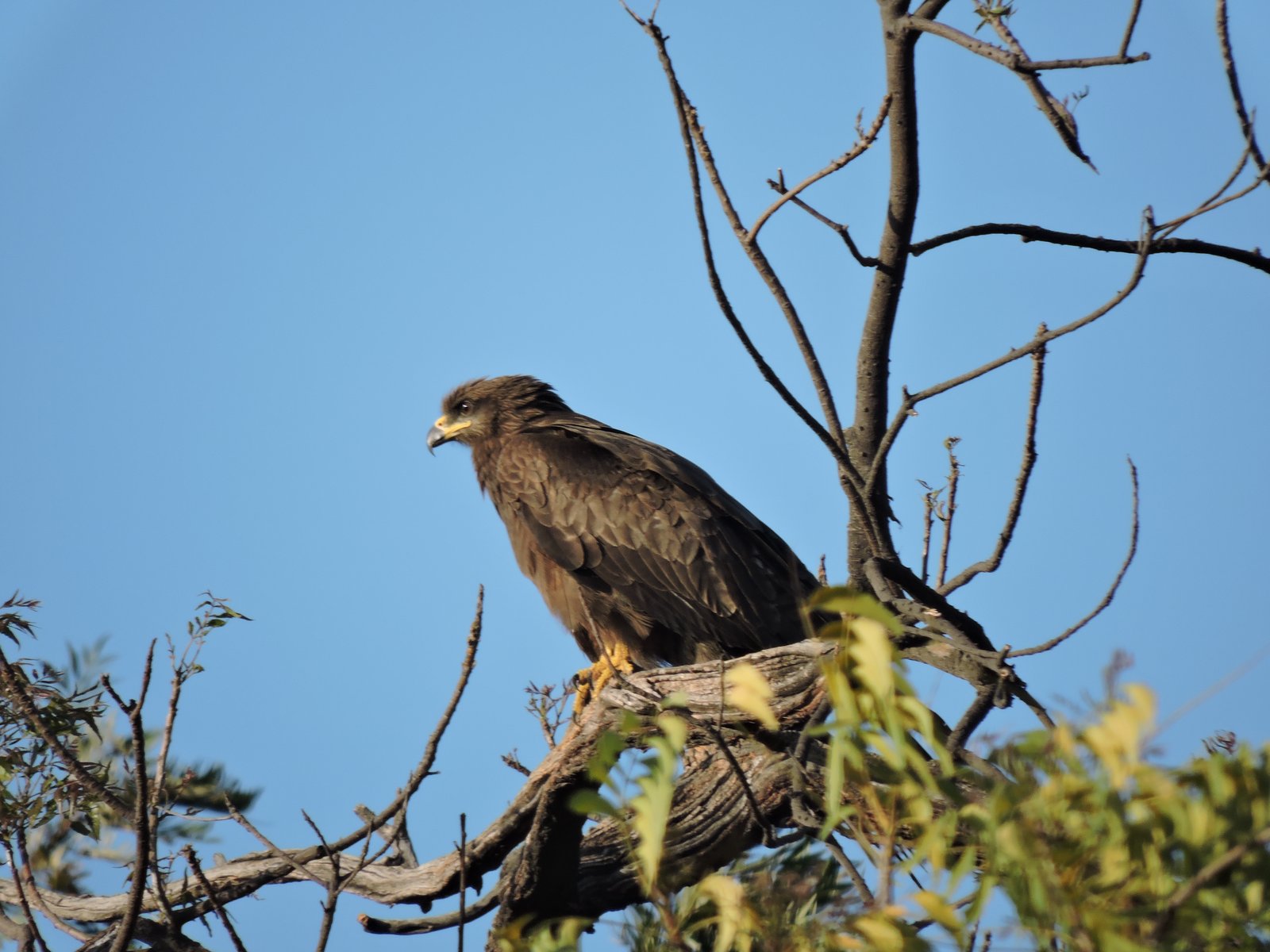
59–69 cm, wingspan 155–180 cm. A medium-sized, stocky eagle with broad, rectangular wings, a short tail and a rather small head. The adult is uniformly dark blackish-brown, in flight with the underwing coverts as dark as or darker than the flight feathers and usually a single pale comma at the carpal; a narrow white U above the tail. The juvenile is blackish-brown with rows of large white drops on the wing coverts, a white trailing edge to wing and tail and a clear white U on the rump. The pale morph fulvescens, wholly tawny with dark flight feathers, is rare. Glides with the hands slightly drooped; the nostril is round.
Confusion species
Lesser Spotted Eagle (Clanga pomarina) is smaller and paler brown; the adult has underwing coverts paler than the flight feathers and a double pale carpal comma, and the juvenile a creamy nape patch and only one row of small white spots. Steppe Eagle (Aquila nipalensis) is larger and longer-necked, with longer wings, a yellow gape reaching behind the eye and, in juveniles, a broad white band across the underwing. Black Kite (Milvus migrans) has a forked tail and narrower wings. Hybrids with Lesser Spotted Eagle occur.
Habitat
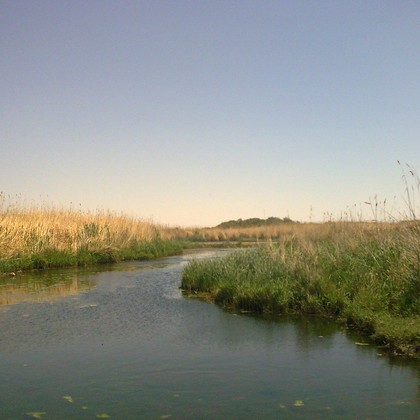
Marshes, reedbeds, lakes, river valleys and wet grasslands, in winter also fishponds, irrigated farmland and rubbish dumps. Sits still for long periods on a post, a bank or the ground.
Where the bird is most at home, classified by the habitats of North Africa and the Middle East.


Range and movements
A scarce passage migrant and winter visitor. In Israel a few dozen birds winter in the Hula and Jezreel valleys and on the coastal plain; in Egypt in the Nile Delta and at the northern lakes. In Iraq in the southern marshes; in Saudi Arabia, Kuwait, Bahrain and Qatar scarce, mainly in the east. In the Emirates and Oman a regular winter visitor, concentrating at rubbish dumps, sewage lagoons and farmland, among others around Abu Dhabi, Sohar and Salalah. In Yemen, Jordan, Lebanon and Syria scarce on passage. Rare in the Maghreb, with a few winter records in Morocco, Algeria and Tunisia. Breeds from Poland and Belarus to Siberia and Manchuria; winters from south-east Europe and Turkey to South Asia and north-east Africa.
- Resident
- Summer visitor (c. Oct–Mar)
- Winter visitor (c. Apr–Sep)
- Passage (Mar–Apr, Oct–Nov)
- dark = core range, pale = thinly spread
How and when to look
Between November and February visit the Hula Valley in northern Israel or the dumps and sewage lagoons of Salalah and Sohar in Oman; the birds often sit on the ground or on posts among Steppe Eagles and Black Kites. In juveniles look for the rows of white drops on the wing.
Conservation status
Vulnerable. The world population numbers only a few thousand pairs and is declining through drainage of marshes and floodplains, forestry, disturbance, hybridisation with Lesser Spotted Eagle and electrocution and shooting on migration and in winter quarters.
Scientific name
Clanga clanga | (Pallas, 1811) (GBIF: Aquila clanga)
Pallas described the species in 1811 as Aquila Clanga; because it was later moved to another genus, the author and year stand in brackets. The genus Clanga was introduced in 1857 by Adamowicz. Clanga is from Ancient Greek klangos, a kind of eagle mentioned by Aristotle; others derive it from klangē, 'scream'. The specific name repeats the genus name. The specimen the first description was based on came from Russia and Siberia.