All species › Waders, gulls and terns › Gulls and terns › Bridled Tern
Bridled Tern | Onychoprion anaethetus
Brilstern | Charrán embridado
The commonest ocean tern of Arabian waters: a slim, dark tern with a striking white 'spectacle' above the eye. In summer it breeds on countless islands in the Red Sea, the Persian Gulf, the Gulf of Oman and the Arabian Sea; in winter it moves out to the open Indian Ocean.
Voice
A high, yapping wep-wep or ki-yah, and at the colony a rasping kerrr.
Recording: David Darrell-Lambert — CC BY-NC-SA 4.0 · converted to mono · xeno-canto
Identification
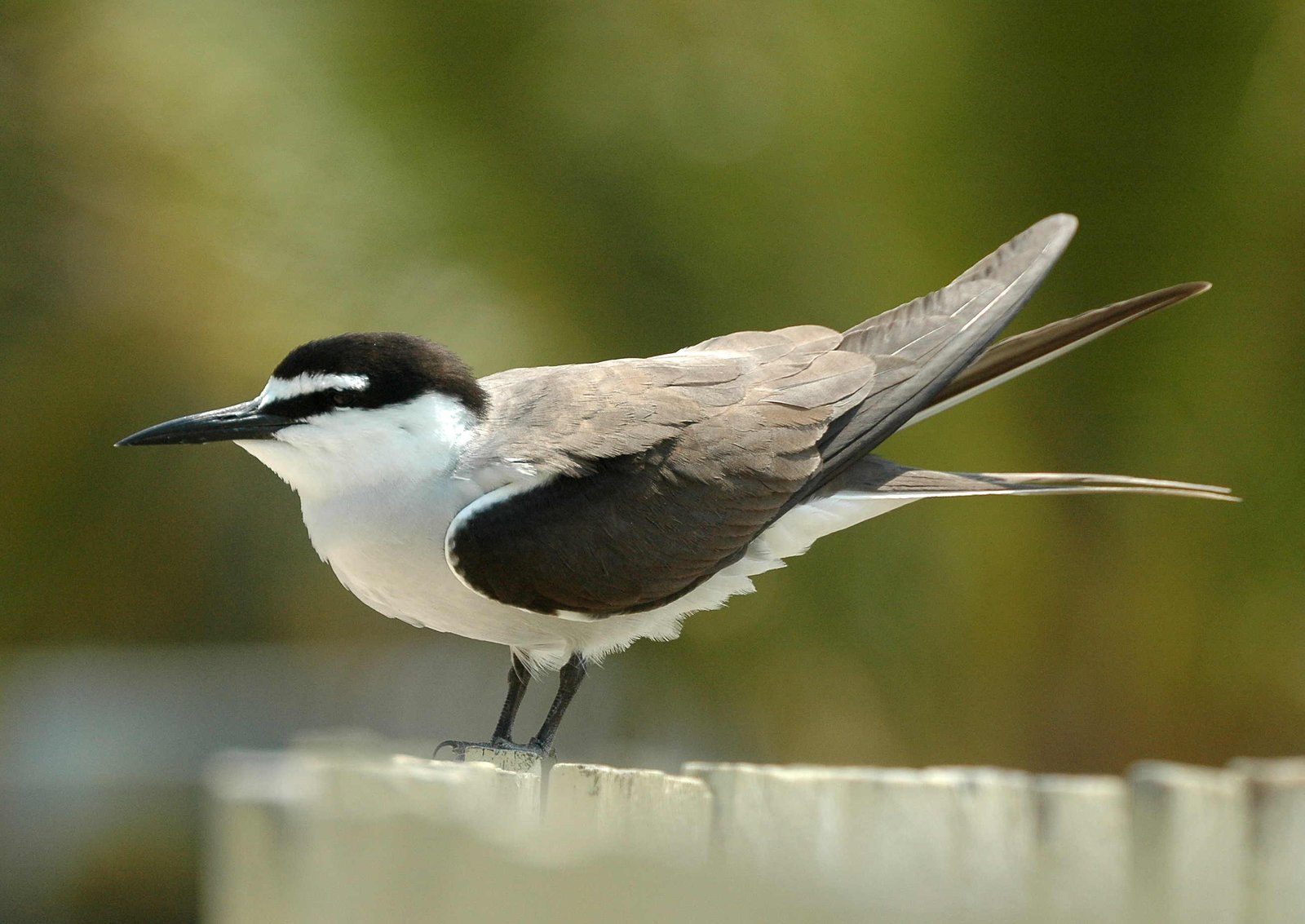
Mantle and wings dark grey-brown, tail grey-brown with white outer feathers, underparts white. Black cap with a narrow white forehead patch running like an eyebrow to behind the eye; the black loral stripe is narrow. A pale grey nape band separates cap and mantle. Bill and legs black. Deeply forked tail. Juveniles have a streaked, paler cap and pale, scaly fringes on the upperparts. Flight light and buoyant, often low over the sea; likes to rest on floating weed, buoys and ropes.
Confusion species
Sooty Tern (Onychoprion fuscatus) is larger and bulkier, with black, not grey-brown upperparts showing no contrast with the cap, no pale nape band and a broader white forehead patch that does not extend behind the eye. White-cheeked Tern (Sterna repressa) and Common Tern (Sterna hirundo) are much paler grey above.
Habitat
Warm coastal waters and open sea. Breeds in loose colonies on rocky and sandy islands and coral islets, the nest hidden under a bush, in a rock crevice or beneath an overhanging coral ledge. Feeds far out at sea, often in flocks near floating weed and over shoals of small fish.
Where the bird is most at home, classified by the habitats of North Africa and the Middle East.



Range and movements
A numerous summer visitor to the Red Sea: breeds on islands along the Egyptian coast (including Siyal, Ashrafi and Magawish, with hundreds of pairs), in the Gulf of Aqaba and along the Saudi, Yemeni and Eritrean coasts. In the Persian Gulf it breeds on islands off Kuwait (Kubbar, Qaru, Umm al-Maradim), Saudi Arabia, Bahrain, Qatar and the UAE; further in the Gulf of Oman (Daymaniyat Islands) and along the Arabian Sea coast of Oman, at Socotra and in the Gulf of Aden. Rare in Israel at Eilat. Almost absent from October to April. Vagrant to the Mediterranean. Beyond the region it breeds in the tropical Atlantic, the Indian Ocean and the western Pacific.
- Summer visitor (c. Oct–Mar)
- Winter visitor (c. Apr–Sep)
- Passage (Mar–Apr, Oct–Nov)
- dark = core range, pale = thinly spread
How and when to look
A boat trip to the Daymaniyat Islands near Muscat in June and July yields hundreds of Bridled Terns, together with White-Cheeked Terns. In Kuwait they are plentiful in summer at Kubbar; from the ferry between Egyptian Sinai and Hurghada they pass regularly.
Conservation status
Not globally threatened. In the Gulf and Red Sea the colonies are vulnerable in many places to disturbance of islands by recreation, egg collecting, oil pollution and introduced rats; where islands are protected, as in Kuwait and Oman, numbers are stable or have increased.
Scientific name
Onychoprion anaethetus | (Scopoli, 1786)
Scopoli described the species in 1786 as Sterna Anaethetus; because it was later moved to another genus, the author and year stand in brackets. The genus Onychoprion was introduced in 1832 by Wagler. Onychoprion comes from Greek onux 'nail, claw' and prion 'saw'. anaethetus goes back to Greek anaisthētos and means 'senseless, stupid'. The specimen the first description was based on came from Panay, Philippines.