All species › Kingfishers, bee-eaters and rollers › Rollers › Broad-Billed Roller
Broad-Billed Roller | Eurystomus glaucurus
Breedbekscharrelaar | Carraca picogorda
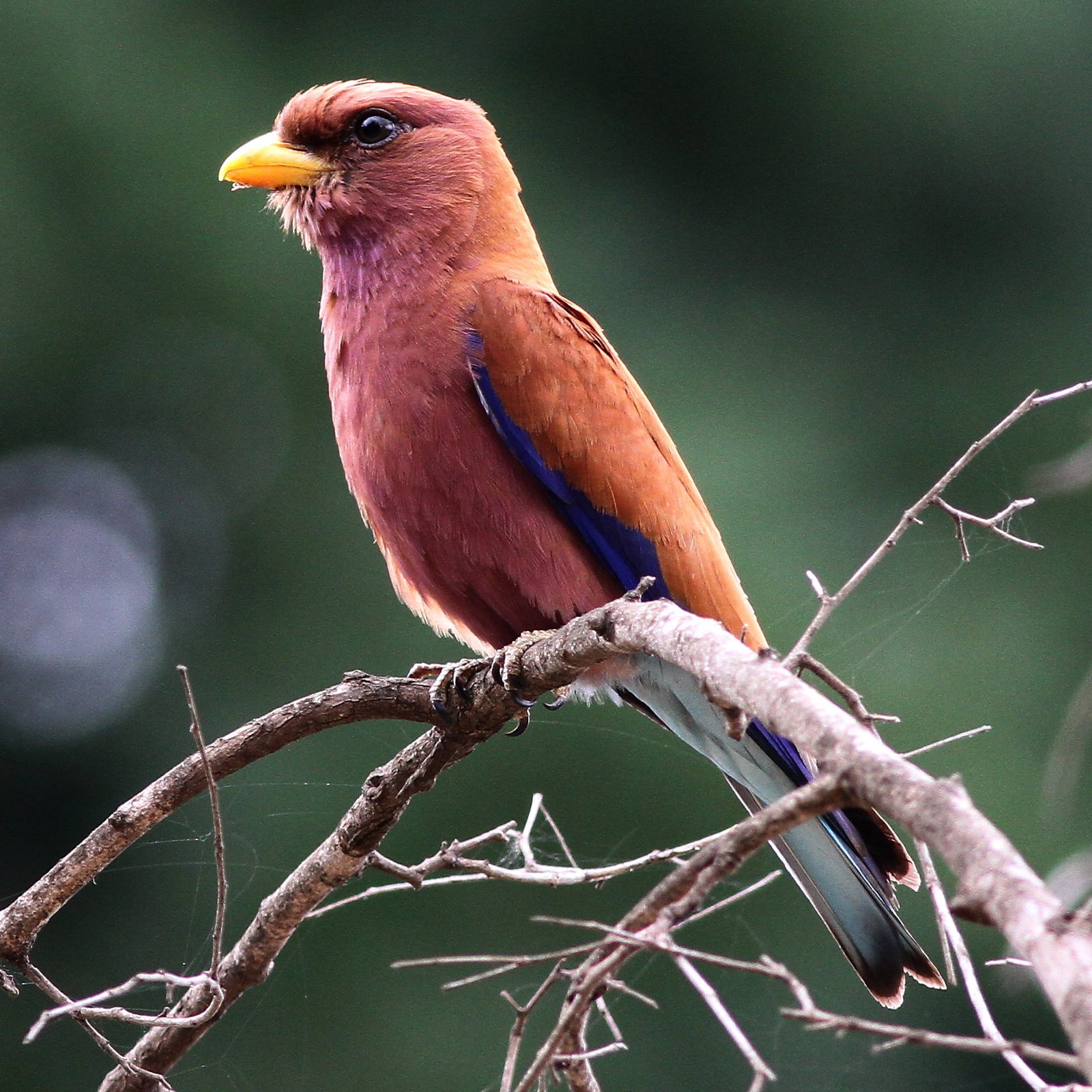
A stocky, cinnamon-brown roller with a short, broad, bright yellow bill from tropical Africa. In the region it is an exceptional vagrant: the only record is of a single bird that stayed for a week in September 2019 at Kibbutz Karmiya, near Ashkelon in Israel, the first for the country.
Voice
A harsh, hoarse, chattering series, krrrr-krrrr-kik-kik-kik, and a rasping gaa-gaa, often laughing in tone. Especially noisy at dusk.
Recording: Jonathan Onongo — CC BY-NC-SA 4.0 · converted to mono · xeno-canto
Identification
About 28 cm, with a large head and a short, very broad yellow bill. Upperparts warm cinnamon-brown, underparts lilac to purplish, undertail coverts and tail light blue to turquoise with a dark terminal band; the tail is slightly forked. The flight feathers are dark blue. Sexes alike. Juveniles are duller, with greenish-blue, brown-mottled underparts and a black-tipped bill. In flight dark and falcon-like, with long wings and fast, sometimes tumbling movements.
Confusion species
The Coracias rollers of the region, such as European Roller (Coracias garrulus) and Abyssinian Roller (Coracias abyssinicus), are much paler blue with a black bill. In flight and at dusk it may recall a small falcon such as Red-footed Falcon (Falco vespertinus), but the yellow bill and constant chattering give it away.
Habitat
In Africa tall trees along rivers, gallery forest, open woodland near water and palm savanna. Hunts flying insects from a tall, bare perch, especially at dusk when termites and ants swarm. The Israeli bird sat in tall trees in the gardens and surroundings of a kibbutz.
Where the bird is most at home, classified by the habitats of North Africa and the Middle East.


Range and movements
Vagrant: one record in the region, in Israel, from 12 to 18 September 2019 at Kibbutz Karmiya near Ashkelon, accepted as the first for the country. No other accepted records in North Africa or Arabia. Breeds across almost all of tropical Africa south of the Sahel, from Senegal to Ethiopia and south to north-eastern South Africa, partly as a migrant, and on Madagascar.
How and when to look
A once-in-many-years chance. Anyone who sees a dark, falcon-like bird with a yellow bill catching insects at dusk in autumn should photograph it and report it to the national rarities committee.
Conservation status
Not globally threatened and common in tropical Africa. In the region an exceptional vagrant: one bird in Israel in 2019. Records should be submitted to the Israeli Rarities and Distribution Committee (IRDC) or the committee of the country concerned.
Scientific name
Eurystomus glaucurus | (Müller, 1776)
Müller described the species in 1776 as Coracias glaucurus; because it was later moved to another genus, the author and year stand in brackets. The genus Eurystomus was introduced in 1816 by Vieillot. Eurystomus comes from the Greek eurystomos, 'wide-mouthed', from eurys, 'broad', and stoma, 'mouth' — for the short, very broad bill with which these rollers catch insects in flight. glaucurus comes from the Greek glaukos, 'blue-grey', and oura, 'tail' — for the bluish tail. The specimen the first description was based on came from Madagascar.