All species › Kingfishers, bee-eaters and rollers › Rollers › Indian Roller
Indian Roller | Coracias benghalensis
Indische scharrelaar | Carraca india
The eastern counterpart of the European Roller, a resident of the Mesopotamian plain and eastern Arabia. It sits conspicuously on wires and posts along fields, date gardens and parks, and in recent decades has become a familiar bird of irrigated land in the Emirates and northern Oman.
Voice
A harsh, hoarse chak or kak, often repeated, and in display flight a loud, rasping screeching and cackling as the bird tumbles and rolls. Especially noisy in spring.
Recording: David Darrell-Lambert — CC BY-NC-SA 4.0 · shortened to the first 60 s, mono · xeno-canto
Identification
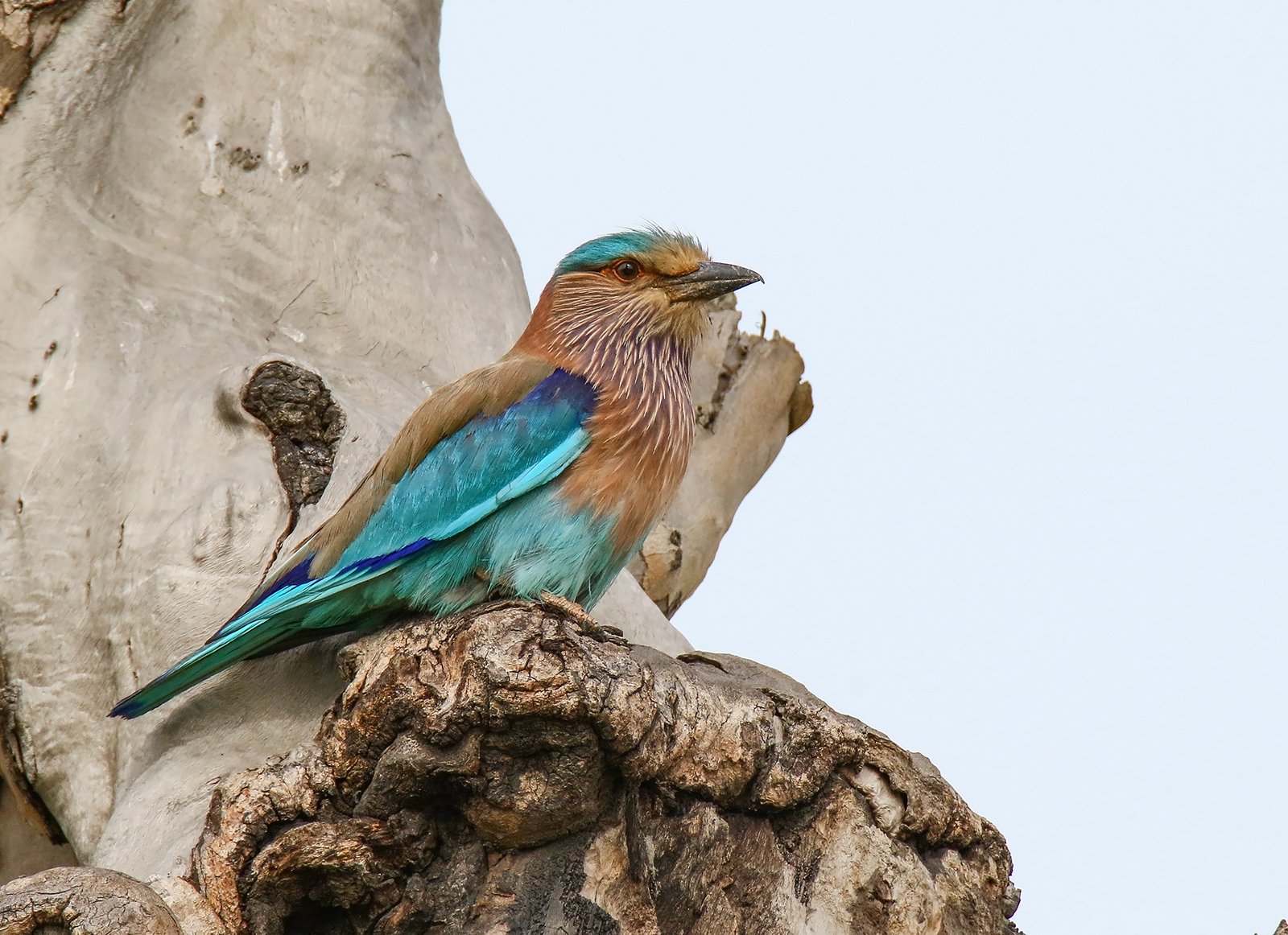
Slightly stockier than European Roller. Crown and hindneck blue-green to dark blue, face and throat lilac with fine white streaks, breast rufous-brown to dull cinnamon, belly and undertail light blue. The back is olive-brown. Spectacular in flight: dark blue flight feathers with a broad light blue band across the base of the primaries, and a light blue tail with a dark blue terminal band. Heavy black bill. Sexes alike; juveniles duller and browner.
Confusion species
European Roller (Coracias garrulus) has an entirely light blue head and breast and, in flight, black flight feathers without a pale band. Abyssinian Roller (Coracias abyssinicus) of south-west Arabia has long tail streamers and a light blue breast. In flight it may recall Eurasian Jay (Garrulus glandarius), which has a white rump and no light blue in the wing.
Habitat
Open irrigated country with trees and perches: fields, date gardens, orchards, parks, golf courses and village edges, also open thorn scrub with scattered trees. Hunts large insects, lizards and frogs on the ground from wires and posts. Nests in tree holes, often in date palms, and in holes in buildings.
Where the bird is most at home, classified by the habitats of North Africa and the Middle East.


Range and movements
Resident in Iraq, on the plains of central and southern Iraq along the Euphrates and Tigris. In the Emirates it breeds in the east and north: around Al Ain, on the east coast at Fujairah and Kalba, in Ras al-Khaimah, and increasingly in the parks and gardens of Dubai and Abu Dhabi. In Oman it breeds in the north, mainly on the Batinah plain. In Kuwait a scarce wanderer in autumn, winter and spring, mainly in the farmland of Jahra and Abdali; rare in eastern Saudi Arabia, Qatar and Bahrain, and a vagrant elsewhere in the region. Beyond the region from Iran and Afghanistan across the whole Indian subcontinent to Myanmar.
- Resident
- Winter visitor (c. Oct–Mar)
- Passage (Mar–Apr, Oct–Nov)
- dark = core range, pale = thinly spread
How and when to look
In the Emirates it sits all year on the wires along the fields around Al Ain and in the date gardens of the east coast; in winter also in the parks of Dubai. Look for the light blue wing band as soon as it takes off: that separates it at long range from a migrant European Roller.
Conservation status
Near Threatened. The species is globally common, but is declining in the Indian subcontinent, partly through road kills, pesticides and trapping. In eastern Arabia it has actually increased thanks to irrigation, date-palm planting and the growth of parks and gardens.
Scientific name
Coracias benghalensis | (Linnaeus, 1758)
Linnaeus described the species in 1758 as Corvus benghalensis; because it was later moved to another genus, the author and year stand in brackets. The genus Coracias was introduced in 1758 by Linnaeus. Coracias comes from Ancient Greek korakias, from korax 'raven, crow'; the Greeks used it of a corvid, probably the red-billed chough. benghalensis means 'of Bengal'. The specimen the first description was based on came from Chennai (Madras), Tamil Nadu, India.