All species › Kingfishers, bee-eaters and rollers › Bee-eaters › White-Throated Bee-Eater
White-Throated Bee-Eater | Merops albicollis
Witkeelbijeneter | Abejaruco gorjiblanco
A slender bee-eater of the Sahel with a black-and-white striped head and extremely long, wire-thin tail streamers. Within the region it breeds only in south-west Arabia, arriving from Africa in spring; in the western Sahara it appears as a rare vagrant.

Voice
A liquid, rolling prrrp or pruik, higher and softer than European Bee-Eater. Small groups call while hunting high above the trees; in chorus it sounds like a continuous soft twittering.
Recording: Mischa Keijmel — CC BY-NC-SA 4.0 · converted to mono · xeno-canto
Identification
The body is 19–21 cm; the needle-thin central tail feathers project up to 12 cm in adults, rather less in females. The head pattern is unique in the region: black crown, white supercilium and cheek, a broad black eye-stripe and a white throat closed off by a narrow black breast band. Nape and upper mantle are golden buff, back and wings green, rump and tail pale blue, underparts pale greenish white. In flight the flight feathers are ochre with a dark trailing edge. Juveniles are duller, with a greenish crown and no streamers.
Confusion species
No other bee-eater in the region has a black-and-white head. Arabian Green Bee-Eater (Merops cyanophrys) is much smaller and all green with a blue throat and short streamers. Blue-cheeked Bee-Eater (Merops persicus) and European Bee-Eater (Merops apiaster) are bulkier with a yellow chin and a rufous or yellow throat. Juveniles without streamers already show the dark crown and the white supercilium and cheek.
Habitat
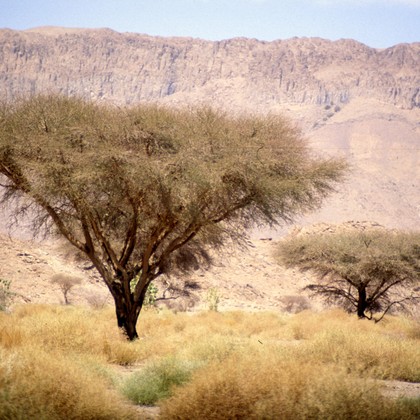
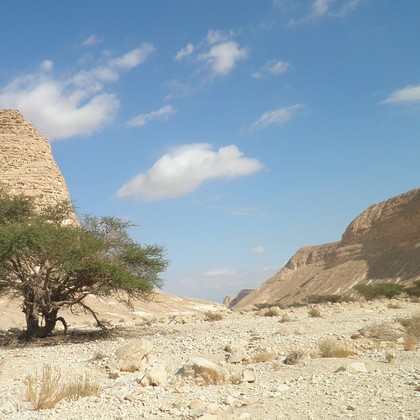
Dry acacia savanna, wadis with scattered trees and small-scale farmland with earth banks and bunds in which it digs its nest burrow; in Arabia mainly below 1600 m. Hunts in loose groups high in the air, often on flying ants and termites after rain.
Where the bird is most at home, classified by the habitats of North Africa and the Middle East.

Range and movements
Within the region a scarce breeder in south-west Arabia: the Tihama and the foot of the western escarpments in south-west Saudi Arabia (Jizan, Asir, including below the Raydah escarpment) and western Yemen. Elsewhere a vagrant: in Western Sahara near Dakhla and Oued Dahab (December 2013 and February–March 2017, the first Western Palearctic records), in the far south of Algeria (first record reported in 2022) and a few times in Israel. Otherwise breeds across the Sahel belt from Mauritania to Sudan, Ethiopia and Kenya, and winters in the forest zone of West and Central Africa.
- Resident
- Summer visitor (c. Apr–Sep)
- Winter visitor (c. Oct–Mar)
- Passage (Mar–Apr, Oct–Nov)
- dark = core range, pale = thinly spread
How and when to look
Look for it from April to August at the foot of the escarpments in south-west Saudi Arabia and in the Tihama of Yemen, where wadis with acacias meet fields with earth banks. Birds like dead branches and wires and give themselves away by their soft calls high overhead. A bee-eater with a black-and-white head in the western Sahara is a major find: take photographs.
Conservation status
Not globally threatened and common in the Sahel. In Arabia scarce and local, and vulnerable to the loss of earth banks and bunds to mechanised farming and road building.
Scientific name
Merops albicollis | Vieillot, 1817
Vieillot described the species in 1817 and placed it straight away in the genus where it still stands. The genus Merops was introduced in 1758 by Linnaeus. Merops is Greek and means 'bee-eater'. albicollis is Latin, from albus, 'white', and collum, 'neck' — for the white throat. The specimen the first description was based on came from Senegal.