All species › Gannets and cormorants › Gannets › Cape Gannet
Cape Gannet | Morus capensis
Kaapse jan-van-gent | Alcatraz del Cabo
The southern counterpart of Northern Gannet, breeding on a handful of islands off Namibia and South Africa. Outside the breeding season mainly young birds wander north along East and West Africa; in the region it has been recorded only in Oman.
Voice
Silent away from the colony. At the breeding site a harsh, hoarse warrah, as in Northern Gannet.
Recording: Daniel Danckwerts — CC BY-NC-SA 4.0 · converted to mono · xeno-canto
Identification
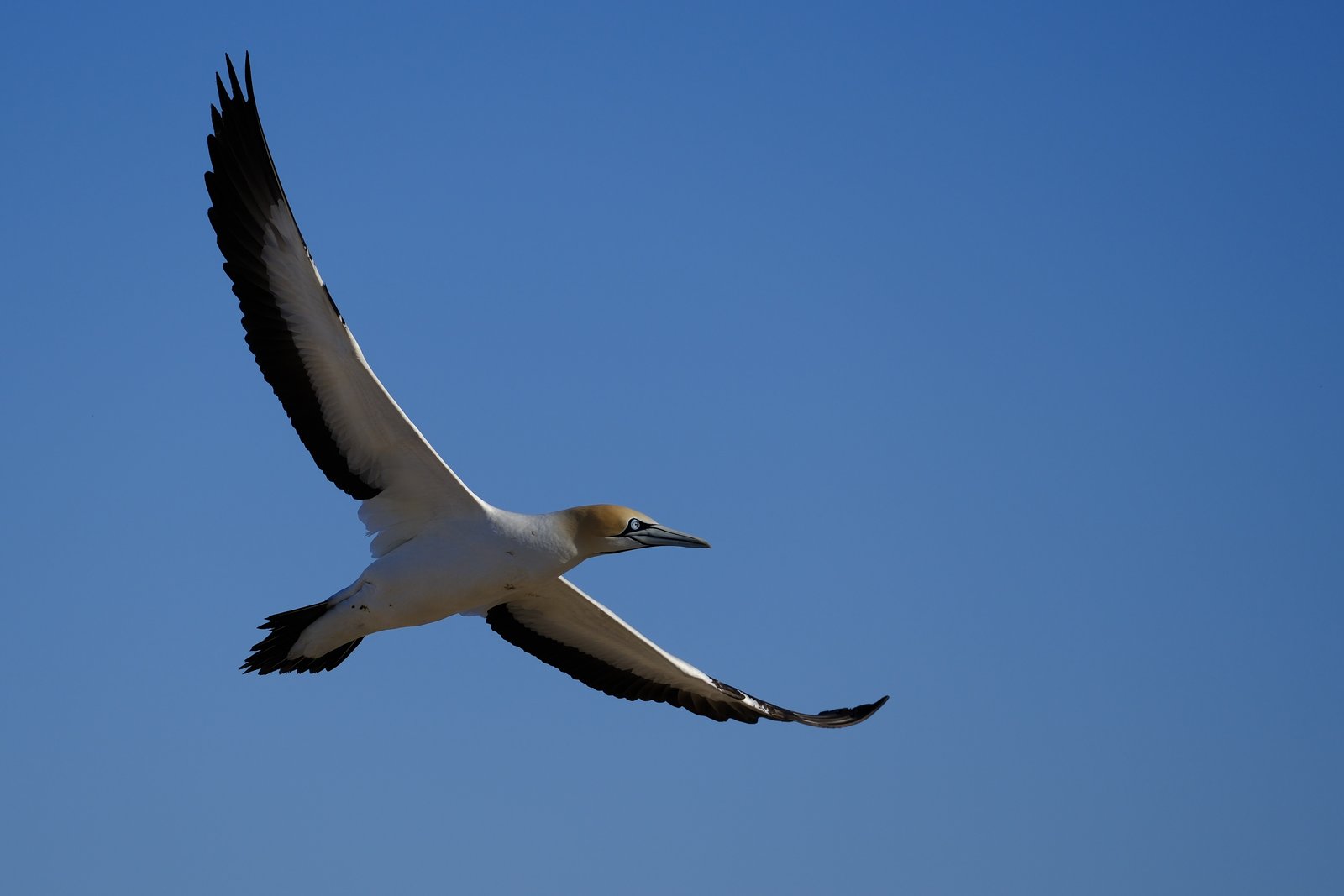
Structure and flight like Northern Gannet: long pointed bill, pointed tail and long, narrow wings. The adult is white with an ochre-yellow head and hindneck, but has black primaries and secondaries, so the whole trailing edge of the wing is black, and an all-black tail. The black throat stripe is long and runs well down the neck. Juveniles are dark grey-brown with white spots and almost impossible to tell from young Northern Gannets; immatures in transitional plumage show a black tail and black secondaries early on.
Confusion species
Northern Gannet (Morus bassanus) has white secondaries, a white tail (sometimes with a few dark feathers in immatures) and a shorter throat stripe. Australasian Gannet (Morus serrator), not recorded in the region, has a black tail with white outer feathers and a short throat stripe. Masked Booby (Sula dactylatra), the commonest booby in the Arabian Sea, is smaller, with a white head, a black mask and a yellow bill.
Habitat
Cold, productive coastal waters over the continental shelf, where it hunts sardines and anchovies, often in groups and behind trawlers. Wandering birds occur at sea and along coasts, sometimes among other seabirds at fishing boats.
Where the bird is most at home, classified by the habitats of North Africa and the Middle East.

Range and movements
Oman: one at Jazirat al-Shinas on the Gulf of Oman in March 2004 and one at the Daymaniyat Islands in November 2015; the species is on the Omani list as an accidental. No accepted records elsewhere in the region; an old report from Western Sahara in 1966 almost certainly rests on an error in the position. Breeds on six islands off Namibia and South Africa; outside the breeding season it wanders along the west coast to the Gulf of Guinea and along the east coast to Mozambique and Kenya. In the Western Palearctic only a sighting off the Azores in 2016 has been accepted.
How and when to look
Any gannet in the Gulf of Oman or the Arabian Sea deserves a second look: check the tail, the secondaries and the length of the throat stripe, and photograph the bird. Look especially at fish farms and fishing boats, where wandering seabirds gather.
Conservation status
Endangered. The world population has more than halved since the 1950s, mainly through the collapse of sardine and anchovy stocks off Namibia and South Africa; bycatch, oil pollution and predation by fur seals also play a part. For the region the species is merely a rare wanderer.
Scientific name
Morus capensis | (Lichtenstein, 1823)
Lichtenstein described the species in 1823 as Dysporus capensis; because it was later moved to another genus, the author and year stand in brackets. The genus Morus was introduced in 1816 by Vieillot. Morus goes back to the Greek mōros 'foolish, stupid': early travellers remarked that gannets and boobies at their colonies allowed a close approach and were easily killed. capensis is Latin for 'of the Cape', after the Cape of Good Hope where the species breeds. The specimen the first description was based on came from Cape of Good Hope.