All species › Gannets and cormorants › Gannets › Red-Footed Booby
Red-Footed Booby | Sula sula
Roodpootgent | Piquero patirrojo
The smallest and most arboreal booby, a tropical seabird that nests in shrubs and trees on remote oceanic islands and hunts flying fish and squid far out at sea. The nearest colonies are on Aldabra and the outer Seychelles; in the region it is a rare wanderer along the Arabian coasts.
Voice
Silent at sea. At the colony a hoarse, rattling ka-ka-ka and grating calls.
Recording: GABRIEL LEITE — CC BY-NC-SA 4.0 · converted to mono · xeno-canto
Identification
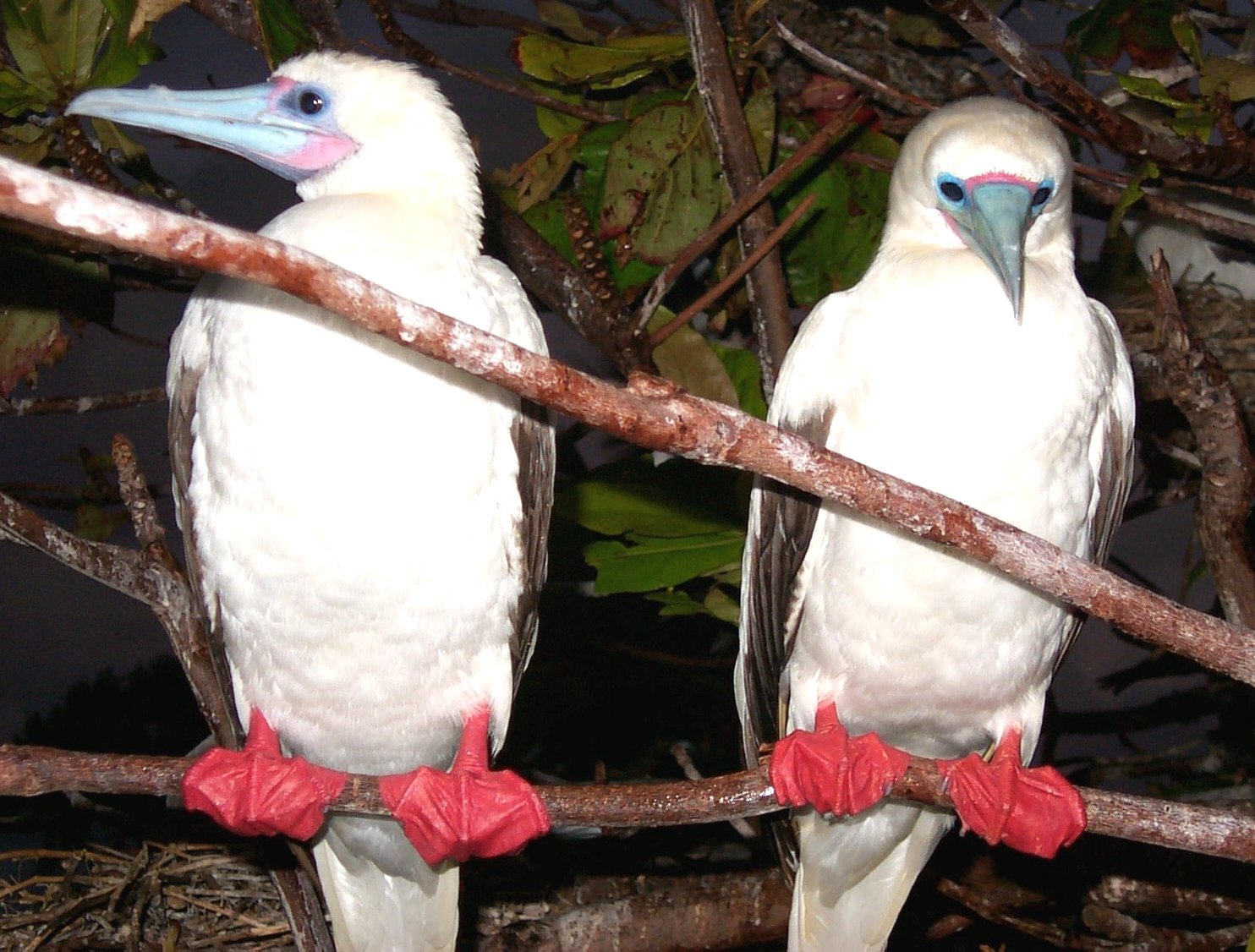
Slender and fairly small, with a long wedge-shaped tail, narrow wings and a relatively short, pale blue bill with a pink base. Adults have bright red feet. There are several colour morphs: the white morph is white with black primaries and secondaries and a black patch on the underwing at the carpal; the brown morph is uniform grey-brown; intermediates are brown with a white tail and white rump. Juveniles are uniform grey-brown with a dark bill and grey to pinkish feet, and have a dark underwing without a pale central stripe. Flies lightly and quickly, with faster beats than other boobies, and readily perches on the masts and railings of ships.
Confusion species
Masked Booby (Sula dactylatra) is much larger and heavier, with a yellow bill, a black mask, a black tail and grey-green feet; the white-morph Red-footed Booby has a white tail, and Masked lacks the black carpal patch. Juvenile Brown Booby (Sula leucogaster) shows a contrasting paler belly and a pale stripe across the underwing. A juvenile Red-footed Booby is uniformly brown everywhere, including the underwing.
Habitat
Warm, deep ocean far offshore, where it often hunts flying fish and squid at dusk. Breeds in trees and shrubs on tropical islands. Wanderers rest on ships, buoys, oil platforms and fish-farm cages and sometimes come ashore on islets.
Where the bird is most at home, classified by the habitats of North Africa and the Middle East.


Range and movements
Oman: a handful of records along the Arabian Sea coast, including Ras al-Hadd (1979), Al Khaluf (2001), Ras Madrakah (2018) and at sea off Mirbat (2024). United Arab Emirates: seven sightings in 45 years up to the end of 2023, the latest at the fish farms off Ras Dibba on the Gulf of Oman, and in January 2025 one on Qarnain Island in the Persian Gulf. Saudi Arabia: seen in 2023 and 2024 at Jizan and from the ferry to the Farasan Islands in the Red Sea. Not recorded in North Africa. Breeds in all tropical oceans; in the Indian Ocean on Aldabra, the Seychelles, the Chagos Islands and Christmas Island, among others. Some wanderers probably hitch rides on ships.
How and when to look
Pelagic trips off Mirbat in Dhofar and boat trips to the fish farms at Dibba offer the best chance; also check boobies on masts and buoys. With any brown booby lacking a pale belly, always check the foot colour and the bill.
Conservation status
Not globally threatened, with a large population estimated at over a million birds. Locally threatened by introduced rats and cats, loss of nesting trees and hunting; in the region merely a vagrant.
Scientific name
Sula sula | (Linnaeus, 1766)
Linnaeus described the species in 1766 as Pelecanus Sula; because it was later moved to another genus, the author and year stand in brackets. The genus Sula was introduced in 1760 by Brisson. Sula goes back to súla, the Old Norse and Icelandic word for the gannet; the name passed to the boobies. sula comes from the Old Norse and Icelandic súla, the name for the gannet. The specimen the first description was based on came from Barbados (designated later).