All species › Gannets and cormorants › Cormorants › Reed Cormorant
Reed Cormorant | Microcarbo africanus
Afrikaanse dwergaalscholver | Cormorán africano
A small, long-tailed cormorant of African lakes and rivers that in the region occurs only in the far south of Egypt. After more than a century of absence it was rediscovered on Lake Nasser in 2024, where it was found breeding again in 2025.

Voice
Almost silent away from the colony. At the breeding site hissing and cackling calls, such as a rapid ka-ka-ka, and soft groans.
Recording: Bram Piot — CC BY-NC-SA 4.0 · converted to mono · xeno-canto
Identification
Small and slender, with a strikingly long tail, a small round head and a short, thin bill. Breeding adults are glossy black with silver-grey, black-edged coverts on the back and wing, giving a fine scaly pattern; the eye is red, the bare facial skin yellow to orange, and there is a short erect crest on the forehead. Non-breeding and immature birds are brown above and dirty white to pale brown below. Flies low with fast beats and a straight neck, the long tail obvious.
Confusion species
Pygmy Cormorant (Microcarbo pygmaeus) is almost identical in shape and size, but practically unknown in Egypt; in breeding plumage it has a chestnut-brown head with white filoplumes, a dark eye and less scaly upperparts. Great Cormorant (Phalacrocorax carbo) is much larger, with a heavy bill, a short tail and a white chin patch; even pale-bellied young Great Cormorants are told by size and bill. African Darter (Anhinga rufa), further south in Sudan, has a much longer thin neck and a dagger-shaped bill.
Habitat
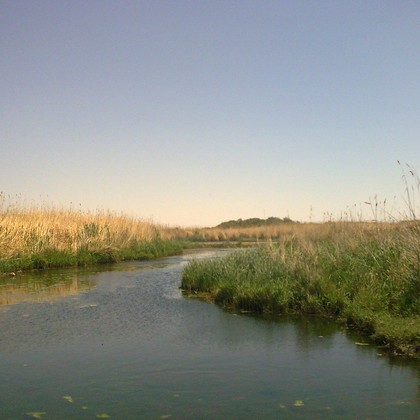
Quiet fresh water with vegetated banks: the flooded inlets and bays of Lake Nasser, with drowned trees and bushes for perching and nesting. Elsewhere in its range also rivers, marshes, dams and fishponds. Fishes alone or in small groups, often close to the bank, and likes to sit with spread wings on branches above the water.
Where the bird is most at home, classified by the habitats of North Africa and the Middle East.


Range and movements
In the region only in Egypt. The species formerly bred in the country, but after a record in 1903 it was absent for more than a century. In March 2024 a flock of at least twenty birds was photographed on Lake Nasser near the Sudanese border, and in August 2025 two juveniles were seen: the first breeding in Egypt in over a hundred years. There are no certain records from the rest of North Africa and the Middle East. Beyond the region it is a common resident of sub-Saharan Africa, from Senegal and the coast of Mauritania to Sudan, Ethiopia and South Africa, and on Madagascar.
- Resident
- Summer visitor (c. Apr–Sep)
- Winter visitor (c. Oct–Mar)
- Passage (Mar–Apr, Oct–Nov)
- dark = core range, pale = thinly spread
How and when to look
Lake Nasser is vast and the birds are scattered in quiet bays; the best chance is by boat from Aswan or Abu Simbel, where other African species also turn up. Look for small, long-tailed cormorants on dead trees along the shore.
Conservation status
Not globally threatened, and widespread and common in Africa. Its status in the region is new and fragile: the Lake Nasser population is small and probably arrived down the Nile from Sudan. Disturbance by fishing, entanglement in nets and fluctuating water levels could easily undo this colonisation.
Scientific name
Microcarbo africanus | (Gmelin, 1789)
Gmelin described the species in 1789 as Pelecanus africanus; because it was later moved to another genus, the author and year stand in brackets. The genus Microcarbo was introduced in 1856 by Bonaparte. Microcarbo combines Greek mikros 'small' with the genus name Carbo, and thus means 'small cormorant'. africanus is Latin for 'African' — for its range. The specimen the first description was based on came from Africa (not specified).