All species › Waders, gulls and terns › Sandpipers and snipes › Common Sandpiper
Common Sandpiper | Actitis hypoleucos
Oeverloper | Andarríos chico
A small, constantly bobbing wader that flies off low over the water with stiff, flickering wingbeats. In the region it is one of the most widespread waders, turning up on any shore, from mountain streams in the Atlas to the canals of the Nile, the harbours of the Gulf and the rocky coasts of Socotra.
Voice
A high, clear, descending swee-wee-wee, usually when flushed; the song is a fast, high, repeated tee-tee-weedee.
Recording: Arjun Dutta — CC BY-NC-SA 4.0 · converted to mono · xeno-canto
Identification
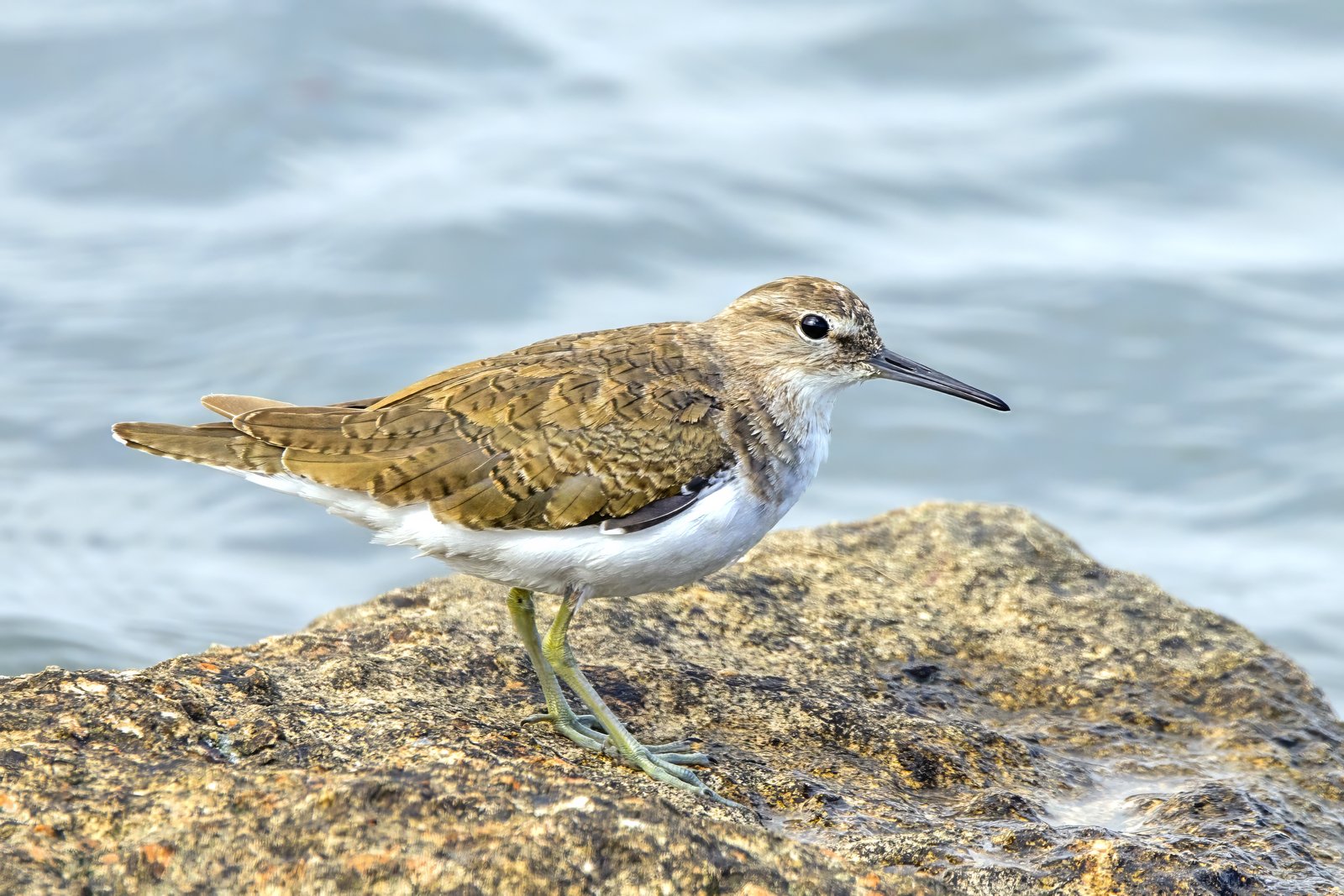
Small and elongated, with short yellowish to grey-green legs, a short straight bill and a tail that projects well beyond the wingtips. The upperparts are plain olive-brown with fine dark barring, the breast sides brown, and the white of the underparts forms a hook up in front of the bend of the wing. A pale supercilium and dark eye-stripe. Bobs its rear and head almost constantly. In flight a narrow white wingbar and white tail sides; the wingbeats are fast, shallow and stiff, alternating with short glides just above the water.
Confusion species
Green Sandpiper (Tringa ochropus) is larger, darker and more contrasting, with a brilliant white rump and blackish underwing. Wood Sandpiper (Tringa glareola) is slimmer, longer-legged, with clear pale spotting on the back and a white rump. Terek Sandpiper (Xenus cinereus) has a long upturned bill and orange legs. Spotted Sandpiper (Actitis macularius), a vagrant elsewhere in the Western Palearctic, has a shorter tail and in winter plainer breast sides and pale legs.
Habitat
Almost any shore: rivers and streams with gravel or stones, lakes, reservoirs, canals, ditches and irrigation works, rocky coasts, harbours, beaches, mangroves and lagoons; on migration also small pools in oases and desert wadis. Breeds along fast-flowing rivers with shingle banks in the mountains.
Where the bird is most at home, classified by the habitats of North Africa and the Middle East.


Range and movements
Breeds locally along rivers in the Rif and the Middle and High Atlas in Morocco and scattered in northern Algeria. As a migrant and winter visitor it occurs throughout the region: along the coasts and wetlands from Morocco to Western Sahara, Algeria, Tunisia and Libya, along the entire Nile from the Delta to Aswan, on the Red Sea, in Israel, Jordan, Lebanon, Syria and the Iraqi rivers and marshes, and on the Arabian Peninsula from Kuwait to Yemen, Socotra and Dhofar. On migration Saharan oases and desert pools are also visited. Beyond the region it breeds from western Europe to Japan and winters from the Mediterranean and Africa to South Asia and Australia.
- Resident
- Summer visitor (c. Oct–Mar)
- Winter visitor (c. Apr–Sep)
- Passage (Mar–Apr, Oct–Nov)
- dark = core range, pale = thinly spread
How and when to look
It can be found almost anywhere there is water: check the edges of a harbour quay, a river bridge or an irrigation pond and you are likely to see it bobbing. In the breeding season the rivers near Azrou and in the Ourika Valley in Morocco are good places to hear it sing.
Conservation status
Not globally threatened, although declining in parts of Europe through river regulation and disturbance of banks. In the region it benefits on migration from reservoirs, canals and treatment ponds, while the small breeding population in the Maghreb is vulnerable to gravel extraction and recreation along mountain rivers.
Scientific name
Actitis hypoleucos | (Linnaeus, 1758)
Linnaeus described the species in 1758 as Tringa Hypoleucos; because it was later moved to another genus, the author and year stand in brackets. The genus Actitis was introduced in 1811 by Illiger. Actitis is Greek, from aktitēs, 'coast-dweller', from aktē, 'coast'. hypoleucos is Greek for 'white beneath', from hupo, 'beneath', and leukos, 'white'. The specimen the first description was based on came from Sweden.