All species › Waders, gulls and terns › Sandpipers and snipes › Terek Sandpiper
Terek Sandpiper | Xenus cinereus
Terekruiter | Andarríos del Terek
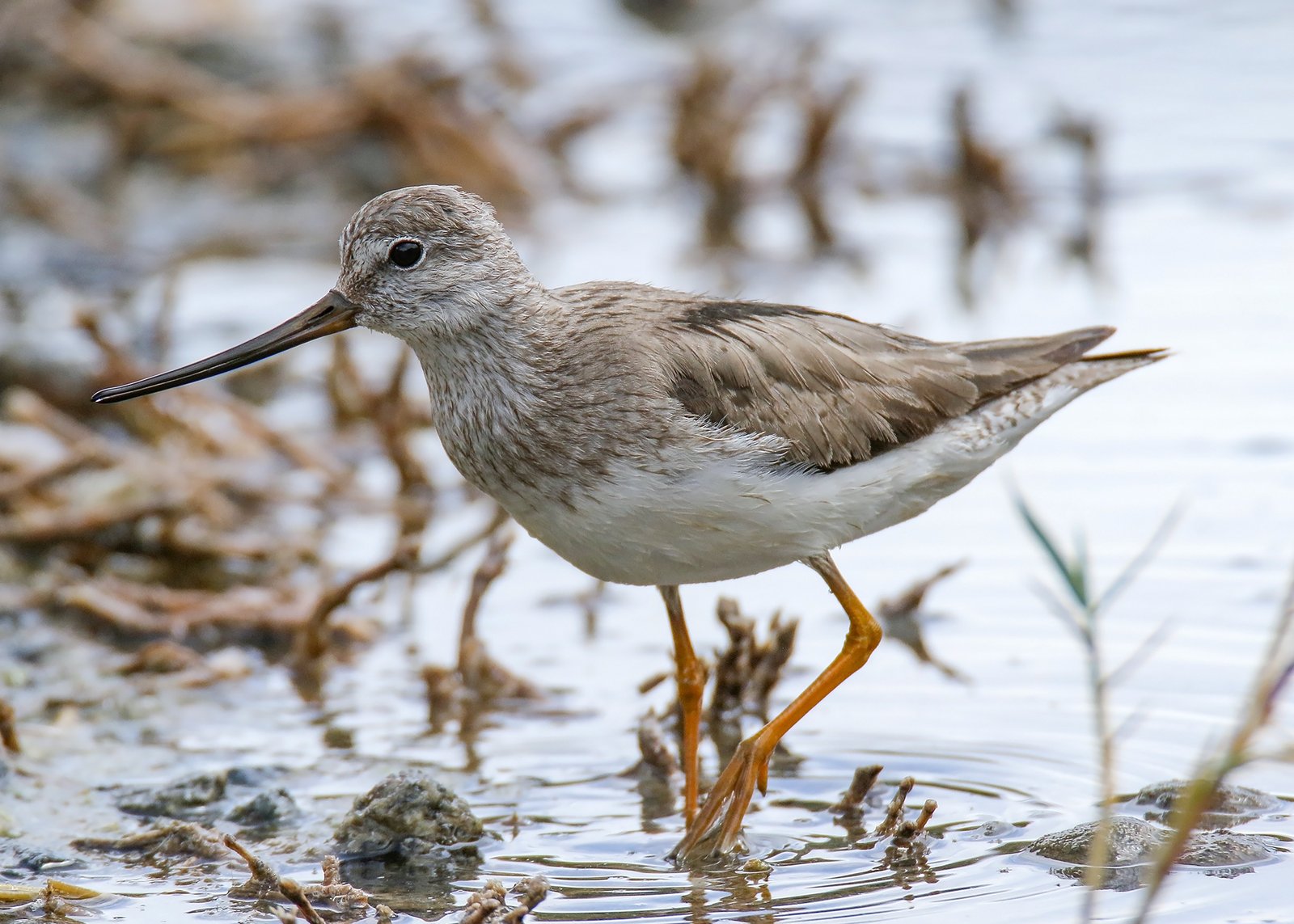
A small, active wader with a long, upturned bill and short orange-yellow legs, which hunts across the mudflats in dashing runs and abrupt stops. In the region it is mainly a bird of the Arabian coasts: it winters in numbers along the Persian Gulf, the Arabian Sea and the Red Sea, while it turns up only rarely in North Africa.
Voice
A melodious, fluty wee-wee-wee or tu-tu-tu of three to five notes, rather softer and flatter than Common Redshank; when flushed also a short twit.
Recording: Ray Tsu 诸仁 — CC BY-NC-SA 4.0 · converted to mono · xeno-canto
Identification
Slightly larger than Common Sandpiper, with a long, slightly upturned dark bill with a yellowish base and strikingly short orange-yellow legs. The upperparts are plain grey-brown; in breeding plumage the scapulars show a black longitudinal stripe. The underparts are white, with grey-washed breast sides. In flight a broad white trailing edge to the secondaries stands out, as in a redshank, along with a grey rump and tail. Feeds with rapid, jerky dashes, often changing direction abruptly; sometimes bobs its rear like a Common Sandpiper.
Confusion species
Common Sandpiper (Actitis hypoleucos) has a short straight bill, a white notch in front of the bend of the wing and a narrow white wingbar. Marsh Sandpiper (Tringa stagnatilis) is slimmer and long-legged, with a needle-fine straight bill and a white back wedge. Common Redshank (Tringa totanus) has red legs and a white back wedge. Curlew Sandpiper (Calidris ferruginea) has a decurved bill and black legs.
Habitat
Tidal flats, muddy creeks, mangroves, lagoons and estuaries, also salt pans and river mouths; on migration sometimes at fresh water. At high tide rests in flocks on sandbars, rocks or among the mangroves, often with other waders.
Where the bird is most at home, classified by the habitats of North Africa and the Middle East.


Range and movements
Along the Persian Gulf a common passage migrant and winter visitor in Kuwait (Jahra Bay), eastern Saudi Arabia, Bahrain, Qatar and the Emirates (including Khor Kalba and the lagoons of Abu Dhabi). In Oman common, with large numbers at Barr al Hikman and on Masirah and also at Salalah. Along the Red Sea a passage migrant and winter visitor on the coasts of Saudi Arabia and Yemen (Tihama, Aden) and on Socotra; in Egypt scarce on the Red Sea coast and in the Gulf of Suez. In Israel a scarce passage migrant at Eilat and rare on the Mediterranean coast. In Iraq locally on the coast near Fao. Rare in North Africa: a few records in Tunisia (including Thyna near Sfax, April 2019) and Morocco, exceptional elsewhere. Oversummering non-breeders remain on the Arabian coasts. Breeds from Finland and Belarus across Russia to eastern Siberia and winters on the coasts of eastern and southern Africa, South Asia and Australasia.
- Resident
- Summer visitor (c. Oct–Mar)
- Winter visitor (c. Apr–Sep)
- Passage (Mar–Apr, Oct–Nov)
- dark = core range, pale = thinly spread
How and when to look
The flats of Barr al Hikman and Masirah in Oman hold thousands in winter; the mangroves of Khor Kalba (Emirates) and the coast at Jahra (Kuwait) are also reliable. On a rising tide, look for small waders that run strikingly fast and turn sharply.
Conservation status
Not globally threatened, although numbers are declining along the East Asian flyway. In the region coastal development, mangrove clearance and disturbance of high-tide roosts along the Gulf and the Red Sea threaten its winter habitat.
Scientific name
Xenus cinereus | (Güldenstädt, 1775)
Güldenstädt described the species in 1775 as Scolopax cinerea; because it was later moved to another genus, the author and year stand in brackets. The genus Xenus was introduced in 1829 by Kaup. Xenus is from Ancient Greek xenos 'stranger'. cinereus is Latin for 'ash-grey', from cinis 'ashes', after the grey upperparts. The specimen the first description was based on came from the Caspian shore at the mouth of the Terek.