All species › Waders, gulls and terns › Sandpipers and snipes › Pin-Tailed Snipe
Pin-Tailed Snipe | Gallinago stenura
Stekelstaartsnip | Agachadiza colicorta
An Asian snipe that breeds in the Siberian taiga and winters mainly in South and South-East Asia. The region lies on the western edge of its migration range: in the Emirates and Oman it occurs annually in small numbers, further west it soon becomes rare.

Voice
When flushed a short, slightly hoarse and nasal tchek or squak, softer, shorter and lower than the harsh call of Common Snipe.
Recording: Bo Shunqi 薄顺奇 — CC BY-NC-SA 4.0 · converted to mono · xeno-canto
Identification
Very similar to Common Snipe, but slightly more compact, with a shorter bill, a rather larger-looking head and short tertials that barely cover the primaries, so the tail hardly projects beyond the wingtips. The supercilium is broader than the dark loral stripe at the bill base. The mantle stripes are narrower and less contrasting; the scapulars have narrow, even fringes on both webs. In flight there is no clear white trailing edge to the wing, the underwing is evenly and densely barred and the toes project further beyond the tail. The narrow, pin-like outer tail feathers are visible only in the hand or on sharp photographs.
Confusion species
Common Snipe (Gallinago gallinago) has a longer bill, a clear white trailing edge and a pale underwing with white bands. Great Snipe (Gallinago media) is heavier, with white-tipped wing-coverts and much white in the tail. Swinhoe's Snipe (Gallinago megala), not yet recorded in the region, is almost indistinguishable.
Habitat
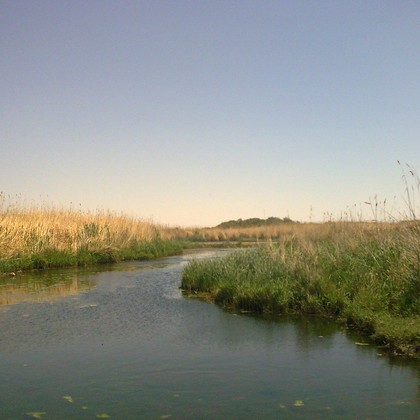
Drier and grassier sites than Common Snipe: irrigated fodder fields, alfalfa, large lawns, ditch banks and marsh edges, also rice fields and small wet patches on farms.
Where the bird is most at home, classified by the habitats of North Africa and the Middle East.

Range and movements
In the United Arab Emirates a fairly regular passage migrant and winter visitor in very small numbers, notably at the Wamm Farms near Fujairah; in Oman scarce, mainly on the Batinah and in Dhofar around Salalah. Rare in Bahrain, Qatar, eastern Saudi Arabia and Kuwait, and a few records from Yemen. In Israel a vagrant with two confirmed records (Eilat, September 1984, and Kfar Ruppin, November 1998) and a few later probable birds at the same site. Not known from North Africa. Breeds from the Urals to eastern Siberia and winters from Pakistan and India to South-East Asia and Indonesia; only rarely west to East Africa.
- Winter visitor (c. Apr–Sep)
- Passage (Mar–Apr, Oct–Nov)
- dark = core range, pale = thinly spread
How and when to look
The fodder fields at Wamm in the Emirates are the most reliable site; photograph every snipe that flushes with a short nasal call, as tail and underwing decide the identification. Common Snipe always outnumber them.
Conservation status
Not globally threatened, with a large breeding range in Siberia. In the region it is a fringe species; its occurrence depends on irrigated farmland, and it is probably often overlooked among the far more numerous Common Snipe.
Scientific name
Gallinago stenura | (Bonaparte, 1831)
Bonaparte described the species in 1831 as Scolopax stenura; because it was later moved to another genus, the author and year stand in brackets. The genus Gallinago was introduced in 1760 by Brisson. Gallinago is New Latin for a snipe, from Latin gallina 'hen' and the suffix -ago 'resembling'. stenura is Greek for 'narrow-tailed', from stenos 'narrow' and oura 'tail', after the needle-like outer tail feathers. The specimen the first description was based on came from the Sunda Islands.